
From "Burn" to "Earn": Why 2026 IPL Sponsors are More Profitable than 2021
Table of Contents
Toggle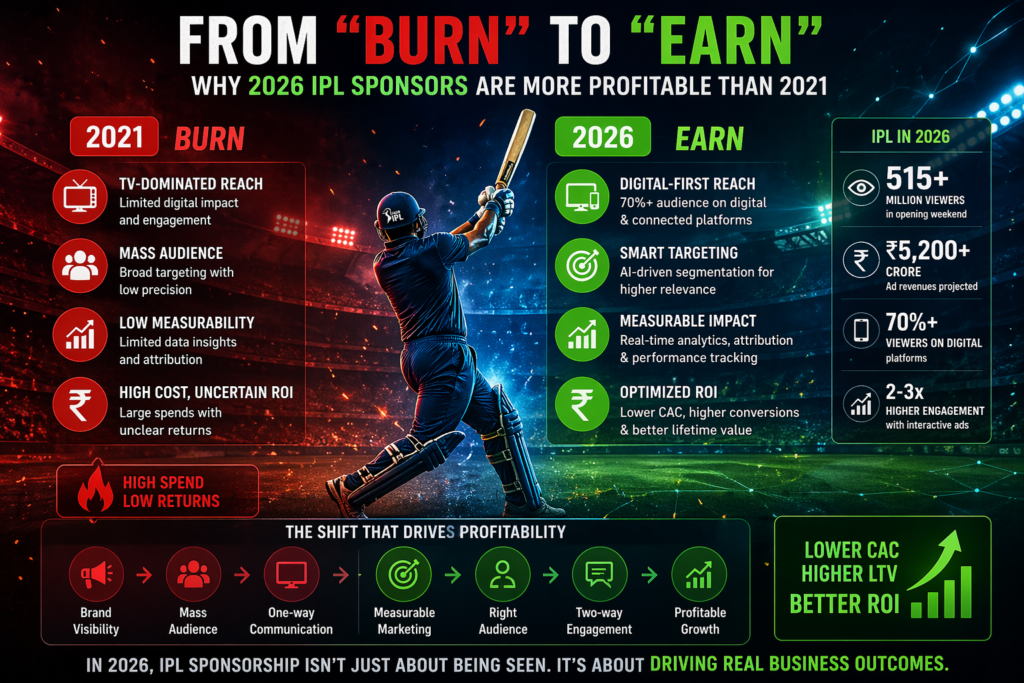
At FounderPin, we’ve always seen the IPL as more than just a cricket event; it’s the biggest marketing venue in India, where businesses can either scale quickly or spend quickly. But as 2026 approaches, the conversation is shifting because of 2026 IPL sponsorship. “How many customers did we actually acquire, and at what cost?” is much more important than “How many people saw our ad?”
In an era driven by capital efficiency, every marketing rupee is under scrutiny. With IPL viewership continuing to surge across digital platforms and sponsorship investments reaching record highs, the opportunity is massive—but so is the pressure to perform.
Because here’s the reality: if your Customer Acquisition Cost (CAC) during the IPL outweighs your Lifetime Value (LTV), even the most high-profile sponsorship can quickly turn into a costly mistake. But when executed strategically, 2026 IPL Sponsorship has the power to transform from a branding expense into a high-performance revenue engine.
This shift—from “burn” to “earn”—is exactly what defines the new age of IPL marketing.
The Shift from Visibility to Measurable ROI
2021: High Spend, Limited Attribution
In 2021, IPL sponsorship focused heavily on mass exposure. Brands invested in jersey placements, TV commercials, and stadium visibility. While these tactics ensured reach, they lacked precision.
- Limited real-time analytics: Brands could see overall impressions but couldn’t track how viewers interacted with their campaigns or whether those impressions led to actual sales.
- Weak attribution models: It was difficult to determine which specific ad or platform contributed to conversions, making ROI calculations unreliable.
- Dependence on TV metrics: Television ratings dominated decision-making, even though they didn’t reflect deeper audience engagement or intent.
As a result, sponsorship was often seen as a branding expense rather than a revenue-generating investment.
2026: Data-Driven Performance Marketing
By 2026, sponsorship strategies are powered by advanced analytics and AI tools.
- AI-powered audience segmentation: Brands can now identify and target specific user groups based on behavior, preferences, and purchase intent, ensuring more relevant messaging.
- Real-time campaign optimization: Campaigns can be adjusted instantly based on performance data, improving efficiency and reducing wasted spend.
- Performance-based models: Many sponsorship deals now include measurable KPIs such as clicks, leads, or conversions, directly linking investment to outcomes.
This transformation ensures that every sponsorship rupee is accountable and optimized.
Explosion of Digital and Streaming Platforms in 2026 IPL Sponsorship
The Rise of Multi-Screen Engagement
The IPL viewing experience has shifted dramatically from television to digital platforms.
- 70%+ digital viewership: A majority of fans now watch matches via streaming apps, allowing brands to reach audiences on personal devices.
- Higher engagement time: Viewers spend more time interacting with content, including highlights, stats, and social media discussions.
- Interactive ad formats: Features like clickable ads and in-stream engagement tools encourage active participation rather than passive viewing.
Why This Matters for Sponsors
Digital ecosystems provide unprecedented control and insights.
- Precise targeting: Brands can reach niche audiences instead of broadcasting to everyone.
- Personalized messaging: Ads can be tailored to individual user preferences, increasing relevance and effectiveness.
- Behavior tracking: Every interaction—clicks, views, conversions—can be measured, enabling accurate ROI analysis.
This makes digital platforms a cornerstone of 2026 IPL Sponsorship success.
Smarter Audience Targeting = Higher Conversions
From Mass Marketing to Micro-Targeting
Instead of targeting the entire IPL audience, brands now focus on specific segments.
- Demographic targeting: Campaigns can be tailored to age groups, income levels, or professions, ensuring relevance.
- Geographic precision: Brands can focus on high-value regions or cities where demand is strongest.
- Intent-based targeting: Users showing interest in related products or services can be prioritized, increasing the likelihood of conversion.
Result: Better Conversion Rates
This level of precision significantly improves outcomes.
- Higher click-through rates: Relevant ads attract more user interaction compared to generic campaigns.
- Improved lead quality: Targeted audiences are more likely to convert into paying customers.
- Efficient customer acquisition: Marketing budgets are spent on users who are more likely to engage and purchase.
Integration with Influencer and Social Media Ecosystems
2021 vs 2026: The Content Evolution
Sponsorships have expanded beyond traditional advertising into content-driven engagement.
- Influencer collaborations: Players and creators promote brands through authentic storytelling, making campaigns more relatable.
- Behind-the-scenes content: Exclusive access to players or teams creates deeper fan engagement.
- Story-driven campaigns: Brands connect emotionally with audiences rather than just promoting products.
Social Amplification
Social media plays a critical role in extending sponsorship impact.
- Short-form video dominance: Platforms like reels and shorts help brands reach younger audiences quickly.
- Real-time engagement: Brands participate in live conversations, memes, and trending topics during matches.
- Viral potential: Engaging content can spread organically, multiplying reach without additional cost.
This continuous engagement ensures brands stay relevant throughout the tournament.
Advanced Brand Integration Opportunities
Beyond Traditional Sponsorships
Modern IPL sponsorship offers immersive and interactive formats.
- Augmented reality experiences: Fans can interact with branded filters or virtual elements, enhancing engagement.
- Gamification: Prediction games, quizzes, and contests keep users engaged while promoting the brand.
- In-app integrations: Brands can appear within streaming platforms through native content and features.
Example Use Cases
- Fan engagement campaigns: A brand could create a prediction game that rewards users, increasing interaction and recall.
- Real-time offers: E-commerce platforms can push match-time deals, driving immediate purchases.
- Data-driven storytelling: Tech brands can integrate with live stats to provide value-added experiences.
These integrations make sponsorship more interactive and conversion-focused.
Cost Efficiency and Flexible Sponsorship Models
Smarter Budget Allocation
The financial structure of sponsorships has evolved significantly.
- Tiered packages: Brands can choose sponsorship levels based on budget and goals, making IPL accessible to more businesses.
- Digital-first options: Companies can participate without investing in expensive TV slots.
- Performance-linked pricing: Payments can be tied to actual results, reducing financial risk.
ROI Optimization
Flexibility enables smarter decision-making.
- Test and scale approach: Brands can experiment with smaller campaigns and expand successful ones.
- Reduced waste: Underperforming strategies can be quickly replaced.
- Better budget control: Investments are aligned with measurable outcomes.
Stronger Brand Recall and Customer Loyalty
Emotional Engagement Through Personalization
Modern campaigns focus on building relationships, not just visibility.
- Interactive experiences: Fans engage directly with brands during matches.
- Personalized offers: Tailored promotions increase relevance and satisfaction.
- Emotional storytelling: Campaigns resonate with fans on a deeper level.
Long-Term Value
This approach creates lasting benefits.
- Repeat customers: Engaged users are more likely to return.
- Brand advocacy: Satisfied customers promote the brand organically.
- Community building: Brands become part of the fan experience.
Why Unit Economics Matter in 2026 IPL Sponsorship
Before investing in 2026 IPL Sponsorship, one critical question every brand must answer is: Will this campaign actually be profitable?
Understanding your Customer Acquisition Cost (CAC) and Lifetime Value (LTV) is no longer optional—it’s the foundation of a successful IPL strategy. Without this clarity, even high-visibility campaigns can quietly erode your margins.
If you want a deeper breakdown of how CAC, LTV, and IPL campaigns intersect, read our detailed guide on Unit Economics IPL 2026 Startup CAC Analysis. It explains how startups can evaluate whether IPL is a growth lever—or just an expensive branding exercise.
Pro Insight: The most successful brands in 2026 don’t just sponsor IPL—they model it like a performance channel before investing.
Backed by Industry Data
The scale of 2026 IPL Sponsorship is supported by massive growth in digital viewership and ad revenues. Reports from the detailed analysis of IPL’s media ecosystem highlight how IPL continues to be one of the most valuable platforms for brands seeking both reach and measurable returns.
Conclusion: From Hype to High Returns
For brands in 2026, the verdict is clear: IPL sponsorship is no longer just a visibility milestone—it’s a profitability test. The smartest marketers today aren’t chasing impressions; they’re optimizing outcomes. The winning strategy lies in striking the right balance—leveraging digital for precision and performance, while using traditional channels selectively for scale.
At FounderPin, we believe the brands that truly “win” with 2026 IPL Sponsorship won’t be the ones spending the most, but the ones measuring the best. Success comes down to understanding your unit economics—knowing exactly when an IPL campaign accelerates growth and when it simply inflates costs. If your Customer Acquisition Cost (CAC) is aligned with your Lifetime Value (LTV), IPL becomes a growth engine. If not, even the biggest stage can drain your resources.
The shift from “burn” to “earn” is not automatic—it’s strategic. It requires clarity, discipline, and a performance-first mindset.
Join the FounderPin Growth Mission
- Marketing Budget Audit? Contact Us to analyze your IPL readiness and ensure every rupee drives measurable growth.
- Explore FounderPin: Learn how we empower founders to build capital-efficient, scalable, and resilient businesses.