
Indian Space Startup Funding Reaches $871 Million After Skyroot's Success
Table of Contents
Toggle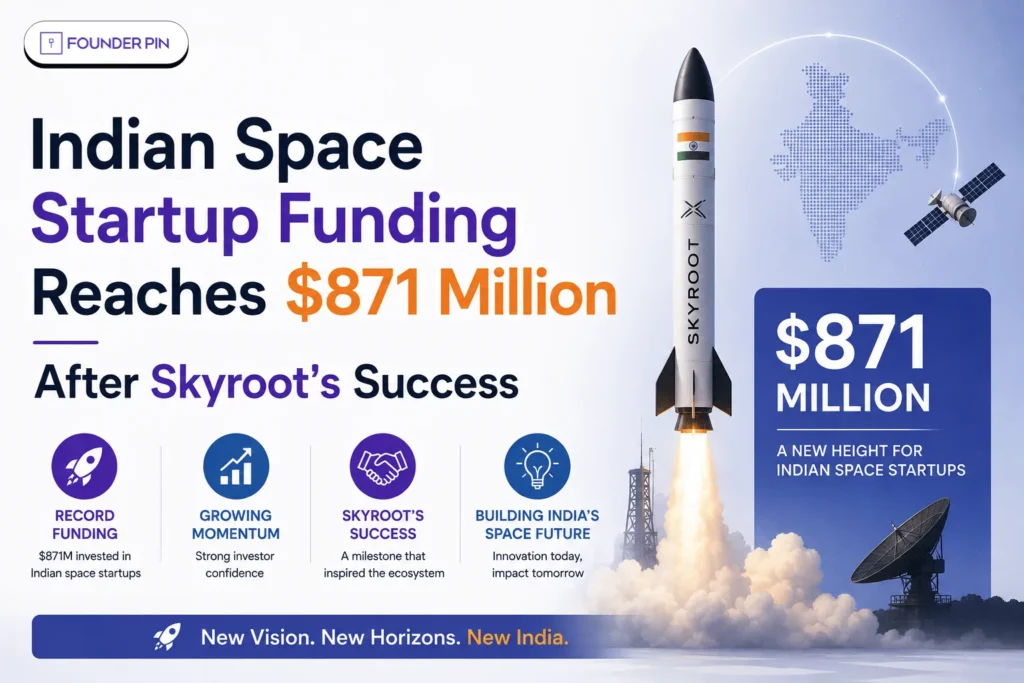
Key Takeaways
- $871 million raised: Indian SpaceTech startups have raised over $871 million across 241 funding rounds since 2021.
- Skyroot milestone: Skyroot’s Vikram-1 successfully reached orbit, strengthening confidence in India’s private space industry.
- Funding is diversifying: Investors are backing launch vehicles, satellites, propulsion, Earth observation and space analytics.
- Government support is growing: Initiatives such as the ₹1,000 crore Antariksh Venture Capital Fund and ₹500 crore Technology Adoption Fund are supporting SpaceTech companies.
- Big opportunity ahead: India’s SpaceTech ecosystem is moving from proving technology to building scalable, commercially successful space businesses.
India’s space startup ecosystem has entered a new phase. Indian Space Startup Funding has crossed $871 million across 241 funding rounds as of July 2026, according to Tracxn data, as investors increasingly back launch vehicles, satellites, propulsion, Earth observation and space analytics.
The timing is hard to ignore. On July 18, 2026, Skyroot Aerospace’s Vikram-1 became the first privately developed Indian rocket to successfully reach orbit from Indian soil, marking a major milestone for the country’s commercial space industry.
This is no longer just a story about rockets. It is becoming a story about capital, commercialisation and India’s growing SpaceTech startup ecosystem.
Why has Indian Space Startup Funding reached $871 million?
Indian Space Startup Funding has grown rapidly as policy reforms have opened India’s space sector to private companies. The ecosystem now has hundreds of startups, although only a fraction have secured institutional equity funding.
According to the latest Tracxn data, India’s private SpaceTech startups have raised more than $871 million across 241 funding rounds since 2021. The ecosystem currently includes more than 285 startups, with 72 having raised institutional equity funding.
The funding trend shows a clear acceleration:
- 2021: $43 million across 12 rounds
- 2024: $72 million
- 2025: Record $200 million across 53 rounds
- First seven months of 2026: $113 million across 24 rounds
- Since 2021: More than $871 million across 241 rounds
The numbers suggest that investors are becoming more comfortable with India’s private space sector.
That confidence did not appear overnight. Regulatory reforms, government-backed funding, access to ISRO facilities and the emergence of commercially focused startups have gradually changed the investment landscape.
ISRO confirmed that Vikram-1, developed by Skyroot Aerospace, successfully lifted off from the Satish Dhawan Space Centre on July 18, 2026, marking the first orbital launch from Indian soil by a private Indian company. Read ISRO’s official Vikram-1 launch announcement
How did Skyroot’s success change India’s SpaceTech story?
Skyroot’s Vikram-1 success gives investors something SpaceTech desperately needs: real-world validation. A privately built Indian rocket has now demonstrated orbital capability from Indian soil.
Skyroot had already made history in November 2022 when its Vikram-S became the first privately developed Indian rocket to undertake a sub-orbital mission.
Vikram-1 takes that story much further.
On July 18, 2026, the Satish Dhawan Space Center launched a four-stage rocket that successfully launched two satellites into Low Earth Orbit, according to ISRO. ISRO and IN-SPACe provided technical and infrastructure support during the mission.
That matters to investors because space startups face a difficult funding problem: they need significant capital before they can demonstrate commercial reliability.
A successful orbital mission reduces some of that technological uncertainty.
It does not make the business risk-free, of course. Rockets remain rockets. But a successful mission can materially strengthen investor confidence in India’s private launch ecosystem.
What does Skyroot’s funding say about investor confidence?
Skyroot has become the clearest example of how India’s SpaceTech funding market is maturing. In May 2026, the company raised about $60 million, taking its valuation to approximately $1.1 billion and making it India’s first space-tech unicorn.
The funding round was co-led by Sherpalo Ventures and Singapore’s GIC, with participation from BlackRock-linked funds and other investors. Reuters reported that the round took Skyroot’s total capital raised to $160 million.
The investment is significant for another reason.
Large institutional investors are not simply betting on a science project. They are betting on a company attempting to build a commercial launch business.
Skyroot plans to use capital to support launch frequency, manufacturing expansion and development of its next-generation Vikram rockets.
That is a useful signal for other Indian SpaceTech founders.
Investors increasingly want to see a path from technology → mission → customer → repeatable revenue.
Which Indian Space Startups Are Attracting Funding?
Although Skyroot has received enormous attention, the funding story includes several other important companies.
Recent Tracxn data identifies Skyroot, Pixxel, AgniKul Cosmos, Digantara, and Bellatrix Aerospace among India’s most-funded SpaceTech startups. Together, the top 10 funded companies have raised more than $548 million, accounting for more than 60% of the capital invested in the sector.
Some notable funding totals reported by Tracxn include:
| SpaceTech Startup | Reported Funding |
|---|---|
| Skyroot Aerospace | $150 million |
| Pixxel | $96 million |
| AgniKul Cosmos | $76 million |
| Digantara | $67 million |
| Bellatrix Aerospace | $34 million |
These figures show both the strength and concentration of the market. Capital is growing, but a relatively small group of companies continues to attract a large share of available funding.
Why is Space startup funding India growing now?
Policy reform is one of the biggest reasons behind the recent funding momentum. India has gradually moved from a predominantly government-led space model toward a more commercially open ecosystem.
The government says India had only one registered space startup in 2014, while the number crossed 400 by early 2026. Investment in space startups had also crossed $500 million by February 2026.
Several policy developments have contributed to that change:
The Indian Space Policy 2023 allowed non-governmental organizations to participate in the larger space value chain.
A single-window system for authorizing and promoting private space operations was established by IN-SPACe.
In 2024, India implemented a more permissive foreign direct investment policy for the space industry.
For space businesses, the government created a ₹1,000 crore venture capital fund.
IN-SPACe launched the ₹500 crore Technology Adoption Fund to support commercialisation of early-stage technologies.
Together, these measures have reduced some of the institutional barriers that previously made private space entrepreneurship difficult.
How is the Indian government supporting SpaceTech startups?
Government support now goes beyond policy announcements. India has created funding programmes, technology-support mechanisms and access to national space infrastructure for private companies.
The ₹1,000 crore Antariksh Venture Capital Fund is particularly important for the funding ecosystem.
As of April 2026, the fund had been operationalised with a ₹1,005 crore committed corpus, with SIDBI Venture Capital Limited serving as investment manager. The government said investments in selected startups were expected to begin from FY2027.
IN-SPACe also operates a Seed Fund Scheme. Early-stage founders can also explore programmes such as the Startup India Seed Fund, which was designed to support startups with funding for proof of concept, prototype development, product trials and market entry.
Selected startups can receive up to ₹1 crore in milestone-based support to demonstrate novel space technologies and move toward the next stage of development.
The Technology Adoption Fund addresses another major problem: moving technology from laboratory development to commercial deployment.
The ₹500 crore TAF can provide funding of up to 60% of project costs for startups and MSMEs, with a maximum support limit of ₹25 crore per project.
This matters because building a prototype is one challenge. Building something that customers can actually buy is another.
Before exploring government-backed funding opportunities, founders should also understand the importance of DPIIT recognition and how it can support their startup’s access to India’s broader startup ecosystem.
Is $871 million enough to build India’s SpaceTech industry?
$871 million is a major milestone, but it is still early days for India’s SpaceTech funding market.
The latest funding data shows strong growth, but only 72 of the more than 285 SpaceTech startups tracked by Tracxn had secured institutional equity funding.
That means a large part of the ecosystem remains relatively underfunded.
Space companies also have unusual capital requirements.
A software startup might test a product with a small engineering team. A launch startup needs propulsion systems, specialised materials, testing infrastructure, regulatory approvals and expensive flight campaigns.
The investment cycle can therefore be longer and more capital-intensive.
This creates an important opportunity for specialised investors who understand deep tech rather than expecting every startup to behave like a conventional SaaS company. The rise in SpaceTech investment also reflects the broader startup trends in India, where investors are increasingly looking beyond traditional software businesses toward deep-tech and technology-driven companies.
What does the funding boom mean for Indian SpaceTech founders?
The funding environment is improving, but investors still want evidence. A strong technology story alone is unlikely to be enough for institutional funding.
Founders should focus on building measurable proof points.
Key areas include:
- Technology readiness: Show how far the technology has progressed beyond the concept stage.
- Commercial demand: Demonstrate customer interest, contracts or a credible pipeline.
- Mission milestones: Use successful tests and deployments to reduce technical uncertainty.
- Capital efficiency: Explain exactly where funding will go.
- Regulatory readiness: Understand the relevant IN-SPACe and government requirements.
- Scalability: Show how the company can move from one successful mission or product to repeatable commercial operations.
This is where SpaceTech fundraising differs from traditional startup fundraising.
Investors are not only buying growth. They are also underwriting technical and execution risk. For SpaceTech founders preparing to approach investors, understanding how to raise funding for startups in India can be just as important as developing the technology itself, especially when fundraising involves long R&D cycles and significant capital requirements.
What is the future of Space startup funding India?
The next stage of Space startup funding India will likely shift from proving that private companies can build space technology to proving that they can build profitable commercial businesses.
India’s space economy was estimated at $8.4 billion in January 2026, with 399 startups operating across areas such as launch vehicles, satellites, propulsion systems and space-grade electronics, according to the Government of India.
The government has also set ambitious long-term targets for expanding India’s share of the global space economy.
But funding alone will not create a globally competitive SpaceTech industry.
The ecosystem needs:
- Reliable launch infrastructure
- More commercial customers
- Export opportunities
- Insurance and specialised financial products
- Advanced manufacturing capabilities
- Skilled engineering talent
- Strong intellectual-property protection
- Repeatable mission success
Skyroot’s achievement helps on one crucial front: proof that private Indian companies can reach orbit.
The next challenge is proving that they can do it repeatedly, competitively and commercially.
FounderPin Perspective: Is India’s SpaceTech funding entering a new era?
At FounderPin, we see the $871 million Indian Space Startup Funding milestone as more than another funding statistic.
The bigger story is the combination of three forces: policy reform, private capital and technical validation.
For years, Indian SpaceTech startups had to convince investors that private companies could meaningfully participate in a sector dominated by government institutions.
Today, that argument looks very different.
Skyroot has reached orbit. Indian SpaceTech has produced its first unicorn. Government-backed capital is entering the sector. And hundreds of startups are exploring everything from satellites to propulsion and Earth observation.
The opportunity is enormous, but so is the execution challenge.
The next generation of founders will need to think beyond raising a round. They will need to build technologies that work, products customers pay for and businesses that can survive the long development cycles of deep tech.
In space, there is no shortcut.
Sometimes the rocket really does have to work before the market believes you.
Conclusion
The rise of Indian Space Startup Funding to $871 million marks an important turning point for India’s private space economy.
The number itself is impressive, but the underlying trend is more important. Investors are increasingly willing to fund technically complex companies, while government reforms are making it easier for private businesses to access infrastructure, approvals and capital.
Skyroot’s successful Vikram-1 mission adds another layer of credibility.
India’s SpaceTech industry has moved from asking “Can private startups build this?” to asking “How quickly and commercially can they scale it?”
That is a much more exciting question for founders, investors and India’s space economy.
Contact FounderPin for Startup Funding Guidance
Building a SpaceTech company requires more than breakthrough technology. Founders need the right business model, investor strategy, funding roadmap, and market positioning.
At FounderPin, we help startups prepare for fundraising, strengthen investor readiness, develop pitch strategies, and identify relevant funding opportunities.
Contact us for a consultation and let FounderPin help you turn your innovation into an investment-ready startup.
Frequently Asked Questions
How much funding have Indian SpaceTech startups raised?
Indian SpaceTech startups have raised more than $871 million across 241 funding rounds since 2021, according to Tracxn data reported in July 2026.
How much did Indian SpaceTech startups raise in 2026?
Indian SpaceTech startups raised $113 million across 24 funding rounds during the first seven months of 2026, according to the latest Tracxn data.
What did Skyroot’s Vikram-1 achieve?
Skyroot Aerospace’s Vikram-1 became the first privately developed Indian rocket to successfully reach orbit from Indian soil on July 18, 2026.
Is Skyroot India’s first SpaceTech unicorn?
Yes. Skyroot reached a valuation of approximately $1.1 billion following its $60 million funding round in May 2026, becoming India’s first space-tech unicorn.
What government funding is available for Indian SpaceTech startups?
Government-backed initiatives include the ₹1,000 crore Antariksh Venture Capital Fund, the ₹500 crore Technology Adoption Fund, and the IN-SPACe Seed Fund, which can provide eligible startups with grants of up to ₹1 crore.
SHARE