
Why BlackBerry Failed: 9 Key Reasons Behind the Fall of a Smartphone Pioneer
Table of Contents
ToggleWhy BlackBerry failed despite dominating smartphones? Explore the key reasons behind its decline, from iPhone competition to apps, strategy, and delayed innovation.
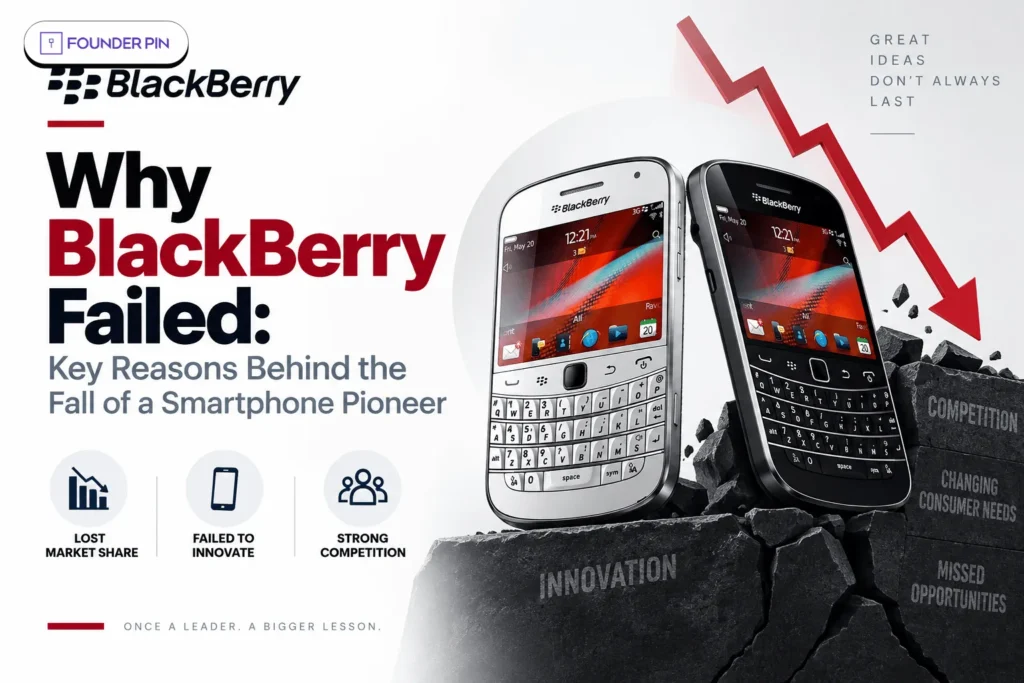
There was a time when BlackBerry basically was the modern smartphone. The physical keyboard, the secure messaging, push email that just worked, a reputation inside every enterprise IT department — it wasn’t competing for the market, it defined it. So why BlackBerry failed is a more complicated story than “the iPhone beat it,” even if that’s the version most people remember.
The real problem was speed. The market moved faster than BlackBerry’s strategy could keep up with. People started wanting big touchscreens, richer app ecosystems, better cameras and media — the stuff BlackBerry hadn’t built for. At the same time, companies stopped locking employees into one device and started letting them bring their own. BlackBerry’s own filings admitted as much at the time, pointing to Apple’s iOS, the rise of Android, shifting consumer tastes, and the BYOD wave as the forces working against it.
The story also has similarities with other technology giants that struggled to respond to major market changes. For example, the Why Nokia Failed story shows another example of an established technology company struggling to adapt when customer expectations and competitive dynamics changed.
Why Did BlackBerry Fail?
The short version: BlackBerry had a business model that worked brilliantly for years, and it just wasn’t fast enough to rebuild that model once the smartphone market shifted under it.
A few things stack up as the real reasons:
- It badly underestimated how quickly touchscreens would take over
- Its app ecosystem never had a real shot against iOS and Android
- It responded to the iPhone and Android far too slowly
- It stayed boxed in as “the business phone,” even as consumers took over the market
- BlackBerry 10 showed up only after competitors already had thriving ecosystems
- Its hardware started to look dated next to what rivals were shipping
- It was fighting on two fronts — Apple on one side, a flood of Android manufacturers on the other
- Its enterprise stronghold eroded once BYOD became the norm
- Launches and big strategic calls kept getting delayed
- Eventually, it stepped away from smartphone hardware entirely and pivoted to software and security
The real lesson here isn’t that BlackBerry stopped innovating — it didn’t. It’s that its innovation and its strategy simply couldn’t keep pace with how fast customers were redefining what a smartphone even was.
BlackBerry’s own regulatory filings later identified factors including an aging product portfolio, intense competition, changing consumer preferences, and the growing popularity of competing platforms such as iOS and Android. BlackBerry’s SEC filing provides the company’s contemporaneous explanation of these challenges.
1. BlackBerry Underestimated the Touchscreen Revolution
Ironically, the thing that made BlackBerry great is also what held it back — its physical keyboard.
That keyboard wasn’t just a feature, it was the whole identity. Professionals loved it because it made typing emails and messages fast in a way touchscreens at the time couldn’t match. But then the iPhone showed up and quietly rewrote what people expected a phone to be.
Suddenly a smartphone wasn’t just for calls and texts. It was:
- A communication device
- A web browser
- A media player
- A gaming platform
- An app platform
- Basically, a touchscreen computer in your pocket
BlackBerry kept doubling down on the keyboard while the rest of the market was sprinting toward big touchscreen displays. By the time it finally released its own touchscreen models, the moment had already passed — competitors weren’t just ahead, they’d already won over the customers BlackBerry needed back.
2. The App Ecosystem Became More Important Than the Phone
Hardware wasn’t BlackBerry’s only weak spot — its software ecosystem turned into an even bigger liability.
By this point, people weren’t just buying a phone; they were buying into an app library. BlackBerry itself admitted as much, acknowledging that consumers were gravitating toward whichever platform had the broadest app selection — and that meant iOS and Android, not them.
The problem fed on itself: fewer users meant less reason for developers to build for BlackBerry, which meant fewer apps, which meant even less reason for consumers to pick it up. Fewer users → less developer interest → fewer apps → weaker demand → fewer users. Round and round it went.
Meanwhile, Apple and Android kept pulling further ahead, riding developer ecosystems that fed themselves in the opposite direction. BlackBerry did try to catch up — BlackBerry World actually crossed 100,000 apps for BlackBerry 10 — but a big number on paper couldn’t match the scale and momentum the other two platforms had already built.
Also Read | Top 10 Indian AI Companies Leading the Tech Revolution in 2026
3. BlackBerry Reacted Too Slowly to the iPhone
The iPhone did not instantly destroy BlackBerry. The bigger problem was the strategic response.
BlackBerry had already built a strong position in smartphones, particularly among business users. That success could make a company confident in the existing formula.
But the definition of a smartphone was changing.
BlackBerry’s own regulatory filings later highlighted its aging product portfolio, intense competition and consumer demand for broader application access.
By the time BlackBerry introduced its new BlackBerry 10 platform, Apple and Android manufacturers had already established strong positions.
This illustrates a classic business problem:
A company can be very successful with yesterday’s product and still lose tomorrow’s market.
4. Android Created a Massive Competitive Problem
BlackBerry was not competing against just one company.
It faced Apple on one side and a rapidly expanding group of Android manufacturers on the other.
Companies such as Samsung and other manufacturers could produce smartphones across different price points and markets. BlackBerry’s filings specifically identified the growing number of Android-based competitors as a factor affecting its market share.
Android also created a platform advantage.
Instead of one company building every smartphone, numerous manufacturers could contribute to the ecosystem. That increased product variety, price competition and consumer choice.
BlackBerry was effectively fighting an entire ecosystem.
5. Its Enterprise Advantage Started to Weaken
BlackBerry built an enormous reputation around enterprise security.
That was a genuine strength—not merely marketing. BlackBerry’s enterprise platform had been widely adopted by major organizations, and the company highlighted its strong position among Fortune 500 enterprises.
But the workplace changed.
The Bring Your Own Device (BYOD) trend allowed employees to use their preferred smartphones for work. Companies increasingly had to support multiple platforms instead of giving everyone a BlackBerry.
BlackBerry itself identified BYOD as a factor increasing competitive pressure on its enterprise business.
Its strongest moat was therefore becoming less powerful.
6. BlackBerry 10 Arrived Too Late
BlackBerry 10 was an important attempt to reinvent the platform.
The problem was timing.
BlackBerry’s fiscal 2013 filing shows that hardware shipments had already fallen sharply, with approximately 28.1 million BlackBerry handhelds shipped compared with about 49 million the previous year. The company attributed the decline largely to its aging portfolio, intense competition and the transition to BlackBerry 10.
The new platform needed to accomplish several things simultaneously:
- Win back consumers
- Attract developers
- Compete with iOS
- Compete with Android
- Modernize the user experience
- Rebuild carrier momentum
That was an extremely difficult task once competitors had already gained significant ecosystem advantages.
7. Hardware Became a Weak Point
BlackBerry’s hardware business deteriorated rapidly as competition intensified.
In fiscal 2013, hardware revenue fell by approximately 51.8% year over year, according to the company’s SEC filing. Device shipments also dropped substantially.
The following year showed how serious the problem had become. In the third quarter of fiscal 2014, BlackBerry recognized only about 1.9 million handheld devices, down roughly 72.5% from the comparable period.
The company was no longer setting the pace of smartphone hardware innovation.
8. BlackBerry Confused a Strong Niche With a Growing Market
BlackBerry built a powerful identity around three words: secure, professional, productive. And for a specific kind of user, that identity worked extremely well.
But the smartphone market wasn’t standing still — it was getting bigger and messier, pulling in people who wanted entertainment, social media, photography, gaming, and a phone that felt personal, not just useful. BlackBerry’s old strengths didn’t disappear; they just stopped being enough on their own to define what a smartphone was for.
That’s maybe the sharpest lesson in the whole BlackBerry story: a strong niche can quietly turn into a trap the moment management mistakes loyal customers today for the shape of demand tomorrow.
9. BlackBerry Eventually Had to Exit Smartphone Manufacturing
By 2016, BlackBerry had basically stopped trying to compete on hardware directly.
Instead, it shifted toward software and services, choosing to license its name and software rather than keep building phones itself. That December, BlackBerry struck a licensing deal with TCL, handing off the design, manufacturing, and sale of BlackBerry-branded devices to them.
It was a bigger move than it might have looked at the time. BlackBerry was essentially admitting that its future no longer hinged on making smartphones at all.
And with that, the smartphone era of BlackBerry quietly came to a close.
What Happened to BlackBerry After Its Smartphone Decline?
BlackBerry never actually went away — it just stopped being a phone company.
It reinvented itself around cybersecurity, secure communications, and embedded software, with QNX becoming the backbone of that new identity. Today, that’s largely what BlackBerry does: secure communications products, cybersecurity tools, and QNX software running inside everything from cars to medical devices to industrial controls, robotics, rail systems, and aerospace and defense equipment.
It’s a reminder worth sitting with — a product category can fail completely without taking the whole company down with it. BlackBerry the phone brand died. BlackBerry the company found a second act most people never noticed.
What Can Businesses Learn From the BlackBerry Failure?
The BlackBerry story provides several important business lessons:
1. Never confuse current success with future demand
A successful product can become outdated when customer expectations change.
2. Ecosystems can be more powerful than hardware
The battle was not only about smartphones. It was increasingly about operating systems, developers, apps and users.
3. Speed matters
Entering a new market late can make catching up dramatically more expensive.
4. Listen to changing customer behavior
BYOD and the growing popularity of consumer smartphones changed enterprise mobility.
5. Protect the business, but do not protect the past
BlackBerry’s greatest strengths—security, keyboard-based productivity and enterprise messaging—also influenced its strategic identity.
The challenge for any established company is knowing when to preserve its advantages and when to abandon familiar assumptions.
For founders looking at emerging opportunities, the same principle applies today: understanding technological shifts early can help businesses identify new markets before they become crowded. Our guide to 20 Tech Startup Ideas for 2026 explores several technology-driven business opportunities.
BlackBerry Failure: The 5-Stage Model
The decline can be summarized in five stages:
Dominance
↓
Disruption
↓
Delayed Response
↓
Strategic Misalignment
↓
Market Share Collapse
BlackBerry dominated an earlier version of the smartphone market. Then touchscreen devices, app ecosystems and Android disrupted that market. Its response came too slowly, and its strategy remained tied to strengths that were becoming less decisive.
The result was a dramatic loss of smartphone market share and the eventual exit from direct handset manufacturing.
Final Takeaway: Why BlackBerry Failed
So, why BlackBerry failed comes down to more than one bad product or one competitor.
BlackBerry was caught in a major technology transition. It underestimated the importance of touchscreen design, failed to build an ecosystem competitive with iOS and Android, responded slowly to changing consumer expectations and saw its enterprise advantage weakened by BYOD.
Yet the story also contains a positive lesson.
BlackBerry successfully transformed parts of its technology expertise into businesses focused on cybersecurity, secure communications and embedded software. Its smartphone business collapsed, but the company itself continued evolving.
For businesses and founders, the biggest BlackBerry lesson is simple: your biggest competitive advantage today can become your biggest strategic blind spot tomorrow.
FAQs About Why BlackBerry Failed
1. Why did BlackBerry fail?
BlackBerry failed because it struggled to adapt quickly enough to touchscreen smartphones, app-based ecosystems and changing consumer and enterprise behavior. Competition from iPhone and Android devices accelerated its decline.
2. Did the iPhone cause BlackBerry’s failure?
The iPhone was a major catalyst, but it was not the only reason. Android competition, the growing importance of apps, an aging product portfolio and the BYOD trend also contributed to BlackBerry’s decline.
3. Why couldn’t BlackBerry compete with Android?
Android created a broad ecosystem of manufacturers, devices and applications. BlackBerry struggled to match the scale and variety of the Android ecosystem while also competing with Apple’s iOS platform.
4. What happened to BlackBerry smartphones?
BlackBerry stopped directly competing in smartphone hardware and shifted toward software and services. It subsequently licensed its brand and software to companies such as TCL for BlackBerry-branded smartphones.
5. Is BlackBerry still in business?
Yes. BlackBerry continues operating as a technology company focused on areas including secure communications, cybersecurity and QNX embedded software. Its current products serve enterprises, governments, automotive companies and other industries.
SHARE