
Why Nokia Failed: 10 Reasons Behind Its Fall
Table of Contents
Toggle
Nokia was once the biggest name in mobile phones. People trusted its phones for their durability, long battery life and simple design. The brand had a strong presence in markets around the world.
Then smartphones changed the game.
Consumers started expecting much more from their phones. They wanted apps, touchscreens and better software experiences. So, why Nokia failed cannot be pinned on a single mistake. The company struggled with its software, missed changes in consumer behaviour and faced growing pressure from Apple and Android.
Nokia itself recognised the shift in 2011. The company noted that competition was no longer just about selling better phones. It was increasingly about building a strong software and device ecosystem.
That change in the market became a major turning point for Nokia.
Why Did Nokia Fail?
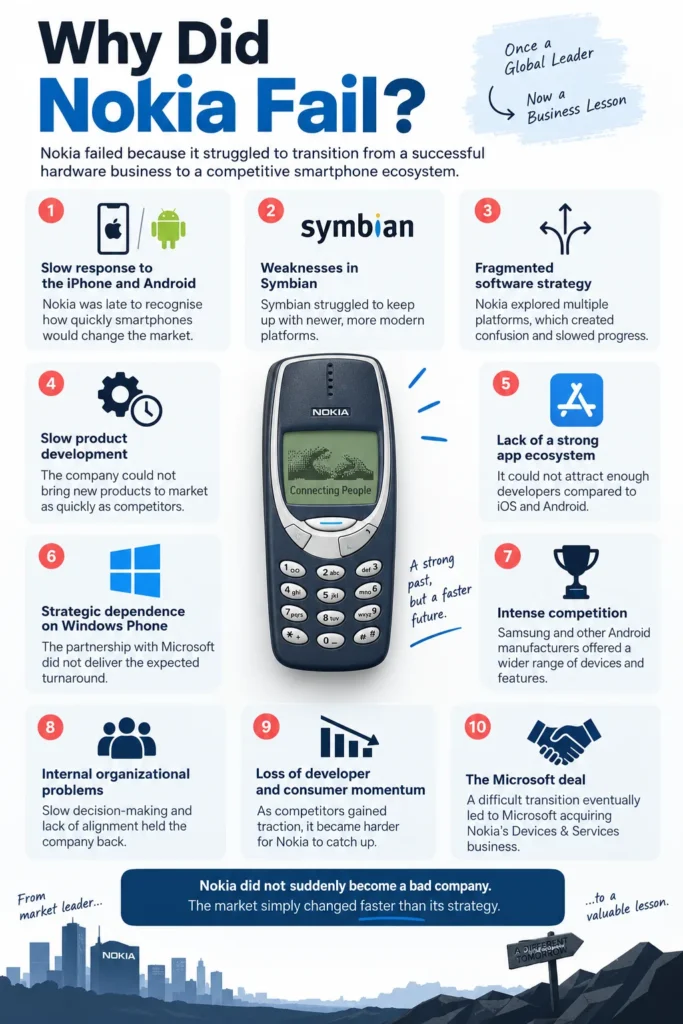
Nokia failed because it struggled to transition from a successful hardware business to a competitive smartphone ecosystem.
The biggest reasons include:
- Slow response to the iPhone and Android
- Weaknesses in the Symbian platform
- A fragmented software strategy
- Slow product development
- Lack of a strong app ecosystem
- Strategic dependence on Windows Phone
- Intense competition from Samsung and Android manufacturers
- Internal organizational problems
- Loss of developer and consumer momentum
- A difficult transition that ultimately led to the Microsoft deal
Nokia did not suddenly become a bad company. The market simply changed faster than its strategy.
Also Read | Failed Startups in India: Reasons Behind Major Startup Failures
1. Nokia Underestimated the Smartphone Revolution
Nokia was slow to realise just how much smartphones were changing.
The company knew how to make reliable mobile phones, but the market was moving in a different direction. The iPhone showed consumers that a phone could be much more than calls, texts and basic features. Touchscreens, apps, software and online services were becoming just as important.
Apple launched the first iPhone in 2007, and Android soon built its own growing ecosystem.
Nokia still had the largest share of global smartphone shipments in 2010, with about 33.1%, compared with Apple’s 15.7%, according to IDC. But the gap was starting to matter less. The real issue was how quickly the market was changing.
Nokia had the scale and resources to compete. What it struggled with was moving fast enough when customer expectations changed.
2. Symbian Could Not Keep Up
Nokia’s Symbian platform became harder to compete with as smartphones became more software-focused.
Nokia had relied on Symbian for years and had a huge base of existing users. However, smartphones were becoming more advanced, and developers were looking for platforms that were easier to build apps and services for.
Nokia acknowledged in its 2011 strategy discussion that Symbian had become difficult to develop for. The company also recognised that the platform was struggling in important markets such as North America.
This created a serious problem for Nokia. It still had millions of users and a strong hardware business, but its software experience was falling behind Apple and Android.
3. Nokia Was Too Slow at Product Development
Nokia’s product development cycle became a serious competitive disadvantage.
The smartphone market started rewarding companies that could combine hardware, operating systems, applications, and services quickly.
Stephen Elop’s famous 2011 “burning platform” message highlighted the issue. He acknowledged that Nokia had strong innovation internally but was not bringing it to market fast enough.
That distinction matters.
Having good technology is not enough if competitors can turn ideas into consumer products faster.
4. The App Ecosystem Became More Important
Nokia was competing against ecosystems, not just phones.
This was perhaps the biggest strategic change in the industry.
Apple had the App Store and iOS ecosystem. Google was building Android across multiple manufacturers. Developers increasingly wanted platforms with large and growing user bases.
Nokia had applications and services, but it lacked the same ecosystem momentum.
Elop described the change clearly in 2011: the industry was becoming a “war of ecosystems” rather than simply a competition between devices.
That shift weakened one of Nokia’s biggest historical advantages: hardware scale.
5. Nokia’s Software Strategy Became Uncertain
Nokia struggled with a complicated transition between platforms.
The company had Symbian, MeeGo, Series 40 and other software initiatives while trying to determine its long-term smartphone direction.
MeeGo was expected to play an important role in Nokia’s high-end smartphones, but Nokia ultimately moved toward Microsoft’s Windows Phone platform in 2011.
That strategic transition created uncertainty at a critical moment.
Consumers and developers needed confidence that Nokia’s chosen platform would survive and grow. Instead, Nokia was moving between technologies while competitors were building momentum.
6. Choosing Windows Phone Was a High-Risk Bet
The partnership with Microsoft gave Nokia a new platform, but it also placed the company behind two much stronger ecosystems.
In February 2011, Nokia announced that Windows Phone would become its primary smartphone platform.
The partnership produced the Lumia range and gave Nokia access to Microsoft’s software ecosystem.
But the timing was difficult.
Android was spreading across manufacturers, while Apple’s iPhone ecosystem was becoming stronger. Nokia therefore had to persuade consumers to choose a third major smartphone ecosystem.
The Lumia products had strengths, but the broader platform lacked the scale of Android and iOS.
7. Android Manufacturers Increased the Pressure
Samsung and other Android manufacturers made the market far more competitive.
Nokia was no longer competing only with Apple.
Android allowed multiple manufacturers to build smartphones around Google’s operating system. Samsung, HTC, LG and others could therefore compete across different price segments.
Nokia’s historical strength was its ability to manufacture phones for different markets. Android manufacturers increasingly matched that advantage while offering a more modern smartphone platform.
The competitive battlefield had expanded dramatically.
8. Nokia Lost Smartphone Momentum
Once Nokia started losing ground in smartphones, the decline became harder to stop.
Its smartphone market share dropped rapidly in the early 2010s. Industry data shows a fall from around 49% in 2007 to about 15.6% in 2011 and just 4.8% in 2012.
Nokia’s 2012 results also pointed to falling Symbian sales as a major reason for the decline in its Smart Devices business. Lumia phones started to add to sales, but they could not reverse the decline quickly enough.
The bigger lesson is simple: market leadership can disappear fast when customer expectations change and a company struggles to keep pace.
9. Internal Problems Also Slowed Nokia Down
Nokia’s problems went beyond its products and technology. The company also struggled with execution and internal alignment.
In his 2011 message to employees, CEO Stephen Elop raised concerns about slow innovation, collaboration and accountability.
Nokia had plenty going for it. It had skilled engineers, a trusted brand, global distribution and years of experience in the mobile industry. But those strengths mattered less when the company could not make decisions and respond quickly enough.
For today’s founders, there is a useful takeaway here: being a large company gives you resources, but it can also make you slower. In a fast-moving market, that lack of speed can become a serious weakness.
10. Microsoft Acquisition Ended Nokia’s Phone Era
By the time Microsoft stepped in to buy Nokia’s Devices and Services business, the phone division was already struggling badly — this wasn’t a deal that came out of nowhere.
The two companies announced it in September 2013. Microsoft agreed to pay €5.44 billion in cash — €3.79 billion for the phone business itself, and another €1.65 billion for patent licensing. The deal officially closed on April 25, 2014.
With that, Microsoft took over Nokia’s Lumia smartphones and the rest of its phone operations. Nokia carried on as a company, but it wasn’t the same Nokia people had known for years — the global handset giant that once seemed untouchable.
For Nokia, this wasn’t just another acquisition on paper. It was, in a real sense, the end of its run as one of the biggest phone makers in the world.
Nokia Failure Timeline
Nokia’s decline happened over several years rather than overnight.
| Year | Key Event |
|---|---|
| 2007 | Apple introduces the iPhone. |
| 2008 | Google-backed Android enters the smartphone market. |
| 2010 | Nokia remains a major smartphone leader but faces growing competition. |
| 2011 | Nokia partners with Microsoft and adopts Windows Phone as its primary smartphone platform. |
| 2012 | Nokia continues to face pressure in its Smart Devices business, especially from declining Symbian sales. |
| 2013 | Microsoft announces the acquisition of Nokia’s Devices & Services business. |
| 2014 | Microsoft completes the acquisition. |
This timeline shows why blaming one product or one executive oversimplifies the story.
What Happened to Nokia After the Phone Business Was Sold?
Nokia didn’t just disappear after selling its phone business to Microsoft in 2014 — it actually reinvented itself into a telecom and technology company.
- Telecom infrastructure. Nokia now puts most of its focus into network infrastructure — mobile networks, optical networks, and connectivity more broadly.
- Technology licensing. A big chunk of its revenue comes from licensing its technologies out to other companies.
- Patents. Nokia held onto a huge portfolio of telecom patents and still licenses them globally to this day.
- New territory. It’s also putting money into newer areas like AI, cloud networking, and 6G.
So the phone brand people grew up with didn’t really survive in the way it once existed. But Nokia the company did — it just found a way to rebuild itself into something completely different.
What Nokia Did Right but Too Late
The frustrating thing about Nokia’s decline is that the company actually saw a lot of this coming — it just moved too slowly to turn that foresight into an advantage.
- Nokia N9 and MeeGo. The N9 had a genuinely modern gesture-based interface and showed Nokia could build something competitive. The problem was timing — Nokia had already committed to Windows Phone as its main smartphone platform by then, so the N9 never really got the shot it deserved.
- Lumia smartphones. Moving to Windows Phone, Nokia launched the Lumia 800 and Lumia 710 in 2011. It was a real attempt to respond to the smartphone shift — but by that point, Android and iOS already had enough momentum that catching up was genuinely difficult.
- HERE Maps. Nokia poured serious money into digital mapping, including buying NAVTEQ, and HERE ended up becoming a sophisticated location platform in its own right. The problem was that none of that translated into a strong enough smartphone ecosystem to matter.
- PureView camera technology. Devices like the 808 PureView pushed smartphone photography forward in ways that were genuinely ahead of the curve at the time — solid proof that Nokia’s hardware and imaging teams weren’t the issue.
The real lesson here is that Nokia wasn’t short on innovation at all. Its actual problem was speed — turning good technology into a fast-growing ecosystem before competitors got too far out in front.
What Can Founders Learn From Nokia’s Failure?
The biggest Nokia lesson is that market leadership does not guarantee future leadership.
Founders can take away five practical lessons:
- Watch changing customer behavior, not just current sales.
- Treat software and ecosystems as strategic assets when the market demands them.
- Move quickly when a disruptive technology changes the category.
- Do not let organizational complexity slow critical decisions.
- Protect your platform and developer ecosystem before competitors make them stronger.
Nokia had enormous resources. What it lacked was enough time to recover after the market’s rules changed.
Nokia Failure Case Study: The 5-Stage Model
Nokia’s decline didn’t happen in one dramatic moment — it built up gradually, through five connected stages.
1. Dominance.
Nokia built a genuinely massive global lead in mobile phones, backed by strong hardware, solid distribution, and a brand that meant something almost everywhere.
2. Disruption.
Then the iPhone and Android showed up, and the whole game changed — competition suddenly revolved around touchscreens, software, apps, and ecosystems, not just hardware.
3. Delayed response.
Nokia did respond, with things like MeeGo and Lumia. But by then, its Symbian business was already losing steam, and the response came a bit too slow to really matter.
4. Strategic misalignment.
Nokia bet its smartphone future on Windows Phone, right around the time Android and iOS were pulling ahead and building real ecosystem momentum that would prove hard to catch.
5. Market share collapse.
Smartphone volumes kept falling, competitiveness kept weakening, and eventually Nokia sold most of its Devices & Services business to Microsoft in 2014.
The real takeaway is that Nokia’s failure wasn’t sudden at all. Each stage fed into the next, and what started as a technology shift slowly turned into a full-blown strategic collapse.
Also Read | Cafe Coffee Day Case Study: Business Model, Rise, Fall and Key Lessons
FounderPin Perspective
Nokia’s story is one of the clearest examples of how a market leader can lose an advantage without losing its capabilities.
The company knew hardware. It had a globally recognized brand, huge distribution, manufacturing expertise, and millions of customers.
But smartphones changed the game from “Who makes the best phone?” to “Who owns the best connected ecosystem?”
Apple and Google understood that transition exceptionally well.
Nokia eventually recognized it too. The problem was that by then, the competitive gap had become extremely difficult to close.
Final Takeaway: Why Nokia Failed
Why Nokia failed can be explained by one central idea: the company was late to a platform-driven smartphone market.
Symbian struggled to keep pace, product development was too slow, the app ecosystem was weaker, and the Windows Phone strategy arrived after Android and iOS had built significant momentum.
Nokia’s decline is therefore more than a technology story. It is a business lesson about timing, adaptability, ecosystems, and execution.
For founders, the message is simple: today’s market leader can become tomorrow’s case study if it fails to adapt when customers change.
Want to understand how your startup can avoid similar strategic mistakes? Contact FounderPin for a consultation.
Frequently Asked Questions
1. Why did Nokia fail in the smartphone market?
Nokia failed to keep pace with the shift toward touchscreen smartphones, mobile apps, and software ecosystems. Its Symbian platform struggled against iOS and Android, while its later Windows Phone strategy could not regain enough market share.
2. What was the main reason behind Nokia’s failure?
The main reason was Nokia’s slow adaptation to the smartphone ecosystem. Strong hardware and a powerful brand were no longer enough as software, apps, and platforms became central to smartphone success.
3. Did Nokia fail because of the iPhone?
The iPhone was an important factor, but it was not the only reason. Apple’s entry exposed weaknesses in Nokia’s software and user experience, while Android, Samsung, internal challenges, and strategic decisions also contributed to Nokia’s decline.
4. What happened to Nokia after it sold its phone business?
Nokia did not disappear. After selling its Devices & Services business to Microsoft in 2014, the company focused more heavily on telecommunications infrastructure, technology licensing, and patents.
5. What can businesses learn from Nokia’s failure?
Nokia’s story shows that market leaders must adapt quickly when technology and customer expectations change. Innovation, speed, software, ecosystems, and strategic execution can matter as much as brand strength and market share.
SHARE