
Can the Adani Business Model Be Replicated by Small Entrepreneurs?
Table of Contents
Toggle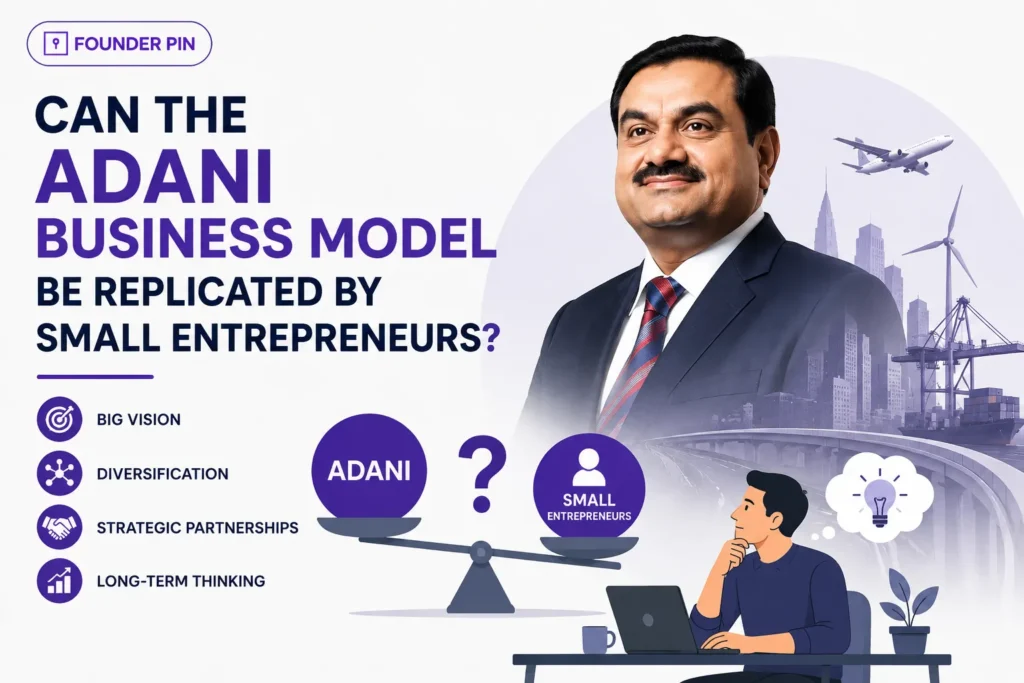
Key Takeaways
- The Adani Business Model focuses on long-term vision, ecosystem development, and disciplined execution. Instead of relying only on diversification, it creates connected businesses that support each other.
- Small entrepreneurs may not match Adani’s scale. However, they can follow its core principles, including strategic expansion, operational excellence, and customer-focused growth.
- Adani Enterprises’ business incubator model shows the value of building one successful business first. Then, companies can expand into complementary industries with greater confidence.
- Moreover, sustainable business success comes from solving long-term market needs. Entrepreneurs should invest ahead of trends and build connected revenue streams instead of chasing short-term growth.
Introduction
Every entrepreneur dreams of developing a business that goes beyond a single product or service into a market-leading enterprise. The Adani Group is one of the few Indian corporate groups that best exemplifies this trajectory.
Over the past three decades, the Group has developed from a commodity trading enterprise into one of India’s major infrastructure conglomerates, operating across ports, airports, logistics, renewable energy, power transmission, mining, data centers, manufacturing, and digital infrastructure.
Naturally, this achievement begs a crucial question:
Can the Adani Business Model be replicated by small entrepreneurs?
The simple answer is yes—but not in terms of scale.
Small businesses cannot replicate billion-dollar infrastructure investments, but they can absolutely adopt the strategic principles that have powered the Adani Group business model. These principles closely align with the Gautam Adani Business Philosophy that has guided the Group’s long-term growth.
At FounderPin, we’ve observed that sustainable businesses are rarely built by copying someone’s assets. Instead, they are built by understanding the thinking, systems, and execution that created those assets.
This article breaks down the Adani Business Model, explains why it has been successful, and explores how startup founders can adapt its core principles to build scalable businesses.
Can Small Entrepreneurs Really Replicate the Adani Business Model?
The answer is yes—but strategically, not financially.
Small businesses cannot replicate billion-dollar infrastructure investments, global financing capabilities, or large-scale acquisitions.
However, they can successfully apply the thinking behind the Adani Business Model.
The true strength of the model lies in its principles:
- Long-term vision
- Ecosystem building
- Operational discipline
- Strategic expansion
- Calculated risk-taking
- Continuous reinvestment
These ideas are valid whether a business makes ₹10 lakh or ₹10,000 crore in annual revenue.
The idea isn’t to become another Adani Group—it is to construct a business that grows consistently, creates long-term value, and remains resilient through shifting market conditions.
A Practical Framework for Startup Founders
Based on our analysis of the Adani Group business model, FounderPin recommends the following framework for entrepreneurs.
Start with One Strong Business
Avoid launching multiple businesses too early.
Instead:
- Validate one business model.
- Build predictable revenue.
- Strengthen operations.
- Create customer trust.
Only then should you consider expansion.
Build Complementary Revenue Streams
Ask yourself:
“What else does my customer need?”
Rather than chasing entirely new markets, expand into services that naturally fit your existing business.
Examples include:
- SaaS → Payroll → Compliance
- Digital Marketing → Branding → Web Development
- Manufacturing → Logistics → Warehousing
This creates an ecosystem that improves profitability while reducing customer acquisition costs.
Invest Ahead of Demand
One of the defining characteristics of the Adani Business Model is investing before demand fully matures.
The Group entered sectors such as:
- Renewable energy
- Airports
- Data centers
- Green hydrogen
well before they became mainstream investment themes.
Startup founders can adopt the same mindset by identifying emerging industries early instead of entering overcrowded markets.
Think in Decades, Not Quarters
Many startups prioritize immediate valuations.
Adani focuses on long-term asset creation.
This mindset encourages:
- Better capital allocation
- Sustainable growth
- Stronger customer relationships
- Long-term competitive advantages
Businesses built for decades often outperform businesses built only for the next funding round.
Understanding the Adani Business Model
Many people mistakenly believe the Adani Group’s success comes primarily from diversification.
In reality, diversification is only one outcome of a much broader strategy.
The Adani Business Model is built around three core ideas:
- Identifying long-term national growth sectors
- Building integrated business ecosystems
- Incubating new businesses before scaling them independently
Rather than investing in unrelated industries, the Group enters sectors that naturally complement one another.
For example:
- Ports strengthen logistics.
- Logistics supports manufacturing.
- Airports improve connectivity.
- Renewable energy powers industries.
- Data centers support digital transformation.
This ecosystem approach allows every business to create value for another.
Instead of operating individual companies, the Adani Group operates interconnected economic platforms. Our guide on Adani Group Diversification: How Adani Entered Airports, Cement, Media and Data Centers explains how this expansion strategy evolved over time.
The Business Incubator Strategy
Perhaps the most unique feature of the Adani Group business model is its incubation strategy.
Unlike traditional conglomerates that acquire mature businesses, Adani Enterprises Limited (AEL) serves as the Group’s business incubator.
Its role is to:
- Identify future growth industries.
- Invest during early stages.
- Build operational capabilities.
- Scale businesses.
- Eventually spin them into independent market leaders.
According to the FY25 Integrated Annual Report, Adani Enterprises describes itself as India’s largest listed business incubator, focused on creating businesses that support India’s long-term economic growth. Readers interested in learning more about Adani Enterprises’ incubation strategy and annual performance can explore the official Adani Enterprises Annual report .
This model has helped create successful companies across:
- Airports
- Renewable energy
- Green hydrogen
- Roads
- Mining services
- Data centers
- Digital infrastructure
Instead of expecting immediate returns, the Group patiently nurtures businesses until they become self-sustaining.
FounderPin Insight
For startups, this principle is extremely valuable.
Rather than launching five businesses simultaneously, founders should focus on building one successful business, strengthening its systems, and then expanding into complementary opportunities.
Long-Term Thinking Over Short-Term Profits
Patience is another key component of the Adani Business Model.
A lot of startups pursue short-term valuations, fundraising rounds, and fast growth.
Adani has a different way of thinking. The Group invests extensively in sectors that may require years before yielding major returns. Learn more in our detailed article on Adani Infrastructure Investments: Why Adani Is Driving India’s Infrastructure Economy.
This long-term perspective is apparent in the following infrastructure sectors:
- Ports
- Airports
- Renewable energy
- Green hydrogen
- Industrial manufacturing
The FY25 financial results indicate how this patience translates into performance.
According to Adani Enterprises:
- ₹1,00,365 crore in revenue
- ₹16,722 crore in EBITDA
- Incubating firms producing ₹10,025 crore EBITDA, representing a 68% year-on-year gain.
These figures show that long-term execution and focused investment can eventually result in very lucrative firms.
Building Ecosystems Instead of Products
Perhaps the biggest lesson entrepreneurs can learn is ecosystem thinking.
Adani rarely builds isolated businesses.
Every new investment strengthens existing operations.
For example:
| Core Business | Connected Businesses |
|---|---|
| Ports | Logistics, Rail, Warehousing |
| Airports | Cargo, Retail, Commercial Real Estate |
| Renewable Energy | Manufacturing, Data Centers |
| Data Centers | AI Infrastructure, Cloud Computing |
Each company supports another.
This reduces dependency on any single revenue source while improving operational efficiency.
For small businesses, ecosystem thinking might involve:
- Offering complementary services.
- Creating recurring revenue.
- Building strategic partnerships.
- Expanding customer lifetime value.
Why the Adani Group Business Model Scales Successfully
The greatest strength of the Adani Group business model is not simply diversification—it’s disciplined scalability.
Many companies expand by entering unrelated industries. Adani, however, grows by extending its presence into businesses that naturally complement one another.
For example:
- Ports generate cargo movement.
- Logistics manages transportation.
- Warehousing supports supply chains.
- Airports improve passenger and freight connectivity.
- Renewable energy powers industrial operations.
- Data centers support India’s digital economy.
Each new business strengthens the existing ecosystem instead of operating independently.
This creates:
- Lower operating costs
- Better asset utilization
- Multiple revenue streams
- Higher operational efficiency
- Greater resilience during economic cycles
Instead of asking, “What business should we enter next?” the Adani Group asks, “What business makes our existing ecosystem stronger?”
FounderPin Insight
This principle applies equally to startups.
Rather than launching unrelated ventures, founders should expand into products or services that naturally solve additional problems for their existing customers.
Case Study: From Trading Company to Infrastructure Giant
In 1988, the Adani Group started off as a commodity trading company.
Instead of remaining solely in trading, the company gradually expanded into infrastructure sectors supporting India’s economic development.
The progression looked like this:
Trading → Ports → Logistics → Power → Renewable Energy → Airports → Manufacturing → Data Centers
Each expansion solved a related problem within the same economic ecosystem.
This strategic evolution demonstrates that sustainable diversification is often gradual rather than immediate.
FounderPin Insight
Many entrepreneurs believe they need multiple businesses to grow.
In reality, one well-executed business can become the foundation for several complementary opportunities over time.
What Entrepreneurs Should NOT Copy
While the principles behind the Adani Group business model are valuable, founders should avoid copying its scale too early.
Some common mistakes include:
Growing Too Fast
Financial and operational resources are frequently stretched when several items are launched before the first is validated.
Taking Excessive Debt
Long-term finance is supported by the steady cash flows of large infrastructure companies.
Most new businesses don’t.
Sustainable expansion should take precedence over aggressive borrowing for entrepreneurs..
Entering Unrelated Industries
Adani’s diversification appears broad, but nearly every business supports the same infrastructure ecosystem.
Random diversification rarely creates lasting value.
What the Adani Business Model Can Teach Small Business Owners
The Adani Business Model is based on a number of strategic ideas that entrepreneurs can adopt, even if few companies have the financial means to construct ports or airports.
1. Focus on Long-Term Opportunities
Rather than following transient market trends, Adani constantly makes investments in industries that are predicted to develop for decades.
Today’s entrepreneurs can use the same approach by focusing on sectors like:
- Artificial Intelligence
- Climate technology
- SaaS
- Healthcare
- FinTech
- Clean energy
- Manufacturing technology
Businesses aligned with long-term economic shifts often create stronger competitive advantages.
2. Build Systems Before Scaling
One reason the Adani Group successfully manages multiple companies is its emphasis on operational systems.
Strong governance, experienced leadership teams, and standardized processes enable consistent execution across businesses.
For startups, this means:
- Documenting processes
- Automating repetitive work
- Building capable leadership
- Creating scalable workflows
Without systems, rapid growth often creates operational chaos.
3. Expand Around Existing Customers
The Adani ecosystem demonstrates how serving one customer need often creates opportunities to solve additional problems.
For example:
A logistics customer may also require:
- Warehousing
- Transportation
- Port services
- Customs support
Similarly, a startup selling accounting software might later expand into:
- Payroll
- Compliance
- Tax filing
- Financial reporting
This ecosystem approach increases customer lifetime value while reducing customer acquisition costs.
FounderPin’s Perspective
At FounderPin, we’ve worked with entrepreneurs across multiple industries, and one lesson consistently stands out:
Successful businesses rarely grow because they copy someone else’s products.
They grow because they adopt proven strategic principles while solving unique market problems.
The Adani Business Model offers valuable lessons for startup founders:
- Build around long-term economic trends.
- Create interconnected businesses rather than isolated products.
- Strengthen execution before expansion.
- Develop systems that support sustainable growth.
- Reinvest profits into future opportunities.
We believe entrepreneurs don’t need billion-dollar capital to think like infrastructure builders.
The real competitive advantage comes from creating businesses that continue generating value year after year.
Conclusion
Although the Adani Business Model is not financially replicable, its fundamental ideas are nevertheless very applicable to contemporary business owners.
The Adani Group has shown that a single company can become an integrated corporation supporting several industries through long-term planning, rigorous execution, ecosystem growth, and strategic diversification.
The most important lesson for business founders is straightforward:
Avoid trying to expand quickly. Rather, establish solid foundations, address related consumer issues, and grow gradually. Entrepreneurs can also learn valuable resilience lessons from our article on Gautam Adani Challenges: The Biggest Obstacles He Faced and How He Responded, which highlights how strategic decision-making helps businesses navigate uncertainty.
Companies that are based on these ideas have a much higher chance of seeing long-term growth than those that are only concerned with immediate prospects.
Entrepreneurs that combine vision with rigorous execution will be well-positioned to create the next generation of prosperous enterprises as India’s economy continues to grow.
Contact FounderPin for Expert Business Guidance
Having the correct advice may make all the difference, whether you’re starting a firm, testing your business plan, organising growth, or developing a long-term growth strategy.
At FounderPin, we help entrepreneurs with:
- Startup registration
- Business strategy
- Compliance
- Fundraising preparation
- Growth planning
- Government scheme guidance
Contact us for a consultation today and discover how proven business strategies can help you build a scalable and sustainable business.
FAQs
1. What is the Adani Business Model?
The Adani Business Model focuses on long-term value creation through integrated businesses, strategic infrastructure investments, and business incubation. Instead of operating standalone companies, the Adani Group builds interconnected ecosystems across ports, airports, logistics, renewable energy, manufacturing, and digital infrastructure.
2. Why is the Adani Group business model considered successful?
The Adani Group business model succeeds because it invests in future-ready industries, creates synergies between businesses, focuses on operational excellence, and aligns its growth with India’s long-term infrastructure and economic development.
3. What lessons can startup founders learn from the Adani Business Model?
Startup founders can learn to think long-term, solve interconnected customer problems, build scalable systems, expand into complementary markets, and prioritize execution over rapid growth. These principles help create resilient businesses capable of long-term success.
4. How does Adani Enterprises support the Adani Business Model
Adani Enterprises acts as the Group’s business incubator by identifying emerging industries, investing in early-stage opportunities, scaling operations, and eventually developing them into independent businesses. This incubation strategy has fueled the Group’s long-term growth.
5. Adani Group Business Structure: How It’s Organized and Why It Matters
The Adani Group operates through a decentralized business structure, with independent listed companies managing sectors such as ports, airports, renewable energy, power, logistics, cement, and data centers. This model allows each business to focus on its core operations while benefiting from the Group’s shared strategic vision, capital allocation, and integrated infrastructure ecosystem.