
Adani Group Diversification: How Adani Entered Airports, Cement, Media and Data Centers
Table of Contents
Toggle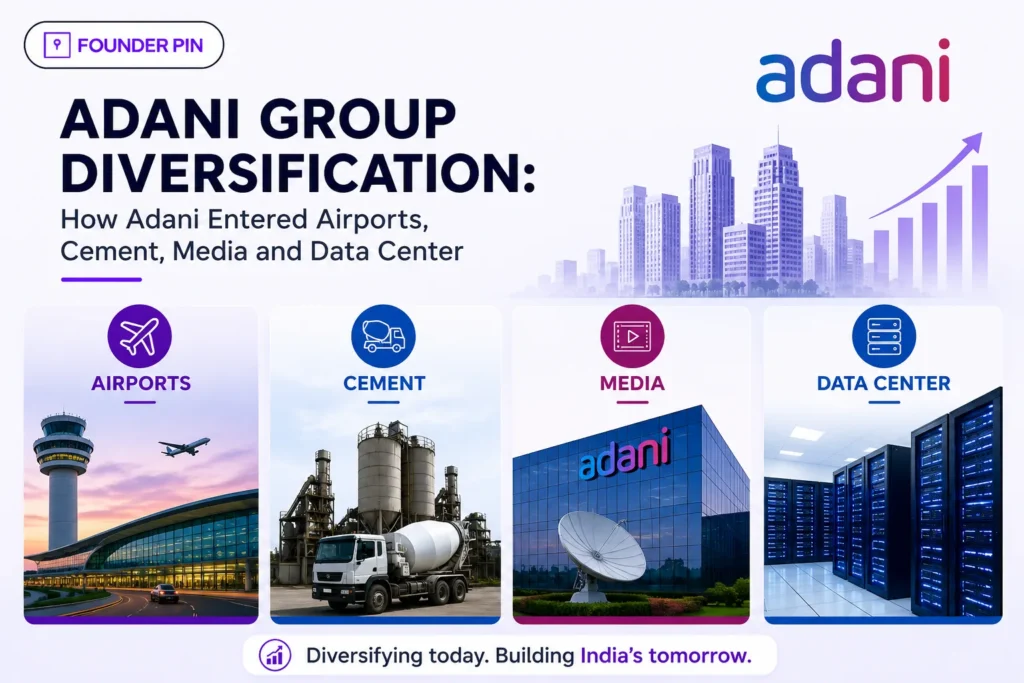
Key Takeaways
- Adani Group Diversification transformed the company from a trading business into a diversified conglomerate spanning airports, cement, media, and AI-ready data centers.
- Strategic acquisitions such as Mumbai International Airport, Ambuja Cements, and ACC accelerated growth and strengthened the Group’s integrated infrastructure ecosystem.
- The Group’s expansion strategy focuses on creating synergies between businesses, combining logistics, infrastructure, renewable energy, and digital technologies for long-term value creation.
- With major investments in Adani airports, Adani Cement, Adani media business, and Adani data centers, the Group is positioning itself for sustainable growth in India’s future economy.
Introduction
The Adani Group is one of the biggest business success stories in India. It started out as a commodity trading company. It has today evolved into a diversified infrastructure conglomerate with businesses in ports, logistics, energy, airports, cement, media and digital infrastructure.
But it did not happen overnight. The Group has invested in industries with strong long term potential by following a well planned Adani Group diversification strategy. At the same time, it built strong links between its businesses to increase efficiency and help growth in the future.
Today, the Adani Group is much more than a ports or power company. Instead, it has become one of India’s largest diversified business groups through strategic acquisitions, infrastructure investments, and digital expansion. As a result, the Group continues to strengthen its position across multiple industries.
In this article, we explore the Adani Group business expansion journey. We also explain how the company successfully entered airports, cement, media, and data centers. Finally, we examine how these investments helped build a future-ready business empire. For more information about the Group’s businesses and expansion strategy, visit the official Adani Group website.
1. Entering the Airport Business
Building India’s Largest Private Airport Network
2019 was one of the major milestones for the Adani Group in terms of its business expansion as the Group bagged rights to operate six major airports under the privatisation program of the Government of India.
Adani Airports has since grown significantly by acquiring Mumbai International Airport, which also includes the under-construction Navi Mumbai International Airport.
Today the company owns and operates eight airports making it India’s largest private airport operator.
These are:
- Ahmedabad
- Lucknow
- Jaipur
- Guwahati
- Mangaluru
- Thiruvananthapuram
- Mumbai
- Navi Mumbai (under development)
As part of the Group’s recent expansion plans, the Group intends to invest about $15 billion by 2030 to increase the passenger handling capacity to 200 million passengers annually.
Adani is not only managing airports but creating integrated airport ecosystems with retail, commercial real estate, logistics and digital services.
2. Expanding into the Cement Industry
The Landmark Ambuja-ACC Acquisition
The Adani Group bought one of India’s largest infrastructure companies in 2022, entering the cement business.
The acquisition of Ambuja Cements and ACC Limited immediately catapulted the Group to become one of the largest cement manufacturers in India.
Adani accelerated growth through acquisition instead of building new manufacturing facilities from the ground up.
This strategy allowed the company to:
- Expand production capacity rapidly
- Strengthen its infrastructure portfolio
- Support India’s growing construction demand
- Create operational synergies with logistics and ports
Today Adani Cement is an integral part of India’s infrastructure development, housing projects, industrialisation and urbanisation.
The Group has improved the efficiency of its supply chain and lowered transportation expenses by integrating cement manufacturing into its logistics capabilities.
3. Entering the Media Industry
The Adani Group entered the media industry in 2022 as part of its broader diversification strategy.
Starting Capital
Its journey through the media started with the purchase of a majority stake in Quintillion Business Media, expanding its presence in business journalism.
Acquisition NDTV
In later years, the Group expanded its media portfolio by acquiring a controlling stake in NDTV (New Delhi Television) through an open offer and also owning one of India’s leading news broadcasters.
4. Entering the Data Center Business
Building India’s Digital Infrastructure
As AI, cloud computing and digital services are transforming industries, the Adani Group has identified data centers as one of its key future growth drivers.
To capitalise on this opportunity, the Group has formed AdaniConneX, a joint venture to develop hyperscale renewable-powered data centers across India.
Unlike conventional facilities, AdaniConneX aims to integrate:
- Renewable energy generation. This clean-energy approach complements the Group’s renewable initiatives highlighted in our Adani Green Energy case study.
- Reliable power infrastructure
- High-performance cloud computing
- AI-ready digital infrastructure
This strategy aligns perfectly with India’s booming digital economy and the increasing demand for secure, energy-efficient data storage.
The Adani Group plans to invest as much as $100 billion by 2035 in renewable-powered, AI-ready data centers and supporting digital infrastructure, according to recent announcements.
This long-term vision makes Adani data centers a key pillar for the company’s future business growth.
Why Adani Group Diversification Has Been Successful
Many companies attempt to add value by branching out into unrelated industries. The Adani Group has mostly avoided this issue by diversifying into complementary sectors.
Infrastructure-Led Ecosystem
The Group’s businesses are interconnected:
- Ports support imports and exports. Learn how this logistics ecosystem was built in our detailed Adani Ports Case Study.
- Logistics connects manufacturing and distribution.
- Airports improve passenger and cargo movement.
- Cement supplies infrastructure projects.
- Renewable energy powers industrial operations.
- Data centers benefit from reliable green energy.
Efficiencies that isolated companies frequently fail to attain are produced by this integrated ecosystem.
Long-Term Investment Approach
Instead of focusing on short-term returns, the Group consistently invests in sectors expected to experience strong demand over the next several decades.
Examples include:
- Infrastructure
- Renewable energy
- Airports
- Digital infrastructure
- Manufacturing
- Logistics
This patient investment philosophy has allowed the company to scale across multiple industries while supporting India’s long-term economic development.
Challenges of Diversification
While Adani Group Diversification has created significant opportunities, managing such a broad portfolio also presents challenges.
Some of the key risks include:
- High capital investment requirements
- Regulatory approvals across multiple industries
- Complex operational management
- Market fluctuations
- Financing large infrastructure projects
Successfully managing these risks requires disciplined execution, strong leadership, and continuous capital allocation—qualities that have become central to the Adani Group’s growth strategy.
Key Lessons for Entrepreneurs
The Adani Group’s diversification journey offers valuable lessons for founders and business leaders.
1. Diversify Around Core Strengths
Rather than expanding randomly, Adani entered industries closely connected to infrastructure and logistics.
Businesses should diversify into sectors where existing capabilities provide a competitive advantage.
2. Think Long Term
Most of the Group’s investments require years before generating maximum returns.
Successful entrepreneurs often focus on building assets that create value over decades rather than months. Discover the leadership principles behind these decisions in our article on Gautam Adani Leadership Style.
3. Scale Through Strategic Acquisitions
The acquisitions of Ambuja Cements, ACC, and Mumbai International Airport demonstrate how acquisitions can accelerate market leadership much faster than organic expansion.
4. Build Business Ecosystems
Instead of operating isolated companies, Adani created businesses that strengthen one another.
This ecosystem approach improves efficiency while generating multiple revenue streams.
5. Invest in Future Industries
Data centers, renewable energy, AI infrastructure, and digital services represent long-term growth sectors.
Identifying future demand before competitors can create lasting competitive advantages.
Conclusion
There is considerably more to the Adani Group’s diversification narrative than just breaking into new markets. It is an example of a well-thought-out plan to create an integrated corporate ecosystem that can sustain India’s long-term economic change.
The Group has continuously made investments in industries with substantial future potential, from growing into media and AI-ready data centers to becoming India’s largest private airport operator and one of the nation’s top makers of cement.
The Adani Group’s business expansion approach has produced a variety of revenue sources, operational synergies, and long-term stability instead of depending on a single business.
The most important lesson for entrepreneurs is that sustainable success results from spotting new opportunities, starting complementary companies, and making patient investments in sectors that will influence the future.
Contact FounderPin for Expert Business Guidance
Whether you’re building a startup, expanding into new industries, or planning long-term business growth, the right strategy makes all the difference.
At FounderPin, we help entrepreneurs with company registration, startup compliance, fundraising support, business strategy, and scalable growth planning.
Contact us today for a consultation and discover how strategic diversification can help build a future-ready business.
FAQs
1. What is Adani Group Diversification?
Adani Group Diversification refers to the company’s strategy of expanding beyond ports and energy into sectors such as airports, cement, media, and data centers. This approach has helped the Group build multiple revenue streams while creating an integrated infrastructure and digital business ecosystem.
2. Why did the Adani Group enter the airport business?
The Adani Group entered the airport sector to strengthen its infrastructure portfolio and capitalize on India’s growing aviation market. Today, Adani Airports operates eight airports, making it India’s largest private airport operator and supporting the country’s increasing passenger and cargo traffic.
3. How did Adani enter the cement industry?
The Group entered the cement business in 2022 by acquiring Ambuja Cements and ACC Limited. This strategic acquisition made Adani Cement one of India’s leading cement producers while creating strong synergies with the Group’s ports, logistics, and infrastructure businesses.
4. What is AdaniConneX and why are Adani data centers important?
AdaniConneX is the Adani Group’s data center platform focused on developing renewable-powered, AI-ready digital infrastructure across India. These Adani data centers are designed to support the country’s growing demand for cloud computing, artificial intelligence, and digital services.
5. What lessons can entrepreneurs learn from Adani Group business expansion?
The Adani Group business expansion strategy teaches entrepreneurs the importance of long-term vision, strategic acquisitions, ecosystem building, and investing in future-focused industries. Expanding into complementary businesses rather than unrelated sectors can create sustainable growth and long-term competitive advantages.
SHARE