
How to Start an Import and Export Business in India: Complete Guide for Beginners
Table of Contents
Toggle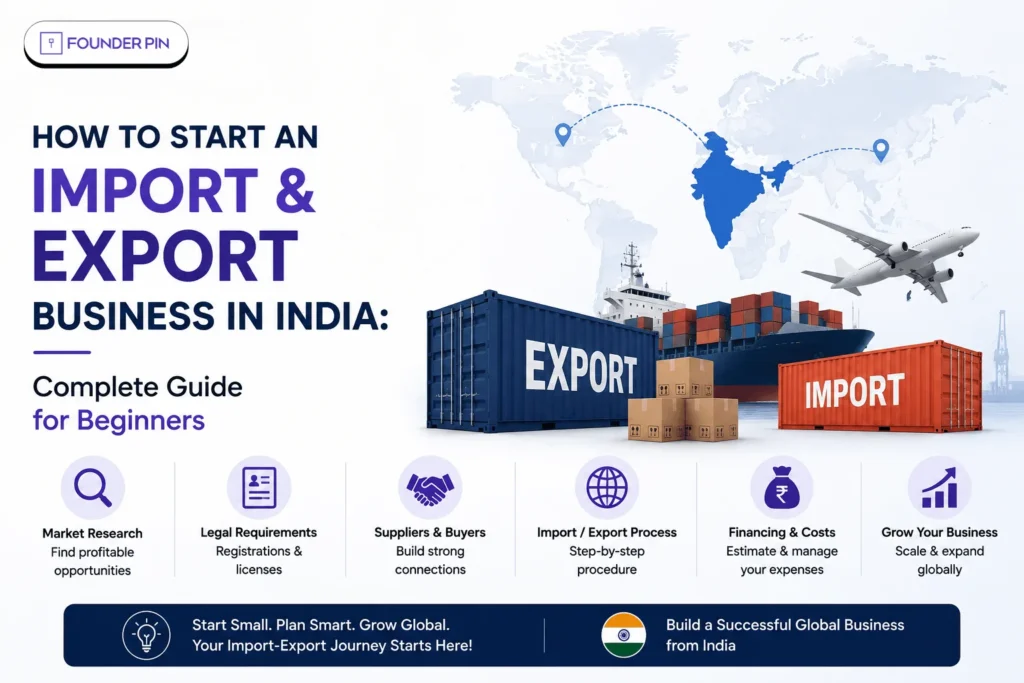
Anyone thinking about how to start an import and export business in India is usually chasing one of two things — selling Indian products overseas, or sourcing goods from other countries to bring in. And here’s the reassuring part: you don’t need a massive manufacturing setup to get into international trade.
You could go the merchant exporter route, become an importer, work as a manufacturer, or run things as a trading company instead. Either way, there’s no skipping the fundamentals — registrations, customs procedures, picking the right products, and building a supply chain you can actually rely on.
This guide walks through what starting an import-export business in India actually looks like — IEC registration, GST, the paperwork, customs, finding buyers, figuring out pricing, and the mistakes most beginners end up making along the way.
What Is an Import and Export Business?
At its core, an import and export business is about moving goods across borders — buying from foreign markets to sell in India, or selling Indian products to buyers overseas.
Think spices, textiles, handicrafts, engineering products, agricultural goods — Indian businesses export all of that to overseas buyers regularly. Go the other direction, and you’ve got machinery, components, electronics, and other permitted goods coming into India instead.
Generally, you’re looking at three ways to approach this:
- Export business: Selling Indian products to buyers abroad
- Import business: Buying from foreign suppliers and selling here in India
- Import-export trading: Doing both — sourcing internationally and selling overseas
If you’re just starting out, it’s usually a lot easier to pick one product and one target market rather than trying to juggle multiple products across several countries right out of the gate.
How to Start an Import and Export Business in India
At a high level, here’s what the process looks like: picking a business structure, choosing a product, researching your target market, getting an IEC, sorting out the relevant tax and product registrations, finding buyers or suppliers, arranging logistics, and handling customs paperwork.
Let’s walk through it step by step.
1. Choose a Business Structure
Start by getting your business set up legally. Depending on what makes sense for you, that could mean a sole proprietorship, partnership, LLP, One Person Company, or private limited company.
Your choice really comes down to things like ownership, liability, how much you’re investing, and whether you’re planning to grow this significantly down the line. DGFT’s export guidance recognizes all of these structures — proprietorships, partnerships, LLPs, OPCs, and companies.
You’ll also need a PAN and a current bank account set up specifically for business transactions.
If you’re still deciding what kind of business to start, you can also explore FounderPin’s guide to profitable startup business ideas in India before finalising your business model.
2. Select the Right Product
Product choice can genuinely make or break this whole venture.
Before settling on anything, dig into the international demand, the competition, sourcing costs, shipping costs, customs treatment, and whatever regulatory requirements apply.
Above all, nail down the correct HS code for your product. India’s trade policies use these tariff classifications to figure out what conditions apply — whether goods are freely tradeable, restricted, or subject to something more specific.
One word of caution: don’t pick a product just because someone tells you it has “high demand.” Actually verify that demand yourself, and run the full cost math before putting money into it.
How Do You Choose the Right Product for International Trade?
Don’t start with paperwork. Start with the product. A product with strong demand, manageable logistics and healthy margins gives you a much better foundation.
Before committing money, evaluate:
- Demand: Are buyers actually looking for the product?
- Competition: How many suppliers already serve the market?
- Margins: Can you make money after freight, duties, insurance and other costs?
- Shelf life: Is the product perishable?
- Regulation: Does the product require special licences or certifications?
- Shipping: Is it expensive or complicated to transport?
- Market access: Are there restrictions in the destination country?
A beginner should avoid choosing a product simply because it is popular on social media. International trade has a habit of turning “trending product” into “expensive warehouse inventory” very quickly.
If you’re looking for other low-investment business opportunities before committing to international trade, check out our guide to best startup business ideas in India for 2026.
3. Obtain an Importer Exporter Code (IEC)
The IEC is probably the single most important requirement when you’re starting out.
According to DGFT, an IEC is mandatory for both imports and exports, unless a specific exemption applies to you. It’s tied to your business PAN and gets issued through the DGFT system directly.
You can apply online through DGFT, and the official fee schedule lists ₹500 for the application.
How do you get an IEC?
The application is made online through DGFT.
At a high level, the process involves:
- Creating or accessing your DGFT account.
- Providing the required business and PAN information.
- Completing the IEC application.
- Uploading the required information/documents.
- Paying the applicable government fee.
- Receiving the IEC after processing.
DGFT documentation states that the IEC application process is online.
Important: Check the current DGFT portal and applicable rules before applying because procedures and fees can change.
One thing worth flagging: don’t mix up an IEC with a GSTIN. They’re not the same thing — they serve completely different regulatory purposes.
4. Register for GST and File LUT for Exports
GST compliance is another piece you can’t skip if you’re exporting.
Under India’s GST framework, exports count as zero-rated supplies. If you’re eligible, you can file a Letter of Undertaking (LUT) through the GST portal, which lets you export without paying IGST upfront — the process runs through Form GST RFD-11.
Your exact obligations here can shift depending on your specific business model and transactions, so it’s worth double-checking current rules before you start shipping commercially.
5. Check Product-Specific Licences
Not every product plays by the same rules.
Food, agricultural products, pharmaceuticals, chemicals, plants, animal products, electronics, and a handful of other regulated categories may need extra registrations, licences, certificates, or approvals on top of the basics.
Agricultural and food exporters, for instance, might need sign-off from relevant authorities depending on the specific commodity. And restricted products can require separate DGFT authorization too.
Bottom line: always check the HS code and the applicable product policy before you commit to an order.
What Documents Are Required for Import and Export?
For every shipment, there’s a set of documents you’ll need to have in order:
Commercial Invoice
This is the detailed invoice covering the seller, buyer, product description (with HS code), quantity, value, Incoterm, currency, and bank/payment terms. Here’s roughly what it looks like:
| Description | Example |
|---|---|
| Invoice No/Date | INV-001, 01 Sep 2026 |
| Seller (Exporter) | XYZ Exports Pvt Ltd, Delhi |
| Buyer (Consignee) | ABC Importers Ltd, London, UK |
| Product | Hosiery Socks, HS 611597 (under ITC-HS) |
| Qty/Unit | 1,000 pairs |
| Unit Price (USD) | $2.00 |
| Total Value (USD) | $2,000.00 |
| Incoterm | FOB Mumbai |
| Payment Terms | Irrevocable LC at sight (confirmed) |
Packing List
This one itemizes what’s actually in each package — net and gross weight, dimensions, packaging details. Customs and the consignee both rely on it to verify the cargo matches what’s declared.
Shipping Bill (Export) / Bill of Entry (Import)
These are electronic declarations filed through ICEGATE, the customs e-filing portal. The shipping bill (sometimes called a Bill of Export) is mandatory for clearing exports through customs, and it includes contract details, HS codes, duty or tax paid, and any exemption claims.
Bill of Lading (Sea) or Airway Bill (Air)
Issued by the carrier or freight forwarder, these documents prove the cargo’s actually been loaded onto a vessel or aircraft — and they double as title documents, since they’re negotiable. The commercial invoice and packing list get attached to these.
Certificate of Origin
Issued by the relevant chamber of commerce or a DGFT-authorised agency, this certifies where the goods actually came from. Overseas buyers often need it for preferential tariffs or trade agreement benefits.
Insurance Certificate
Covers marine cargo insurance. It’s optional, but honestly worth having for anything shipping internationally.
E-SANCHIT Documentation
ICEGATE’s e-SANCHIT portal lets you digitally upload and store shipping documents — invoices, certificates, licences, all of it. Indian customs is increasingly requiring this filing method.
Bank Realisation Certificate (BRC/e-BRC)
Once payment comes through, your bank issues a BRC (now sent electronically to DGFT as an e-BRC). This confirms you’ve actually received the foreign exchange for that shipment, and you’ll need it to claim export benefits and refunds.
Other Forms
Depending on the situation, you might also need a Packing Credit declaration (if you’re using export credit), specific certificates like Fumigation or Halal, or whatever else a particular buyer requests.
Quick checklist: Make sure your IEC number appears on every export document. Double-check the HS (ITC-HS) code for each product — DGFT’s ITC-HS manual classifies goods under the Export Schedule, and depending on classification, items can be “Free” (no licence needed) or “Restricted” (requiring a DGFT licence).
DGFT’s customs guidance highlights IEC, ICEGATE registration, customs declarations, GST-related requirements and other regulatory approvals as important parts of the import process.
Documentation becomes even more important as a business grows. Founders can also review our guide to 20 legal documents every startup in India needs to understand the broader legal foundation behind running a business.
How to Find International Buyers and Suppliers
Finding reliable trading partners is just as important as completing registrations.
For exports, you can find potential buyers through:
- B2B marketplaces
- Trade fairs and exhibitions
- Export Promotion Councils
- Industry associations
- LinkedIn outreach
- Distributor networks
- Government trade resources
- Direct email outreach
For imports, compare multiple overseas suppliers instead of depending on a single vendor.
Before placing a large order, verify the company’s identity, business history, certifications, references, payment terms, and product quality. Start with samples whenever practical.
How Does Customs Work in India?
Customs works quite differently depending on whether you’re importing or exporting.
For exports:
- You (or a customs intermediary working on your behalf) submit a Shipping Bill along with supporting information through the customs system
- ICEGATE handles this electronically, covering Shipping Bills and related customs messages
For imports:
- The importer files a Bill of Entry and goes through the applicable assessment and payment process
- Under Section 46 of the Customs Act, importers generally need to make an electronic entry through the customs automated system, though there are specified exceptions
On import costs:
- Imports can involve Basic Customs Duty, IGST, and other applicable levies or charges
- The exact amount depends on the product’s classification, its valuation, where it’s coming from, any exemptions, and whatever current notifications apply
One important reminder: Don’t ever estimate your import duty using some generic percentage you found online. Check the actual current tariff and the relevant customs notifications for your specific HS code instead.
How to Calculate Import-Export Business Costs
Here’s something a lot of beginners miss: profitability comes down to the total landed or delivered cost, not just what you paid for the product itself.
For exports, you’re looking at:
Product Cost + Packaging + Inland Transport + Documentation + Freight + Insurance + Banking Costs + Other Charges + Profit Margin
For imports, the math looks like this:
Supplier Price + Freight + Insurance + Customs Duty + IGST + Port Charges + Customs Clearance + Local Transport + Warehousing = Landed Cost
Running these numbers is really the only way to know whether a product’s actually worth pursuing.
Take a product priced at ₹500 from an overseas supplier, for instance. On paper, that looks like a great deal — until freight, customs duties, taxes, clearance fees, and domestic transport all stack up and push the real landed cost a lot higher than that ₹500 sticker price ever suggested.
How Do You Receive and Make International Payments?
International transactions require clear payment terms.
Common Payment Methods in International Trade
- Advance Payment (T/T – Telegraphic Transfer): The buyer makes the payment before the goods are shipped. This offers the highest level of security to the exporter but can be harder to agree on, especially with a new buyer.
- Letter of Credit (LC): The buyer’s bank provides a payment undertaking to the seller, with payment made when the exporter submits the documents specified in the LC. It offers a relatively balanced level of protection and is commonly used for high-value international transactions.
- Documents Against Payment (DP): After shipping the goods, the exporter sends the required documents through the buyer’s bank. The buyer receives the documents only after making the full payment.
- Documents Against Acceptance (DA): The buyer accepts a bill of exchange promising to pay at an agreed future date. The shipping documents are released before payment, which means the exporter takes on greater credit risk.
- Open Account: The exporter ships the goods first and allows the buyer to pay later, usually according to agreed invoice terms. This method is generally used between established trading partners with a strong level of mutual trust.
Don’t focus only on the headline product price. Currency movements, bank charges, payment delays and transaction risks can affect your final margin.
For larger orders, consider appropriate trade-finance and risk-management options with your bank.
What Is the Role of an AD Code?
An Authorised Dealer (AD) Code connects an exporter’s bank account with customs-related processes and foreign-exchange transactions.
Your bank provides the relevant AD Code information, and the required customs registration depends on the applicable port and current procedures.
Because banking, customs, and foreign-exchange compliance are connected, discuss your export setup with your authorised dealer bank before your first commercial shipment.
Export Benefits and Government Schemes
- Eligible exporters may benefit from government schemes designed to neutralise certain embedded duties and taxes, or to boost overall export competitiveness
- Depending on the product and current policy, relevant schemes can include:
- RoDTEP
- Duty Drawback
- Advance Authorisation
- EPCG
- However, eligibility and rates can change over time — DGFT’s EPCG framework, for instance, provides specified import benefits on capital goods, subject to export obligations and scheme conditions
- Always check the latest DGFT notification before factoring any incentive into your business’s financial projections
7 Important Facts About Starting an Import-Export Business
Here are some facts beginners should remember:
- IEC is generally mandatory for India’s merchandise imports and exports, subject to exemptions.
- IEC applications are handled online through DGFT.
- The official IEC application fee is ₹500 under DGFT’s fee schedule.
- Eligible exporters can file an LUT through the GST portal for exports without upfront IGST payment.
- HS classification directly affects trade compliance, so product classification should happen before pricing or shipping.
- ICEGATE supports electronic customs filing for documents such as Shipping Bills and Bills of Entry.
- Import tax and customs costs vary by product, so businesses should check the current tariff rather than rely on generic duty percentages.
Common Import-Export Business Mistakes to Avoid
Many beginners focus on finding customers but overlook compliance.
Avoid these mistakes:
- Choosing products without checking HS codes
- Ignoring destination-country regulations
- Underestimating freight and customs costs
- Shipping before verifying the buyer
- Accepting risky payment terms
- Using incorrect product descriptions on documents
- Ignoring product-specific licences
- Forgetting to account for currency fluctuations
- Depending on outdated information about duties or incentives
A profitable shipment starts with good research, not just a good-looking purchase order.
Final Checklist: How to Start an Import and Export Business in India
Stepwise Setup Checklist:
- Register business entity (select entity, file with MCA or registrar).
- Obtain PAN and GSTIN in that name.
- Open business bank account; get Digital Signature (for filings).
- Apply for IEC online on DGFT portal.
- Register with EPC (RCMC) for your product sector.
- Identify products and markets (HS code search, demand analysis).
- Establish supply chain (source/manufacture products, quality control).
- Arrange logistics and warehousing (decide freight forwarder, storage).
- Develop sample/marketing material, finalize pricing & Incoterms.
- Find buyers and negotiate contracts (LCs or secure payments).
- Book shipment and file Shipping Bill via ICEGATE (with invoices, packing list).
- Send goods & follow up (track shipment, ensure delivery).
- Collect payment (via LC/TR) and obtain e-BRC from bank.
- Claim export incentives (drawback/RODTEP) if eligible.
Conclusion
You don’t need to become an international-trade expert overnight to figure out how to start an import and export business in India. Honestly, the smarter approach is starting small — one product, one market, and a solid grip on your actual costs and compliance requirements before you scale anything up.
The steps that matter most: getting the right registrations sorted, nailing down the correct HS code, checking product-specific regulations, finding trading partners you can actually trust, putting together accurate documentation, and working out the real cost of every single shipment — not just the headline price.
Before you make that first commercial transaction, it’s worth double-checking the latest rules directly through DGFT, ICEGATE, GST Portal, and RBI. Trade regulations, duties, and scheme conditions shift often enough that it’s not worth assuming last year’s rules still apply.
Frequently Asked Questions
Is an IEC mandatory for an import-export business in India?
Yes. DGFT states that an IEC is mandatory for imports and exports unless the transaction falls under a specified exemption.
Can I start an import-export business as a sole proprietor?
Yes. A sole proprietorship is one of the business structures recognised in DGFT’s export guidance.
How much money is needed to start an import-export business in India?
There is no single fixed investment amount. Your requirement depends on the product, inventory, order size, packaging, freight, compliance, marketing, and payment cycle.
A merchant exporter working against confirmed orders may require considerably less working capital than a business importing and holding inventory.
Is GST required for export business?
GST requirements depend on the nature and structure of your business and transactions. Exporters should understand their GST registration, return-filing, input-tax-credit, LUT, and refund obligations before beginning commercial exports.
Which products are best for an export business?
There is no universally “best” export product. Look for products with proven international demand, competitive Indian sourcing, manageable logistics, acceptable margins, and straightforward compliance.
SHARE