The New Era of AI Employees and Virtual Teams
Table of Contents
Toggle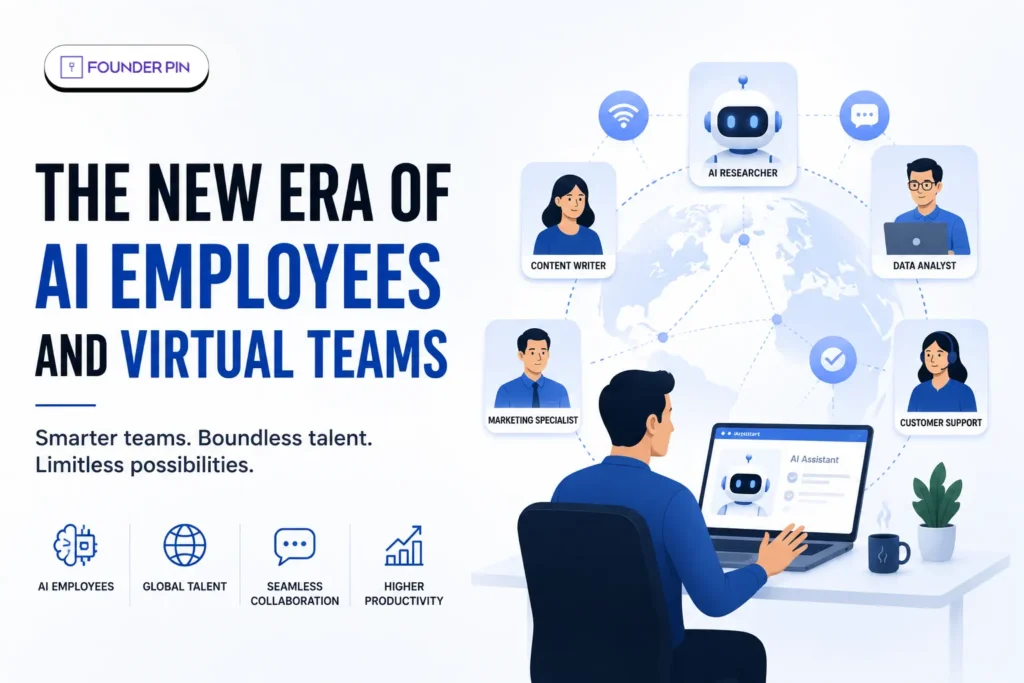
Key Takeaways
- AI Employees help businesses automate tasks and improve productivity.
- Virtual AI employees can support customer service, marketing, research, and operations.
- Startups can grow faster with AI while keeping teams lean and costs low.
- The future workplace will combine human talent with an AI workforce.
- Businesses that adopt AI early can gain a strong competitive advantage.
Introduction
For decades, business growth was closely tied to hiring more people. As companies expanded, they built larger teams to manage operations, customer support, marketing, sales, and administration.
Today, that traditional model is evolving.
Artificial intelligence is introducing a new category of workers known as AI Employees. These intelligent systems can perform tasks, automate workflows, and support business operations around the clock. Combined with remote collaboration tools, they are helping create virtual teams that operate faster, leaner, and more efficiently than ever before.
As AI technology continues to advance, businesses of all sizes are exploring how AI employees can become an essential part of their workforce strategy.
What Are AI Employees?
AI Employees are software-based systems designed to perform specific business functions traditionally handled by humans.
Unlike simple automation tools, modern AI employees can:
- Analyze information
- Communicate with customers
- Generate content
- Manage workflows
- Perform research
- Assist with decision-making
These systems can operate continuously without requiring breaks, making them valuable assets for modern businesses.
Rather than replacing every human role, AI employees are increasingly acting as digital teammates that enhance productivity and efficiency.
Reasons for Business Organizations to Use an AI Workforce
Business organizations are using AI workers to increase productivity, cut down cost, and scale up operations without having to hire many people. Through the use of AI, tasks are automated, data is analyzed, and good customer experience is provided.
1. Increased Productivity
The automation of tasks such as data entry, writing of documents, and management of workflow enables employees to undertake other important business tasks.
2. Cut Down Operating Costs
Companies are able to scale up without having to increase their labor force, thereby cutting down the cost of hiring, training, and employee benefits.
3. Improved Decision-Making Processes
AI analysis of huge data within a very short period of time enables businesses to identify and capitalize on business trends and customer behavior.
4. Continuous Customer Support
Unlike human labor forces, AI does not have downtime; it responds immediately to customer queries and support requests 24 hours a day.
Also Read | Community-Driven Business: Why Small Communities Are Becoming Big Businesses
How Virtual AI Employees Support Modern Teams
Virtual AI employees are transforming the workplace by acting as digital coworkers that automate repetitive tasks, streamline workflows, and provide round-the-clock support. By handling routine responsibilities, they allow employees to focus on strategic planning, creativity, and complex decision-making.
Here are some of the key ways virtual AI employees support modern teams.
1. Meeting Management and Collaboration
AI assistants make meetings more productive by automating administrative tasks.
- Generate real-time meeting transcripts and summaries.
- Identify action items and assign tasks automatically.
- Schedule meetings across different time zones with ease.
2. HR and Employee Support
AI simplifies many human resource functions and improves the employee experience.
- Answer employee questions about company policies, benefits, and leave.
- Assist with recruitment by screening candidates and scheduling interviews.
- Monitor employee feedback to help HR improve engagement and workplace satisfaction.
3. Software Development and IT Operations
Virtual AI employees help technical teams work more efficiently.
- Detect coding errors and recommend improvements.
- Monitor systems and automatically respond to technical issues.
- Prioritize and assign IT support tickets, allowing engineers to focus on critical tasks.
4. Learning and Knowledge Management
AI makes onboarding and knowledge sharing faster and more effective.
- Organize company information so employees can find answers quickly.
- Help new team members learn processes and complete onboarding faster.
- Continuously improve through feedback and support team collaboration.
Virtual AI employees help businesses increase productivity, improve collaboration, and reduce manual work. As AI technology continues to evolve, these digital coworkers are becoming valuable partners that enable teams to work smarter and achieve better results.
Virtual Employees: The Future of Digital Work
| Feature | Chatbot | AI Agent | Virtual Employee |
|---|---|---|---|
| Purpose | Answers questions | Completes tasks | Runs business workflows |
| Autonomy | Low | High | Very High |
| Tasks | Simple tasks | Complex tasks | End-to-end operations |
| Role | Customer support | Decision maker | Digital coworker |
| Example | Website FAQ bot | AI scheduling assistant | AI onboarding manager |
The Rise of Hybrid Teams
Humans and AI Working Together
The future workplace is unlikely to consist entirely of humans or entirely of AI.
This shift is being accelerated by the emergence of AI agent startups, which are building autonomous systems capable of handling increasingly complex business tasks.
Instead, businesses are moving toward hybrid teams where human talent and AI systems collaborate.
Human employees contribute:
- Creativity
- Emotional intelligence
- Leadership
- Strategic thinking
AI employees contribute:
- Speed
- Automation
- Data processing
- Consistency
This combination often produces better outcomes than either working alone.
Augmentation, Not Replacement
Successful organizations view AI as a productivity enhancer rather than a complete replacement for human workers.
The goal is to augment human capabilities, not eliminate them.
Industries Leading the AI Workforce Revolution
Technology and SaaS
Technology companies are among the earliest adopters of AI workforce solutions.
AI assists with:
- Software development
- Customer onboarding
- Product support
- Analytics
E-Commerce
Online businesses use AI employees to manage:
- Customer interactions
- Product recommendations
- Inventory insights
- Marketing automation
Professional Services
Consulting, legal, and financial firms increasingly use AI for research, document preparation, and administrative workflows.
Opportunities Across Every Sector
Virtually every industry can benefit from AI employees in some capacity.
The question is no longer whether AI will be adopted, but how effectively businesses will implement it.
How to Successfully Onboard a Virtual Employee
Bringing a virtual employee into your business requires careful planning. By following a structured approach, you can improve productivity, automate repetitive tasks, and help your team focus on higher-value work.
1. Identify Tasks to Automate
Start by finding repetitive and time-consuming tasks that can be automated. This allows your team to spend more time on strategic activities while improving overall efficiency.
2. Set Clear Goals
Define the purpose of your virtual employee and establish measurable objectives. Clear goals help ensure the AI delivers results that support your business priorities.
3. Choose the Right Platform
Select an AI platform that fits your business needs, budget, and future growth plans. Look for features such as security, ease of use, scalability, and system integrations.
4. Train Your Virtual Employee
To maximize performance:
- Map out each workflow clearly.
- Connect the AI to relevant databases and business systems.
- Configure rules and automation logic based on your processes.
5. Test Before Deployment
Run a pilot program to evaluate the virtual employee’s performance. Resolve any issues before rolling it out across the organization.
6. Monitor and Improve
After deployment, continuously monitor performance, update workflows, and refine automation rules to keep your virtual employee effective as your business grows.
Risks and Challenges of Virtual Employees
While virtual employees improve efficiency, businesses should also be aware of potential challenges.
Data Privacy
Protect sensitive business and customer data by implementing strong security measures and conducting regular system audits.
Bias and Fairness
AI systems may unintentionally produce biased outcomes. Regular monitoring, diverse datasets, and transparent processes help reduce this risk.
Skills Gap
Employees may need training to work effectively alongside AI. Investing in upskilling and clear communication helps teams adapt more easily.
Best Practices for Success
- Invest in employee training and AI education.
- Build cross-functional teams to manage AI implementation.
- Gather regular feedback and continuously improve AI workflows.
- Review performance regularly to ensure the virtual employee continues to deliver value.
Conclusion
The rise of AI Employees represents one of the most significant shifts in modern business operations. From customer support and marketing to research and administration, AI workforce solutions are helping companies become more productive, scalable, and cost-efficient.
For startups, virtual AI employees offer an opportunity to achieve rapid growth without building large teams. For established organizations, they provide a pathway toward greater operational efficiency and innovation.
The future of work is not simply human or artificial—it is a collaboration between both. Companies that embrace this transformation early will be best positioned to thrive in the next era of business.
Contact FounderPin for Startup Growth and AI Strategy Support
Understanding how to integrate AI employees into your business can create significant competitive advantages.
At FounderPin, we help startups and growing businesses develop scalable strategies, improve operational efficiency, and prepare for future growth.
Contact us for a consultation today and discover how AI-powered business models can accelerate your success.
What are AI Employees?
AI Employees are intelligent software systems designed to perform tasks that traditionally required human workers. They can handle customer support, content creation, research, data analysis, and workflow automation. Businesses use AI employees to improve efficiency, reduce costs, and operate continuously without the limitations of traditional work schedules.
How can AI employees help startups?
AI employees help startups achieve more with limited resources. They can automate repetitive tasks, support customer service, create marketing content, and analyze business data. This allows founders to focus on growth and strategy while reducing operational costs and extending the startup’s financial runway.
What is an AI workforce?
An AI workforce refers to a network of AI-powered tools, virtual assistants, and intelligent agents working alongside human employees. These systems can manage various business functions, improve productivity, and streamline operations. Many companies are adopting AI workforce solutions to remain competitive in an increasingly digital economy.
Can virtual AI employees replace human workers?
Virtual AI employees can automate routine and repetitive tasks, but they cannot fully replace human creativity, leadership, emotional intelligence, and strategic decision-making. The most effective business model is often a hybrid approach where humans and AI collaborate to maximize productivity and business performance.
What is the future of AI employees and virtual teams?
The future of work is expected to combine human talent with AI-powered virtual teams. Businesses will increasingly use AI employees for operational tasks while human employees focus on innovation, customer relationships, and strategic planning. This shift will help organizations become more agile, scalable, and efficient.
SHARE