The Creator Economy vs Traditional Businesses: Which Model Wins in 2026?
Table of Contents
Toggle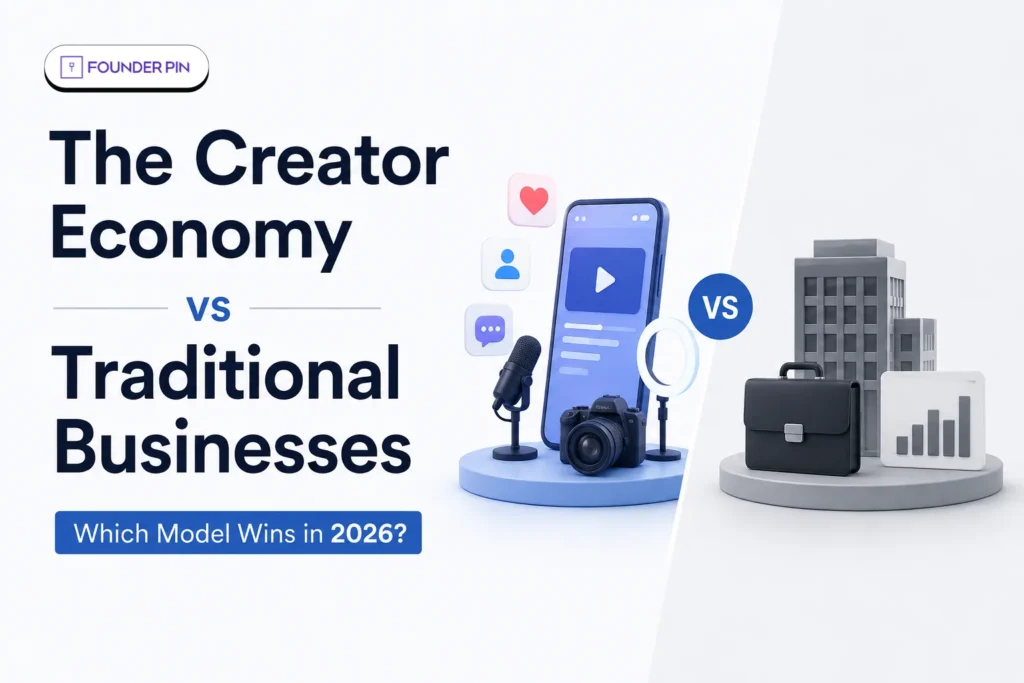
Key Takeaways
- The creator economy allows individuals to build businesses with low startup costs and global reach.
- Traditional businesses offer greater scalability, stability, and long-term asset creation.
- Creators benefit from flexibility and personal branding, while traditional businesses rely on structured operations.
- Regarding growth and profitability, each model has particular benefits and difficulties.
- The future belongs to hybrid businesses that combine audience-building with scalable products and services.
Introduction
The way people build businesses is changing rapidly. A decade ago, entrepreneurship usually meant opening a store, launching a company, or building a team. With a laptop, creators can now develop audiences, make money, and build international businesses.
This shift has sparked an important discussion: creator economy vs traditional businesses. While traditional businesses continue to dominate many industries, the creator economy has opened entirely new opportunities for individuals to monetize their skills, expertise, and content.
Understanding the strengths and limitations of both models can help entrepreneurs choose the right path for long-term success.
What Is the Creator Economy?
Understanding the Creator Economy
The creator economy refers to an ecosystem where individuals earn income by creating content, building communities, and monetizing audiences across digital platforms.
Creators generate revenue through:
- Sponsorships
- Brand partnerships
- Digital products
- Membership communities
- Online courses
- Affiliate marketing
- Advertising revenue
Unlike traditional businesses, creators often begin with a personal brand rather than a product or physical infrastructure. This trend closely aligns with the growing movement of professionals becoming solopreneurs and building independent businesses.
Why the Creator Economy Is Growing
Several factors have fueled the growth of the creator economy:
- Social media accessibility
- Low startup costs
- Global audience reach
- AI-powered content tools
- Increased demand for authentic content
As a result, creators can now compete with established businesses in ways that were impossible just a few years ago.
According to MIDiA Research’s analysis of the creator economy, creators are increasingly reshaping how audiences discover, consume, and engage with content globally.
What Is a Traditional Business?
The Traditional Business Model
Traditional businesses operate by selling products or services through structured organizations.
Examples include:
- Retail stores
- Manufacturing companies
- Consulting firms
- Restaurants
- Technology companies
- Service agencies
These businesses typically require employees, operational systems, inventory management, and significant capital investment.
Why Traditional Businesses Still Matter
Despite the rise of digital entrepreneurship, traditional businesses remain the backbone of most economies.
They often provide:
- Stable revenue streams
- Greater scalability
- Long-term asset creation
- Stronger market defensibility
Many of the world’s largest companies still operate using traditional business models.
Creator Economy vs Traditional Businesses
The creator economy is a rapidly growing ecosystem where individuals earn income by building audiences, creating content, and developing strong online communities. Unlike traditional businesses, which focus heavily on products and large-scale marketing, creator-led businesses thrive on personal branding, audience trust, and direct engagement with followers.
Key Differences Between the Creator Economy and Traditional Businesses
| Feature | Creator Economy | Traditional Business |
|---|---|---|
| Core Asset | Personal brand, audience trust, and community loyalty | Intellectual property, inventory, and physical assets |
| Marketing Approach | Organic content, recommendations, and community engagement | Paid advertising, public relations, and mass marketing |
| Customer Relationship | Direct interaction with followers and customers | Interactions through retailers, sales teams, or intermediaries |
| Trust Factor | Built through authentic and personal connections | Built through brand reputation and corporate credibility |
Major Differences in Business Models
Audience First vs Product First
Traditional businesses usually develop products before attracting customers. In contrast, creators often build an audience first through valuable content and then monetize that audience through products, courses, memberships, sponsorships, or merchandise.
Greater Flexibility and Speed
Creator-led businesses operate with smaller teams and fewer layers of management. This allows them to test ideas quickly, launch products faster, and adapt to changing trends more efficiently than traditional organizations.
Identity-Driven Brands
Conventional businesses frequently concentrate on the qualities and advantages of their products. Creator businesses, however, sell a lifestyle, identity, or sense of belonging. As a result, creators can successfully expand into multiple product categories while maintaining strong audience loyalty.
Why the Creator Economy Is Growing
As social media platforms continue to expand, creators can build direct relationships with their audiences without relying on traditional gatekeepers. This direct connection gives creators a unique advantage, allowing them to launch businesses, influence purchasing decisions, and build highly engaged communities at scale.
Which Model Is More Profitable?
Creator Economy Profit Potential
The creator economy provides ample revenue sources. Why?
A successful creator is able to generate revenue from several sources at once.
For example:
- Content monetization
- Coaching programs
- Digital products
- Community memberships
- Sponsorship deals
Despite not having the management of an extensive team, a single creator could generate revenue similar to launching or operating a business. The rise of AI and digital tools has even sparked discussions around the possibility of a one-person billion-dollar company.
Traditional Business Profit Potential
Traditional businesses are often limited in their long-term revenue.
However, traditional businesses can generate significant recurring revenue with the help of scalable systems, employees, and operational infrastructure.
When they scale, the valuations of these companies often exceed that of most individual creators.
The Role of Personal Branding
Why Creators Have an Advantage
In today’s digital world, trust is increasingly built through individuals rather than institutions.
Consumers often prefer learning from people they follow rather than corporate advertisements.
This gives creators a unique advantage in building relationships with audiences. Many successful creators are effectively building community-driven businesses where engagement becomes a competitive advantage.
Why Traditional Businesses Are Adapting
Many companies now encourage founders and executives to become public-facing personalities.
The success of founder-led brands demonstrates how traditional businesses are increasingly adopting creator economy principles.
The future may not be creator economy versus traditional business—it may be a combination of both.
Challenges of the Creator Economy
Platform Dependence
Websites such as YouTube, Instagram, LinkedIn, and TikToak are frequently used by creators.
Changing algorithms can result in significant changes to their visibility and revenue.
Income Volatility
Depending on the audience, sponsorship opportunities, and platform’s success, creators may receive different amounts of money.
Creating predictable revenue often requires diversification.
Burnout Risks
Creating content demands both consistency and creativity.
Several writers are forced to produce new material on a regular basis to ensure their relevance.
Challenges of Traditional Businesses
Higher Operational Costs
More capital and resources are typically required to maintain traditional businesses.
Slower Decision-Making
With the expansion of organizations, decision-making can become more complex and slower. Why?
Increased Competition
Traditional industries are often vying with both established and emerging digital-first businesses for market share.
The Future: Hybrid Business Models
The Best of Both Worlds
The most successful entrepreneurs increasingly combine creator economy strategies with traditional business models.
Examples include:
- Founders building personal brands
- Businesses creating content communities
- Experts launching digital products
- Companies leveraging creator partnerships
This hybrid approach allows businesses to build trust while maintaining scalable operations.
Why Hybrid Models Will Dominate
In the future, audience ownership may become as important as product ownership.
Businesses that combine strong branding, community engagement, and operational excellence are likely to outperform competitors. Many of these businesses are also leveraging AI employees and virtual teams to scale operations more efficiently.
Conclusion
The debate around creator economy vs traditional businesses is not about determining a single winner.
Both models offer unique advantages.
The creator economy provides accessibility, flexibility, and rapid audience growth. Traditional businesses provide operational stability, long-term asset creation, and scalability.
For modern entrepreneurs, the biggest opportunity may lie in combining both approaches. Building an audience while creating scalable products or services can provide the best foundation for sustainable growth in 2026 and beyond.
Contact FounderPin for Expert Business Guidance
Whether you’re building a creator-led brand, launching a startup, or scaling a traditional business, having the right strategy is essential.
At FounderPin, we help entrepreneurs with startup growth, business planning, fundraising preparation, and scaling strategies.
Contact us for a consultation today and discover the best path for your business growth journey.
Frequently Asked Questions About Creator Economy vs Traditional Businesses
What is the difference between the creator economy and a traditional business?
The creator economy is built around individuals monetizing content, audiences, and personal brands through digital platforms. Traditional businesses generate revenue by selling products or services through structured operations, employees, and established business systems.
Is the creator economy more profitable than traditional businesses?
Profitability depends on the business model and execution. The creator economy offers low startup costs and multiple income streams, while traditional businesses often provide greater scalability, recurring revenue, and long-term asset creation.
Can creators build sustainable businesses?
Yes. Many creators build sustainable businesses by diversifying income through sponsorships, digital products, memberships, consulting, and online courses. Successful creators focus on audience ownership rather than relying solely on platform-generated revenue.
Why are traditional businesses adopting creator economy strategies?
Traditional businesses are increasingly using personal branding, content marketing, and community-building to strengthen customer relationships. These creator economy tactics help businesses improve trust, visibility, and customer engagement in competitive markets.
What is the future of the creator economy vs traditional businesses?
The future is likely to be a hybrid model. Entrepreneurs who combine audience-building, personal branding, and scalable products or services can benefit from the strengths of both the creator economy and traditional business models.
SHARE