
CRED Success Story: How did Kunal Shah started Cred
Table of Contents
Toggle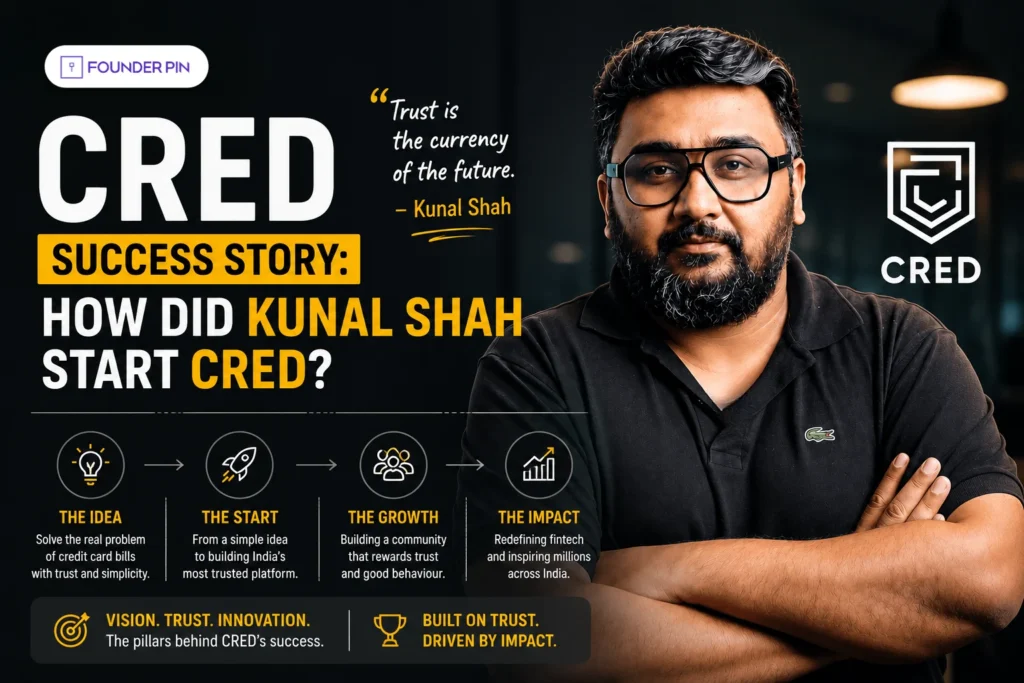
Key Takeaways
- CRED was founded by Kunal Shah in 2018 to reward users for paying credit card bills on time.
- CRED reported ₹2,735 crore revenue in FY25, up 16% year-on-year.
- The company succeeded by targeting financially responsible consumers and building a premium fintech brand.
- CRED now offers lending, payments, and other financial services in addition to bill payment.
- Kunal Shah’s deep understanding of consumer behavior played a major role in CRED’s growth.
- In 2026, Kunal Shah further strengthened his global reputation by becoming the CEO of WhatsApp, highlighting his influence in the technology industry.
Introduction
The Indian startup ecosystem has produced several unicorns, but few have generated as much curiosity as CRED. Launched in 2018 by entrepreneur Kunal Shah, CRED transformed a simple idea—rewarding people for paying credit card bills on time—into one of India’s most talked-about fintech platforms.
Today, CRED serves millions of users and has expanded far beyond credit card payments. The CRED success story is a powerful example of how understanding consumer behavior can create entirely new business opportunities.
This article will discuss the origins of CRED, the company’s mission, its growth trajectory, its business model, its difficulties, and the lessons that entrepreneurs may take away from Kunal Shah CRED.
Who Is Kunal Shah?
The Entrepreneur Behind CRED
Before launching CRED, Kunal Shah had already built a strong reputation as an entrepreneur. His career path also inspires many aspiring founders who are exploring the rise of solopreneurship and independent business building.
In 2010, he founded FreeCharge, a digital payments platform that quickly became popular across India. As a result, the company experienced rapid growth in the digital payments market.
Later, in 2015, Snapdeal acquired FreeCharge for approximately $400 million. This deal became one of the largest startup acquisitions in India at the time.
After the acquisition, Shah spent several years studying consumer behavior, financial services, and digital payments. During this period, he identified a major gap in the market.
Consequently, this research led him to launch CRED, a platform designed to reward financially responsible credit card users.
Kunal Shah Becomes WhatsApp’s Global CEO in 2026
In 2026, Kunal Shah achieved another major milestone in his career when he was appointed as the global CEO of WhatsApp by Meta. The appointment attracted worldwide attention and reinforced his reputation as one of India’s most influential technology entrepreneurs. After successfully building FreeCharge and transforming CRED into a leading fintech platform, Shah’s move to WhatsApp highlighted the growing global influence of Indian startup founders and business leaders.
This leadership transition positioned Kunal Shah among a select group of entrepreneurs who have successfully moved from building startups to leading one of the world’s largest technology platforms.
How CRED Started: The Story Behind India’s Premium Fintech Platform
Kunal Shah launched CRED in April 2018 with a unique vision. Unlike most fintech startups that targeted the mass market, CRED focused on India’s most financially responsible consumers. The Bengaluru-based platform initially welcomed only users with a credit score of 750 or higher, creating an exclusive community for premium credit card holders.
The Idea Behind CRED
Before founding CRED, Kunal Shah had already achieved success with FreeCharge, which Snapdeal acquired for $400 million in 2015. After the acquisition, Shah spent years studying consumer behavior, financial habits, and trust systems.
During this period, he identified a major gap in India’s financial ecosystem. While banks penalized customers for missed payments, they offered very few rewards for maintaining good financial discipline. Shah believed responsible users deserved recognition and incentives for their behavior.
He also applied his well-known Delta 4 Theory, which suggests that consumers permanently switch to a new product when it delivers a significantly better experience than existing alternatives. Since paying credit card bills through traditional banking portals often felt slow and inconvenient, Shah saw an opportunity to create a smoother and more rewarding solution.
Launching the First Version of CRED
When CRED launched in 2018, the app offered a simple proposition: users could pay their credit card bills on time and earn CRED Coins as rewards.
To maintain exclusivity, only individuals with a 750+ credit score could join the platform. Users earned one coin for every rupee paid toward their credit card bills. They could then redeem these coins for discounts, cashback offers, and premium experiences from lifestyle, travel, and dining brands.
The concept quickly attracted investor interest. Leading venture capital firms, including Sequoia Capital India (now Peak XV Partners) and Ribbit Capital, backed the company with significant early-stage funding.
Marketing That Captured Attention
Rather than relying solely on conventional advertising, CRED built its brand through memorable and unconventional marketing campaigns. The company created viral advertisements featuring well-known personalities and nostalgic themes that resonated with Indian audiences.
One of its most talked-about campaigns featured former cricketer Rahul Dravid in a humorous road-rage role, helping transform CRED from a simple bill payment app into a recognizable consumer brand.
Expanding Beyond Bill Payments
Many critics initially questioned whether rewarding users with points could become a sustainable business model. However, Shah had a much broader vision.
After building a trusted network of high-spending and financially disciplined users, CRED expanded into several new services:
- CRED RentPay: Enables users to pay rent using credit cards for a small convenience fee.
- CRED Cash: Offers instant personal credit solutions and became one of the company’s largest revenue drivers.
- CRED Pay: Provides a seamless one-click payment experience across partner merchant platforms.
From Startup to Unicorn
By focusing on trust, rewards, and premium customer experiences, CRED built a powerful fintech ecosystem. The company achieved unicorn status in 2021 and evolved from a simple credit card bill payment platform into one of India’s leading financial and lifestyle technology companies.
What Makes CRED Different?
Understanding Consumer Psychology
The biggest factor behind the CRED success story is Kunal Shah’s deep understanding of consumer behavior.
Rather than targeting the entire population, CRED focused on a specific group of financially disciplined consumers.
This allowed the company to build a strong premium brand and highly engaged community.
Exclusivity as a Growth Strategy
Most startups try to maximize access.
CRED did the opposite.
Initially, membership was limited to users with high credit scores, creating a sense of exclusivity and aspiration.
This strategy generated curiosity and strengthened brand perception.
Strong Brand Building
CRED’s marketing campaigns became famous for their creativity and humor.
The company partnered with celebrities, launched memorable advertisements, and built one of the most recognizable fintech brands in India.
CRED Funding, Valuation, and Financial Performance
According to Entracr report CRED recently secured a $900 million Series H funding round led by Meta, significantly strengthening its position in India’s fintech sector. Following the investment, the company’s post-money valuation reached $4.5 billion. As part of this transition, founder Kunal Shah stepped away from his CEO role to join Meta, while Miten Sampat assumed the position of interim CEO.
Funding and Valuation Highlights
Current Valuation
CRED now holds a post-money valuation of $4.5 billion (₹43,239 crore), with a pre-money valuation of approximately $4.03 billion.
Latest Funding Round
The company raised $900 million (₹8,550 crore) in its latest funding round led by Meta. The investment includes both primary capital and secondary share transactions.
Valuation Recovery
In 2025, CRED raised $72 million from its existing investors at a valuation of $3.64 billion, recovering from a lower valuation after reaching its peak valuation of $6.4 billion in 2022.
Meta’s Role as an Investor
Although Meta has become a minority shareholder in CRED, the company has confirmed that Meta will not receive access to any customer financial data or user information.
CRED Financial Performance in FY25
Revenue Growth
CRED reported operating revenue of ₹2,735 crore in FY25, representing a 16% year-on-year increase.
Reduced Losses
The company significantly improved its financial performance by reducing operating losses by 51%, bringing them down to ₹298 crore.
User Growth and Lending Scale
CRED now serves more than 17 million monthly active users. The platform processes over 40% of India’s credit card bill payments and manages more than ₹22,000 crore in Assets Under Management (AUM) through its lending partnerships.
These figures highlight CRED’s continued growth as it expands its fintech ecosystem and moves closer to long-term profitability.
Lessons Entrepreneurs Can Learn from the CRED Success Story
Solve an Overlooked Problem
CRED succeeded because it focused on a customer segment that many businesses ignored.
Build Around Trust
Trust remains one of the most powerful competitive advantages in financial services.
Think Long-Term
Kunal Shah consistently prioritized customer value and ecosystem development over immediate profits. These qualities are often highlighted when discussing what makes a founder investable to investors and venture capital firms.
Understand Human Behavior
Technology alone rarely creates great businesses. Understanding customer motivations often matters even more.
The Future of CRED
CRED continues to expand its financial ecosystem while exploring new products and services.
As digital payments, fintech adoption, and consumer credit usage continue to grow in India, the company is well-positioned to capture additional opportunities.
Industry observers believe CRED’s next phase may focus on deeper financial services integration, lending innovation, and AI-powered customer experiences.
Conclusion
The CRED success story demonstrates how a simple insight can become a multi-billion-dollar business when combined with strong execution, branding, and customer understanding.
By identifying an underserved consumer segment and building products around trust and rewards, Kunal Shah CRED transformed a niche idea into one of India’s most successful fintech startups.
For entrepreneurs, CRED serves as a reminder that the biggest opportunities often emerge from understanding customers better than anyone else.
Contact FounderPin for Startup Growth Support
Inspired by the CRED business story? Building a successful startup requires the right strategy, execution, and growth roadmap.
At FounderPin, we help founders with startup registrations, fundraising preparation, growth strategy, and business scaling.
Contact us for a consultation today and take the next step toward building your startup success story.
Frequently Asked Questions About the CRED Success Story
What is the CRED success story?
The CRED success story is about how Kunal Shah transformed a simple idea—rewarding users for paying credit card bills on time—into one of India’s most successful fintech startups. Since its launch in 2018, CRED has expanded into lending, payments, and financial services while achieving a multi-billion-dollar valuation.
How did Kunal Shah start CRED?
Kunal Shah founded CRED in 2018 after identifying a gap in the financial ecosystem. He realized that financially responsible consumers received little recognition despite being highly valuable customers. This insight led him to create a platform that rewards users for maintaining good credit behavior.
What makes CRED different from other fintech companies?
Unlike many fintech platforms that focus on transactions alone, CRED built a premium community around users with strong credit scores. Its focus on trust, exclusivity, rewards, and customer experience helped differentiate it from competitors and build a loyal user base.
How does CRED make money?
CRED generates revenue through financial products, lending services, merchant partnerships, payment solutions, and value-added services offered within its ecosystem. The company leverages its high-quality customer base to create business opportunities for financial institutions and brands.
What can entrepreneurs learn from the CRED business story?
Entrepreneurs can learn the importance of understanding consumer behavior, solving overlooked problems, building trust, and focusing on long-term value creation. The CRED success story demonstrates how a unique insight and strong execution can create a category-defining business.
SHARE