Founder Pin

Startup Guide

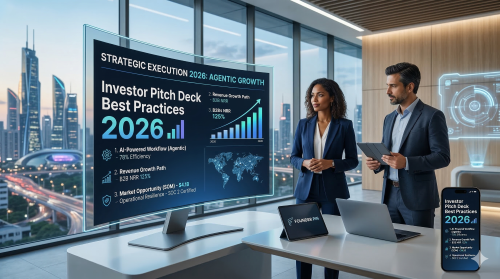
A futuristic 2026 office setting showing a digital "Investor Pitch Deck Best Practices 2026" presentation on a curved glass screen, featuring agentic workflow metrics, revenue growth charts, and the Founder Pin logo.
Funding, Pitch Deck, Startup Guide, Startup Insights & Ecosystem, VC

Investor Pitch Deck Best Practices 2026

Investor Pitch Deck Best Practices 2026: The Founder’s Guide to Winning the Round Investor Pitch Deck Best Practices 2026: The venture capital landscape of 2026 has officially moved past the “growth-at-all-costs” era and the “AI-experimentation” phase. Today, the market is defined by execution, agency, and efficiency. According to recent 2026 venture outlooks, capital is concentrating in fewer deals, but with higher intensity. Investors are no longer looking for “cool tools”—they are looking for category winners that can operate autonomously at scale. If your pitch deck still looks like it belongs in 2024, you’re not just outdated; you’re invisible. Here is the definitive guide to investor pitch deck best practices in 2026. 1. The 2026 “Visual Handshake”: Mobile-First or Fail In 2026, the first time an investor sees your deck won’t be in a boardroom. It will be on an iPhone 17 or a foldable tablet while they are in an Uber or between meetings. Responsive Design is Non-Negotiable: Your deck must be legible on a 6-inch screen. This means a minimum of 24pt to 30pt font for body copy. If an investor has to “pinch and zoom” to see your traction, you’ve already lost. The “Reading” vs. “Presenting” Deck: You need two versions. A Visual Deck (minimal text, heavy impact) for live calls, and a Reading Deck (self-explanatory, link-based) for the “leave-behind.” Move Beyond the PDF: High-growth founders are increasingly using web-based, scrollable formats (like Pitchwise or interactive Canva links). These allow you to track slide-level analytics: you can see exactly which slide an investor spent 2 minutes on and where they dropped off. 2. The “Agentic” Shift: Defining the New Value Prop In 2024, it was enough to say “We use AI.” In 2026, investors assume AI is like oxygen—it’s table stakes. The new differentiator is Agency. The “Execution Layer” Slide Investors want to see how your product moves from suggesting actions to executing them. Your solution slide must address: Autonomy: Can your AI agents handle workflows (like financial reconciliation or security remediation) without human prompts? Orchestration: How does your system manage multiple agents working together? Governance: In an AI-first world, trust is the moat. Include a slide on Operational Resilience and how you handle AI-driven risks and data privacy. 3. The 10-Slide Blueprint for 2026 While the narrative remains king, the “standard” order has evolved to prioritize proof over speculation. Slide 2026 Focus The “Hook” 1. Purpose Your “One-Sentence Handshake.” “We are the agentic operating system for [Industry].” 2. The Problem The “Operational Bottleneck.” Show the human/cost lag that only autonomous systems can fix. 3. Solution The “Agent-Native” approach. Show the product acting, not just thinking. 4. Why Now? The “Regulatory/Tech Window.” Why 2026? (e.g., New AI protocols, GPU cost drops). 5. Market Size “Winner-Takes-Most” potential. Focus on the Serviceable Obtainable Market (SOM) you can dominate. 6. Competition The “2×2 Matrix” of Moats. Be transparent. Show why legacy SaaS is too slow to adapt. 7. Product/Demo The “Live Logic.” High-quality video or interactive mockups of the agent workflow. 8. Business Model “Agentic ROI.” Move from “per seat” to “per outcome” or “usage-based” pricing. 9. The Team “Technical Founders.” Investors in 2026 prioritize CEOs who can build, not just sell. 10. The Ask The “Milestone Roadmap.” “We are raising $Xm to reach [Specific Metric/Series A Benchmark].” 4. Radical Transparency: The “Ugly Slide” 2026 investors have seen the “hockey stick” graph a thousand times. They are now hunting for durability. One of the most effective trends this year is including a Risk & Mitigation slide. By identifying your own bottlenecks—be it GPU supply chains, regulatory hurdles in the EU, or high initial CAC—you signal that you are a “sober” operator. It builds instant rapport and cuts through the “hype fatigue” that many VCs feel. 5. Investor Pitch Deck Best Practices 2026: Modern Aesthetics: Minimalism & Depth Design trends have shifted toward a “Futuristic Minimalist” look. Bento Box Layouts: Use grid-based “Bento” layouts to group related data points (like Team bios or Feature sets) cleanly. Dynamic Typography: Use bold, oversized headers to guide the eye. If the investor only reads the headers, they should still get 80% of the story. Gradients & Depth: Subtle 3D elements and gradient backgrounds are “in,” but only if they don’t distract from the data. 6. Metrics that Matter in 2026: Investor Pitch Deck Best Practices 2026 Forget “Total Users.” In the “Golden Era” of venture capital, investors care about efficiency. LTV/CAC Ratio: Aim for >3x. Net Revenue Retention (NRR): In 2026, 120%+ is the gold standard for B2B. Burn Multiple: How much are you spending to generate each new dollar of ARR? (The 2026 target is <1.5 for Seed/Series A). Agentic Efficiency: The percentage of tasks completed by AI without human intervention. Investor Pitch Deck Best Practices 2026: Conclusion: Lead with Evidence The overarching theme of 2026 is Evidence over Energy. A charismatic founder with a beautiful deck but no data will lose to a quiet founder with a simple, data-backed “Reading Deck” every single time. Your pitch deck is no longer just a presentation—it is a proxy for your execution. If your deck is clear, responsive, and grounded in the realities of the agentic era, you aren’t just asking for money; you’re offering an invitation to a category winner. This blog is brought to you by Founder Pin Check latest other blogs: Your-first-10-customers-in-india-a-field-guide How-to-create-a-winning-pitch-deck-in-2026

Startup Guide

Your First 10 Customers in India: A Field Guide

Your First 10 Customers in India: A Field Guide Getting your first 10 customers in India is   Your First 10 Customers in India: Getting your first 10 customers in India is weirdly hard. Not because India lacks customers. It is the opposite. There are too many. Too many segments, too many price points, too many languages, too many “bhaiya ek call pe aao” moments. And early on, your product is usually not even the main issue. It is distribution. Trust. Proof. And you, as a founder, learning how to sell without sounding like you are selling. This is a field guide. Not theory. Not “growth hacks”. Just the stuff that actually gets you to the first 10. The scrappy, slightly uncomfortable, very real stuff. Before we start, one mindset shift. Your first 10 customers are not a “small version” of your future company. They are a research lab that pays you. Treat them like that. 1. Your First 10 Customers in India: Pick one narrow customer. One. Not “everyone in India”. If you are selling to “SMEs” or “students” or “D2C brands”, you are basically selling to nobody. India forces clarity. Pick a tiny slice like: CA firms with 5 to 20 staff in Tier 1 cities Instagram store owners doing 2 to 10 lakhs a month Independent gyms in Mumbai suburbs College placement cells in private engineering colleges Clinics with one doctor and one receptionist Say it out loud. If it sounds too specific, good. A useful filter: can you list 50 of them from memory or with a little Googling? If yes, you have a target. Also read: A-pre-launch-checklist-for-indian-startups-no-fluff 2. Your First 10 Customers in India: Decide your “first 10 offer”. It is not your final pricing. Most founders price like they are already a brand. You are not. Yet. In India, early customers are taking social risk. They are betting on you. They need to feel like the bet is worth it. So create a first 10 offer: Pilot pricing for 30 days Founding customer plan with extra support Pay after results for a fixed outcome Setup fee waived if they give a testimonial Annual plan at monthly price if they commit early Keep it simple. One page. One WhatsApp message. One line they can forward. Your First 10 Customers in India: A good first 10 offer has 3 parts: The promise (what changes for them) The proof you will create together (case study, numbers, testimonial) The safety (cancel anytime, refund, no lock in) 3. Build a list of 100 leads manually. Yes, manually. You cannot automate trust. Your first 100 leads should come from places where Indian businesses already hang out: Where to find leads fast Google Maps (search “dentist”, “interior designer”, “tuition centre”) Justdial and IndiaMART (old school, still works) LinkedIn (filter by city, title, company size) Instagram (search by location and hashtags) Facebook groups (local business groups are chaotic but alive) WhatsApp groups (if you are in, you are in) Make a simple sheet: Name Business name City Phone/WhatsApp Why they are a fit Status (contacted, replied, call booked, closed) It feels slow. Then suddenly it compounds. 4. Use the “India friendly” outreach script (short, specific, non cringe) Long cold emails are dead here. People will not read your origin story. In India, founders win with short, respectful, direct messages. WhatsApp first message template Hi {Name}, I saw {business name} on Google. Quick one. We help {similar businesses} get {outcome} in {timeframe}. Can I ask 2 questions to see if this is even relevant for you? No sales pitch. If they say yes, send the two questions. Do not jump to demo. Example questions: “How are you doing {process} today?” “What is the biggest headache with it?” “If you could fix one thing this month, what would it be?” This works because it feels human. And it gives them control. Indians hate being trapped in a sales call. 5. Do calls like a doctor. Diagnose first. Prescription later. Your first 10 calls are not demos. They are discovery sessions. A simple call flow that works: Context: “Tell me about your business. How do you get customers today?” Current process: “How do you handle {the thing} right now?” Pain: “What breaks, what wastes time, what costs money?” Impact: “If this stays the same for 6 months, what happens?” Desire: “In an ideal world, what would this look like?” Permission: “Want me to show you how we’re solving it?” Then only show the relevant part of the product. Not everything. If you do a full product tour, you will lose them. Too much info, too little relevance. 6. You need one wedge. One strong entry point. A wedge is a small use case that gets you inside the customer’s workflow. In India, wedges win because people don’t want to change everything at once. Examples: For a marketing tool: start with WhatsApp follow ups, not full funnel automation For a finance product: start with invoice reminders, not full accounting migration For B2B SaaS: start with one department, not company wide rollout For services: start with one campaign, one month, one outcome Your wedge should be: easy to start low risk fast visible value If your time to value is 30 days, your first 10 will be slow. Try to get it to 7 days. Even 48 hours. 7. Take money earlier than you feel comfortable This is going to annoy some people but it is true. If they do not pay, you do not have a customer. You have a user. Or worse, a fan. India has a lot of “interested” people. They will happily take free work. They will also disappear without guilt. So ask for payment once you have clarity. A clean line: If we can deliver {outcome} in {time}, the fee is ₹{amount}. We start with ₹{small amount} to kick off, rest after {milestone}. Even ₹999 matters. It changes the relationship. 8. Use “trust stacking”. India runs on proof. In India, people
Scroll to Top