Founder Pin

Startup Insights & Ecosystem

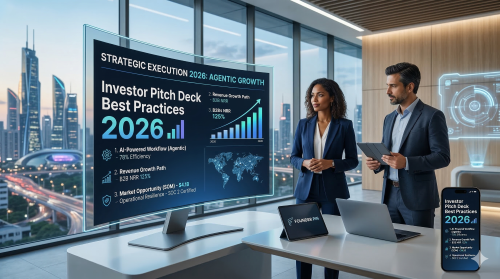
A futuristic 2026 office setting showing a digital "Investor Pitch Deck Best Practices 2026" presentation on a curved glass screen, featuring agentic workflow metrics, revenue growth charts, and the Founder Pin logo.
Funding, Pitch Deck, Startup Guide, Startup Insights & Ecosystem, VC

Investor Pitch Deck Best Practices 2026

Investor Pitch Deck Best Practices 2026: The Founder’s Guide to Winning the Round Investor Pitch Deck Best Practices 2026: The venture capital landscape of 2026 has officially moved past the “growth-at-all-costs” era and the “AI-experimentation” phase. Today, the market is defined by execution, agency, and efficiency. According to recent 2026 venture outlooks, capital is concentrating in fewer deals, but with higher intensity. Investors are no longer looking for “cool tools”—they are looking for category winners that can operate autonomously at scale. If your pitch deck still looks like it belongs in 2024, you’re not just outdated; you’re invisible. Here is the definitive guide to investor pitch deck best practices in 2026. 1. The 2026 “Visual Handshake”: Mobile-First or Fail In 2026, the first time an investor sees your deck won’t be in a boardroom. It will be on an iPhone 17 or a foldable tablet while they are in an Uber or between meetings. Responsive Design is Non-Negotiable: Your deck must be legible on a 6-inch screen. This means a minimum of 24pt to 30pt font for body copy. If an investor has to “pinch and zoom” to see your traction, you’ve already lost. The “Reading” vs. “Presenting” Deck: You need two versions. A Visual Deck (minimal text, heavy impact) for live calls, and a Reading Deck (self-explanatory, link-based) for the “leave-behind.” Move Beyond the PDF: High-growth founders are increasingly using web-based, scrollable formats (like Pitchwise or interactive Canva links). These allow you to track slide-level analytics: you can see exactly which slide an investor spent 2 minutes on and where they dropped off. 2. The “Agentic” Shift: Defining the New Value Prop In 2024, it was enough to say “We use AI.” In 2026, investors assume AI is like oxygen—it’s table stakes. The new differentiator is Agency. The “Execution Layer” Slide Investors want to see how your product moves from suggesting actions to executing them. Your solution slide must address: Autonomy: Can your AI agents handle workflows (like financial reconciliation or security remediation) without human prompts? Orchestration: How does your system manage multiple agents working together? Governance: In an AI-first world, trust is the moat. Include a slide on Operational Resilience and how you handle AI-driven risks and data privacy. 3. The 10-Slide Blueprint for 2026 While the narrative remains king, the “standard” order has evolved to prioritize proof over speculation. Slide 2026 Focus The “Hook” 1. Purpose Your “One-Sentence Handshake.” “We are the agentic operating system for [Industry].” 2. The Problem The “Operational Bottleneck.” Show the human/cost lag that only autonomous systems can fix. 3. Solution The “Agent-Native” approach. Show the product acting, not just thinking. 4. Why Now? The “Regulatory/Tech Window.” Why 2026? (e.g., New AI protocols, GPU cost drops). 5. Market Size “Winner-Takes-Most” potential. Focus on the Serviceable Obtainable Market (SOM) you can dominate. 6. Competition The “2×2 Matrix” of Moats. Be transparent. Show why legacy SaaS is too slow to adapt. 7. Product/Demo The “Live Logic.” High-quality video or interactive mockups of the agent workflow. 8. Business Model “Agentic ROI.” Move from “per seat” to “per outcome” or “usage-based” pricing. 9. The Team “Technical Founders.” Investors in 2026 prioritize CEOs who can build, not just sell. 10. The Ask The “Milestone Roadmap.” “We are raising $Xm to reach [Specific Metric/Series A Benchmark].” 4. Radical Transparency: The “Ugly Slide” 2026 investors have seen the “hockey stick” graph a thousand times. They are now hunting for durability. One of the most effective trends this year is including a Risk & Mitigation slide. By identifying your own bottlenecks—be it GPU supply chains, regulatory hurdles in the EU, or high initial CAC—you signal that you are a “sober” operator. It builds instant rapport and cuts through the “hype fatigue” that many VCs feel. 5. Investor Pitch Deck Best Practices 2026: Modern Aesthetics: Minimalism & Depth Design trends have shifted toward a “Futuristic Minimalist” look. Bento Box Layouts: Use grid-based “Bento” layouts to group related data points (like Team bios or Feature sets) cleanly. Dynamic Typography: Use bold, oversized headers to guide the eye. If the investor only reads the headers, they should still get 80% of the story. Gradients & Depth: Subtle 3D elements and gradient backgrounds are “in,” but only if they don’t distract from the data. 6. Metrics that Matter in 2026: Investor Pitch Deck Best Practices 2026 Forget “Total Users.” In the “Golden Era” of venture capital, investors care about efficiency. LTV/CAC Ratio: Aim for >3x. Net Revenue Retention (NRR): In 2026, 120%+ is the gold standard for B2B. Burn Multiple: How much are you spending to generate each new dollar of ARR? (The 2026 target is <1.5 for Seed/Series A). Agentic Efficiency: The percentage of tasks completed by AI without human intervention. Investor Pitch Deck Best Practices 2026: Conclusion: Lead with Evidence The overarching theme of 2026 is Evidence over Energy. A charismatic founder with a beautiful deck but no data will lose to a quiet founder with a simple, data-backed “Reading Deck” every single time. Your pitch deck is no longer just a presentation—it is a proxy for your execution. If your deck is clear, responsive, and grounded in the realities of the agentic era, you aren’t just asking for money; you’re offering an invitation to a category winner. This blog is brought to you by Founder Pin Check latest other blogs: Your-first-10-customers-in-india-a-field-guide How-to-create-a-winning-pitch-deck-in-2026

Indian startup founder presenting how to create a winning pitch deck
Startup Insights & Ecosystem

How to Create a Winning Pitch Deck in 2026

Creating A Winning Pitch Deck in 2026 Fundraising in 2026 is sharper, slower, and far more analytical than it was just a few years ago. Investors are reviewing more decks than ever, yet writing fewer cheques. Capital has become selective, and founders are expected to demonstrate clarity before confidence. This is the formula for a Winning Pitch Deck Understanding how to create a winning pitch deck is no longer about slide design or clever taglines. It is about strategic thinking, financial realism, and narrative precision. A pitch deck is not a presentation. It is a compressed business strategy document designed to survive investor scrutiny. Before opening PowerPoint or Canva, founders must ensure the foundation is strong. If the business idea itself has not been pressure-tested, fundraising becomes premature. Preparation begins long before the first slide is built, which is why every founder should first understand how to validate a startup idea before you build it A strong deck reflects a validated opportunity, not speculation. Winning Pitch Deck: The 2026 Investor Mindset Investors today evaluate startups through a disciplined lens. Growth-at-all-costs thinking has faded. Capital efficiency, sustainable revenue, and founder execution capability now dominate decision-making. When reviewing a startup pitch deck for investors, most VCs silently evaluate five core factors: Is the problem real, urgent, and measurable? Does the founder possess unique insight? Is there a clear path to monetization? Are unit economics rational? Can this scale without burning irrational capital? Your deck must answer these questions before they are even asked. The 12-Slide Structure that Works best for creating a Winning Pitch Deck Structure reduces friction. Investors think in patterns, and a coherent deck allows them to process information quickly. 1. Cover Slide Include company name, positioning statement, and contact information. The positioning line must clearly state what you do, who you serve, and what differentiates you. Clarity builds authority. 2. The Problem Define a specific, painful, and costly problem. Avoid vague market dissatisfaction statements. Quantify the problem wherever possible using data or real-world examples. Precision increases credibility. 3. The Solution Explain your product in direct business language. Avoid technical jargon unless your audience demands it. Clearly connect your solution to the problem introduced earlier. If your product is in early stages, ensure it aligns with validated user demand and MVP readiness. 4. Market Opportunity Break down your market into: Total Addressable Market (TAM) Serviceable Available Market (SAM) Serviceable Obtainable Market (SOM) Investors fund focused entry points within large markets, not unrealistic global ambitions. 5. Product Demonstration Use visuals instead of heavy text. Screenshots, workflow diagrams, or short demo visuals strengthen belief. Evidence reduces doubt. 6. Business Model Explain: Revenue streams Pricing strategy Cost structure Gross margins Unit economics Even pre-revenue startups must demonstrate revenue logic. Hope is not a strategy. 7. Traction This is where investors lean forward. Include measurable progress such as: Revenue growth User acquisition Retention rates Strategic partnerships Letters of intent Traction transforms narrative into proof. 8. Competitive Landscape Never claim you have no competitors. That signals insufficient market understanding. Instead, map your competitors clearly and articulate how you differentiate. Demonstrating awareness shows maturity. 9. Go-To-Market Strategy Explain how customers will be acquired and retained. Outline acquisition channels, partnerships, and conversion assumptions. Your strategy must demonstrate realistic execution rather than optimistic assumptions. GTM is very Important, this gives confidence to investors that you have right plan. 10. Defensibility and Moat Investors want to understand why you cannot be easily replicated. This could include: Proprietary technology Network effects Community lock-in Brand positioning Strategic partnerships Defensibility strengthens long-term valuation potential. 11. The Team Highlight relevant experience and domain authority. Investors frequently fund teams over ideas. Demonstrate execution capability and founder-market alignment. 12. The Ask Be precise. State: Capital required Intended runway Milestones to be achieved Use of funds Ambiguity weakens confidence. Storytelling: The Invisible Framework for creating Winning Pitch Deck A winning deck follows a psychological arc: Introduce tension through the problem. Present unique insight. Demonstrate structured execution. Validate through traction. Scale through vision. When structured correctly, your startup pitch deck for investors feels inevitable rather than speculative. Investors want to believe that success is logical, not lucky. Winning Pitch Deck: Using a Pitch Deck Template Strategically A strong pitch deck template for fundraising accelerates preparation but does not replace thinking. Templates should help you structure: Financial models Market sizing Competitive matrices Milestone projections Founders must adapt templates to reflect strategic clarity rather than blindly filling placeholders. Fundraising itself is a broader strategic process. For deeper understanding of the full capital journey in India, review the ultimate guide to startup fundraising in India 2026 A deck is one component of a larger fundraising ecosystem. Aligning Your Deck with Funding Stages Different funding stages require different emphasis. Pre-seed decks focus on vision and founder capability. Seed decks require traction and revenue clarity. Series A decks demand operational maturity and predictable growth. Understanding stage expectations prevents misalignment. If you are unsure about stage-specific investor expectations, refer to the pre-seed vs seed full guide, tailoring your pitch to stage context increases fundraising probability. Common Pitch Deck Mistakes in 2026 Even experienced founders make avoidable errors. The most frequent mistakes include: Overloaded slides with excessive text Unrealistic five-year revenue projections Weak unit economics explanation Poor competitive awareness Vague capital allocation strategy Each mistake introduces friction in investor evaluation. Fundraising rewards clarity and punishes exaggeration. AI and the Modern Pitch Deck Winning Pitch Deck: Artificial intelligence tools now assist with market research, slide design optimization, and financial forecasting. While AI enhances efficiency, it cannot replace founder conviction. Technology accelerates execution. It does not replace strategic thinking. Founders who combine structured reasoning, validated demand, and disciplined storytelling produce stronger decks. Final Checklist Before Sending Your Deck Before sharing your pitch deck with investors, confirm: The problem is clearly defined and measurable. The solution logically addresses that problem. Unit economics are realistic and defensible. Traction is prominently displayed. Competitive awareness is demonstrated. The funding ask is specific and justified. The narrative flows coherently from

Scroll to Top