
Fundraising Mistakes Indian Founders Make (And How to Avoid Them)
Table of Contents
Toggle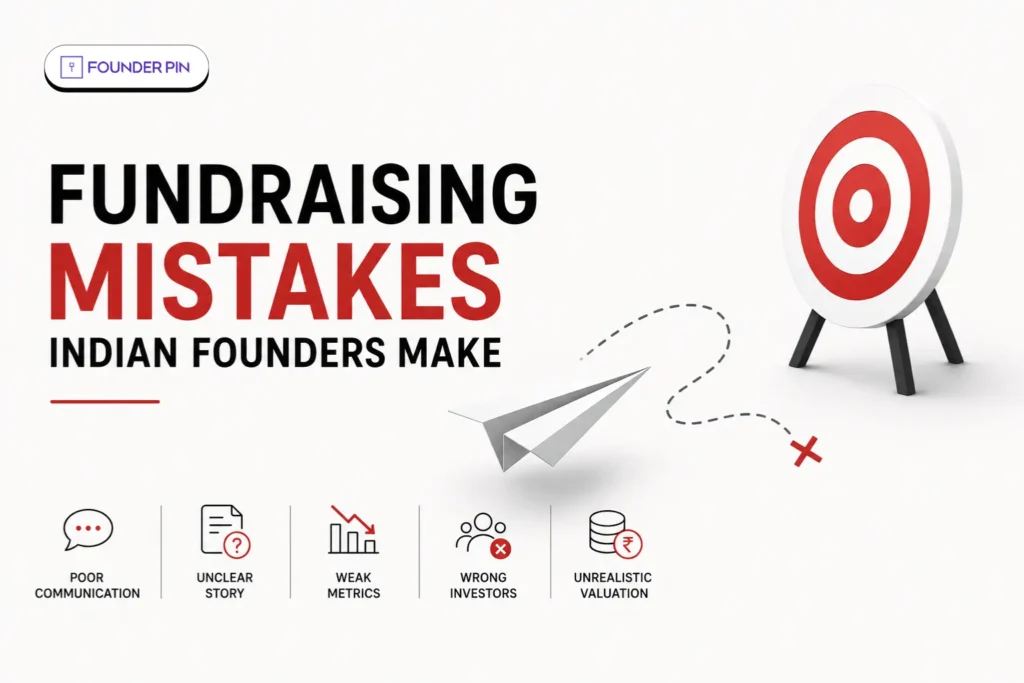
Key Takeaways
- Fundraising mistakes such as raising capital too early, lacking traction, and targeting the wrong investors can significantly reduce a startup’s chances of securing funding.
- Investors look for market validation, measurable growth, a scalable business model, and a strong founding team before making investment decisions.
- A clear and compelling pitch deck is essential for communicating your startup’s value proposition, market opportunity, and growth potential.
- Realistic financial projections and a well-defined use of funds help build investor trust and credibility during fundraising discussions.
- Indian founders can improve fundraising success by focusing on execution, building investor relationships early, and preparing thoroughly before approaching investors.
Introduction
Fundraising is one of the most challenging stages of building a startup. While India’s startup ecosystem has grown rapidly, many promising founders still struggle to secure investment. In most cases, the problem is not a lack of opportunity but a series of avoidable fundraising mistakes that reduce investor confidence.
Investors evaluate hundreds of startups every year, and only a small percentage receive funding. Founders who understand investor expectations, prepare thoroughly, and avoid common pitfalls significantly improve their chances of success.
At FounderPin, we regularly work with startups navigating the fundraising journey. One pattern is clear: the startups that secure funding are not always those with the best ideas, but those that present the strongest investment case.
Why Fundraising Mistakes Matter
Every interaction with an investor shapes their perception of your startup.
Common fundraising errors can result in:
- Immediate rejection
- Loss of credibility
- Delayed fundraising timelines
- Unfavorable investment terms
- Reduced valuation
Understanding these mistakes can save founders months of effort and increase their chances of securing capital.
Top 5 Startup Fundraising Mistakes Indian Founders Should Avoid
Mistake 1: Using the Same Pitch Deck for Every Investor
What This Mistake Looks Like
Many founders prepare one pitch deck and send it to every investor without making any changes. This is one of the most common startup fundraising mistakes. A generic presentation shows that you haven’t researched the investor’s portfolio, investment focus, or industry interests.
Some startups also rely on standard online templates without adapting the content to the Indian startup ecosystem or their specific business model.
Why It Hurts Your Fundraising
Each year, hundreds of pitch decks are reviewed by investors. A generic presentation suggests that you’re sending mass emails instead of building meaningful relationships.
More importantly, you miss the opportunity to demonstrate why your startup aligns with a particular investor’s expertise, investment thesis, or portfolio.
How to Avoid This Mistake
- Research every investor before sending your pitch.
- Study their portfolio companies and recent investments.
- Personalize your introduction for each investor.
- Include industry examples that match their investment experience.
- Explain how their expertise can help your startup grow.
- Create different pitch deck versions for angel investors, venture capital firms, and strategic investors.
Example: Instead of saying “We’re the Uber of healthcare,” explain how your solution addresses a market gap similar to one solved by a company already in the investor’s portfolio.
Mistake 2: Setting an Unrealistic Startup Valuation
What This Mistake Looks Like
Some entrepreneurs place a higher value on their firms based on well-known Silicon Valley success tales than on real company performance. Others rely on optimistic assumptions without considering revenue, market traction, or current funding conditions.
Why It Hurts Your Fundraising
Investors expect valuations to reflect measurable business progress. Asking for a high valuation without supporting data often creates doubt about the founder’s financial understanding.
In India’s startup ecosystem, investors generally look for evidence of growth, customer traction, and sustainable unit economics before accepting premium valuations.
How to Avoid This Mistake
- Compare your startup with similar Indian companies.
- Use multiple valuation methods instead of relying on one estimate.
- Consider current market conditions and investor sentiment.
- Support every valuation assumption with reliable data.
- Leave room for negotiation during funding discussions.
- Focus on future value creation instead of unrealistic expectations.
Mistake 3: Weak Financial Projections
What This Mistake Looks Like
Many startups present revenue forecasts that are overly optimistic without explaining how they will achieve those numbers. Others fail to demonstrate sustainable unit economics or customer profitability.
Why Investors Reject It
Experienced investors can quickly identify unrealistic financial projections. Weak financial planning raises concerns about whether the founders understand their own business model.
How to Build Strong Financial Projections
- Create projections using customer acquisition and retention data.
- Present conservative, expected, and optimistic scenarios.
- Clearly explain every financial assumption.
- Demonstrate positive unit economics.
- Include seasonal trends where applicable.
- Support projections with industry research and market data.
Example: Instead of projecting tenfold revenue growth, explain the expected customer growth, expansion plans, and revenue milestones that support your forecast.
Also Read | Startup Fundraising Readiness: Signs That Your Startup Is Not Ready to Raise Funds
Mistake 4: Inadequate Market Research
What This Mistake Looks Like
Some startups underestimate competition or claim they have no competitors at all. Others fail to understand customer behavior, industry trends, or regulatory requirements in India.
Why It Hurts Your Fundraising
Investors want founders who understand their market thoroughly. Poor market research suggests that the business strategy has not been properly validated.
How to Avoid This Mistake
- Identify both direct and indirect competitors.
- Explain your unique competitive advantage.
- Use India-specific market research and industry reports.
- Understand government regulations affecting your business.
- Validate your ideas through customer interviews.
- Present a clear go-to-market strategy.
Mistake 5: Pitching to the Wrong Investors
What This Mistake Looks Like
Many startups approach investors who do not invest in their industry or funding stage. Others contact investors without introductions or fail to research their investment preferences.
Why It Hurts Your Fundraising
Approaching the wrong investors wastes valuable time and reduces your chances of raising capital. Since the Indian startup ecosystem is closely connected, repeated poor targeting can also affect your reputation.
How to Target the Right Investors
- Create a list of investors that match your startup stage.
- Focus on investors with experience in your industry.
- Look for portfolio companies that complement your business.
- Seek warm introductions through founders, mentors, or advisors.
- Research each investor’s recent funding activity.
- Tailor your pitch based on the investor’s focus and investment strategy.
By targeting the right investors at the right time, you can improve your fundraising success and build stronger long-term relationships.
Also Read | How to Write a Winning Grant Proposal for Startups
1. Research Stage
Understand your investors, industry, and competitors.
Conduct thorough research on potential investors, analyze market trends, and evaluate your competition before starting your fundraising journey.
2. Preparation Stage
Build a compelling investment-ready package.
Create a customized pitch deck, prepare accurate financial statements, and organize all supporting documents required for investor discussions.
3. Valuation Stage
Set a realistic startup valuation.
Determine your company’s valuation using relevant Indian market benchmarks, comparable startups, and measurable business metrics.
4. Investor Targeting
Connect with the right investors at the right time.
Focus on investors whose funding stage, sector expertise, and investment thesis align with your startup’s growth plans.
5. Pitching Stage
Present a clear and convincing investment story.
Communicate your business model, market opportunity, traction, unit economics, and growth strategy with confidence during investor meetings.
6. Measuring Success
Track your fundraising performance.
Evaluate your outreach efforts, investor responses, and conversion rates to improve your fundraising strategy and increase your chances of securing investment.
Key Startup Fundraising Statistics
| Metric | Insight |
|---|---|
| Average Fundraising Timeline | 6–9 months |
| Success Rate Improvement | Up to 300% higher with proper investor targeting and preparation |
| Top Reasons for Investor Rejection | Poor financial planning (40%), Wrong investor fit (35%), Weak founding team (25%) |
Conclusion
The most common fundraising mistakes made by Indian founders are often preventable. Raising funds too early, presenting weak investor materials, targeting the wrong investors, and failing to demonstrate traction can significantly reduce fundraising success.
The good news is that these challenges can be addressed through preparation, validation, and strategic planning. Investors are not simply looking for great ideas—they are looking for founders who can execute, scale, and create long-term value.
By avoiding these common mistakes, founders can improve investor confidence and increase their chances of securing the capital needed for growth.
Contact FounderPin for Fundraising Support
Fundraising requires more than a great business idea—it requires the right strategy, preparation, and investor positioning.
At FounderPin, we help startups create investor-ready pitch decks, improve fundraising readiness, and connect with growth opportunities.
Contact us for a consultation today and strengthen your startup’s fundraising strategy.
Frequently Asked Questions (FAQs)
1. What are the most common fundraising mistakes startups make?
Some of the most common fundraising mistakes include raising capital too early, lacking market validation, targeting the wrong investors, creating weak pitch decks, and presenting unrealistic financial projections. These issues can reduce investor confidence and lead to funding rejections.
2. Why do investors reject startup funding proposals?
Investors often reject funding proposals when startups fail to demonstrate traction, a scalable business model, strong market demand, or a capable founding team. Poor preparation and unclear use of funds are also major reasons for investor rejection.
3. How can Indian founders improve their fundraising success?
Indian founders can improve fundraising success by validating their product, building customer traction, preparing an investor-ready pitch deck, understanding key financial metrics, and approaching investors who align with their industry and growth stage.
4. What should founders do before approaching investors?
Before approaching investors, founders should have a clear business model, customer validation, growth metrics, financial projections, legal documentation, and a compelling fundraising narrative. Proper preparation significantly increases the chances of securing investment.
5. How important is traction when raising startup funding?
Traction is one of the most important factors investors consider. Metrics such as revenue growth, active users, customer retention, and partnerships provide evidence that the market wants the product and that the startup has the potential to scale successfully.
SHARE