How Startup India Recognition Helps in Fundraising
Table of Contents
Toggle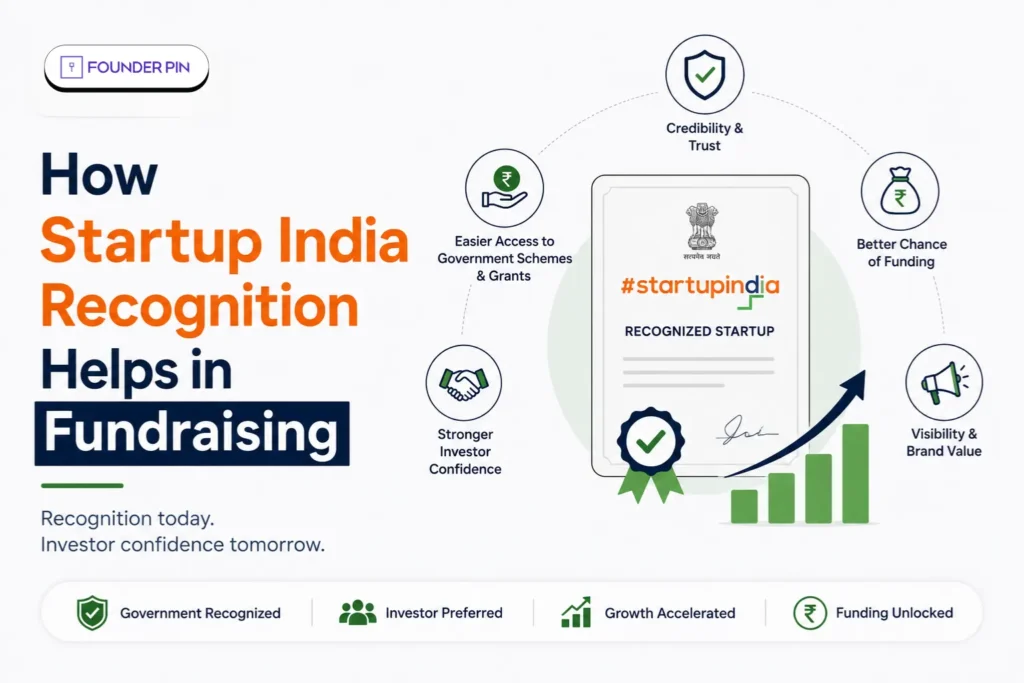
Key Takeaways
- Startup India Recognition (DPIIT) gives startups access to government funding, tax benefits, and startup support programs.
- Eligible startups can claim a 100% income tax exemption for 3 consecutive years under Section 80-IAC and receive Angel Tax exemption under Section 56(2)(viib).
- DPIIT-recognized startups can benefit from the ₹10,000 crore Fund of Funds for Startups (FFS) managed by SIDBI.
- Recognition also provides 80% rebate on patent filing fees, 50% rebate on trademark registration fees, and faster IPR processing.
- Startups receive exemptions from prior turnover and experience requirements when participating in eligible government tenders.
- Only Private Limited Companies, LLPs, and Registered Partnership Firms that are less than 10 years old with an annual turnover below ₹100 crore are eligible.
- Preparing accurate documents and clearly demonstrating innovation can significantly improve the chances of approval.
- Obtaining Startup India Recognition early helps founders build credibility, attract investors, reduce operational costs, and accelerate business growth.
Introduction
Raising capital is one of the biggest challenges for early-stage startups in India. Whether a founder is seeking government grants, angel investment, venture capital, or seed funding, credibility plays a crucial role in attracting financial support. Investors and funding agencies want assurance that a startup is genuine, innovative, and capable of scaling successfully.
This is where Startup India Recognition becomes a powerful advantage. Introduced under the Startup India initiative, the recognition provides startups with official validation from the Government of India while unlocking access to numerous benefits, funding opportunities, tax exemptions, and startup support programs.
At FounderPin, we help startups navigate funding opportunities and government schemes. In this guide, we’ll explore how startup india recognition strengthens fundraising efforts and why every eligible startup should consider obtaining it before approaching investors.
What Is Startup India Recognition?
Startup India Recognition is an official certification issued by the Department for Promotion of Industry and Internal Trade (DPIIT) under the Ministry of Commerce and Industry.
Once a startup receives DPIIT recognition, it becomes eligible for several government incentives designed to support innovation and business growth. After successful registration, founders receive a Startup India Recognition Certificate, which acts as proof of their startup’s eligibility for various government programs.
Recognized startups can benefit from:
- Government funding schemes
- Income tax exemptions
- Angel Tax exemption
- Faster patent and trademark processing
- Easier participation in government tenders
- Access to incubators and startup support programs
For many early-stage businesses, obtaining Startup India Recognition is the first step toward accessing government-backed opportunities.
Key Benefits of Startup India Recognition
Startup India Recognition offers several advantages that help founders reduce costs, raise funding, and accelerate business growth.
1. Income Tax Benefits
One of the biggest advantages of Startup India Recognition is the availability of tax exemptions.
Eligible startups can claim a 100% income tax exemption under Section 80-IAC for any three consecutive financial years within their first 10 years of incorporation.
In addition, DPIIT-recognized startups are eligible for Angel Tax exemption under Section 56(2)(viib). This allows startups to raise investments above the fair market value of their shares without paying additional tax.
As a result, founders can preserve more capital and reinvest it into product development, hiring, and business expansion.
2. Better Access to Startup Funding
Raising capital is often one of the biggest challenges for early-stage startups. Startup India Recognition helps improve access to both government and private funding.
Recognized startups become eligible for support through the ₹10,000 crore Fund of Funds for Startups (FFS), managed by SIDBI. Rather than investing directly, the government allocates this fund to SEBI-registered Alternative Investment Funds (AIFs), which invest in promising startups.
In addition, DPIIT recognition increases investor confidence. Many angel investors and venture capital firms prefer investing in recognized startups because they demonstrate regulatory compliance and government validation.
3. Easier Access to Government Tenders
Government contracts offer significant growth opportunities for startups. However, new businesses often struggle to meet traditional tender requirements.
Startup India Recognition addresses this challenge by providing exemptions from prior turnover and prior experience criteria for eligible government tenders.
This allows startups to compete alongside established companies and build credibility through government projects.
4. Faster Patent and Trademark Protection
Protecting intellectual property is essential for technology-driven startups.
Recognized startups receive:
- 80% rebate on patent filing fees.
- 50% rebate on trademark registration fees.
- Fast-track examination for patent applications.
These benefits reduce legal expenses while helping startups secure their innovations more quickly.
5. Incubation and Networking Opportunities
Startup India also provides access to a strong startup ecosystem.
Recognized startups can participate in:
- Government-supported incubator programs
- Startup boot camps
- Mentorship initiatives
- Investor networking events
- Market access programs
These opportunities help founders build valuable business connections while receiving expert guidance throughout their entrepreneurial journey.
How Startup India Recognition Helps Startups Secure Funding
Access to funding is one of the biggest challenges for early-stage startups. Fortunately, Startup India Recognition improves a startup’s credibility and makes it easier to raise capital from both government-backed programs and private investors.
1. Access to Government Funding
DPIIT-recognized startups become eligible for several government funding initiatives. One of the most important is the Fund of Funds for Startups (FFS), which has a corpus of ₹10,000 crore.
The fund is managed by the Small Industries Development Bank of India (SIDBI). Instead of investing directly in startups, SIDBI provides capital to SEBI-registered Alternative Investment Funds (AIFs), which then invest in eligible startups.
As a result, recognized startups have greater opportunities to secure growth capital from government-supported venture funds.
2. Higher Investor Confidence
Investors often evaluate a startup’s legal status before making investment decisions. A DPIIT Recognition Certificate demonstrates that the business meets the government’s eligibility criteria for startups.
This recognition increases credibility and reassures investors that the company follows regulatory requirements. Consequently, many angel investors, venture capital firms, and institutional investors are more willing to fund DPIIT-recognized startups.
3. Better Opportunities Through Government Tenders
Government procurement can become an important revenue source for startups. However, many tenders require prior experience and minimum turnover, making participation difficult for new businesses.
Startup India Recognition provides exemptions from these requirements for eligible startups. Therefore, founders can compete for government projects even during the early stages of business.
Winning government contracts also strengthens a startup’s market reputation and helps attract future customers and investors.
4. Easier Access to Incubators and Accelerators
DPIIT-recognized startups receive priority consideration for government-supported incubators and accelerator programs.
These organizations often provide:
- Seed funding
- Business mentorship
- Technical guidance
- Networking opportunities
- Investor introductions
- Co-working facilities
As a result, startups receive both financial assistance and strategic support that can accelerate business growth.
Also Read | Government Grants for Women-Led Tech Startups in India
Tax Benefits Available Through Startup India Recognition
In addition to funding support, Startup India Recognition offers several tax incentives that help startups reduce expenses and improve cash flow.
1. Income Tax Exemption Under Section 80-IAC
Eligible startups can claim a 100% income tax exemption under Section 80-IAC.
Tax Benefit
- 100% exemption on profits.
- Available for any three consecutive financial years.
- Can be claimed within the first 10 years after incorporation.
This benefit allows startups to retain more profits and reinvest them into hiring, product development, marketing, and expansion.
2. Angel Tax Exemption
Startups often raise investments at valuations higher than their book value. Normally, this difference may attract Angel Tax under Section 56(2)(viib).
However, DPIIT-recognized startups can claim exemption from this tax.
Key Benefits
- Encourages angel investment.
- Reduces tax liability on startup funding.
- Makes fundraising more attractive for both founders and investors.
This exemption helps startups raise capital more efficiently during their early growth stages.
3. Capital Gains Tax Benefits
Startup India Recognition also provides tax relief under Section 54EE and Section 54GB of the Income Tax Act.
Eligible founders and investors may receive capital gains tax exemptions when investments are made according to the prescribed government guidelines.
These provisions encourage long-term investment in innovative startups and support business expansion.
Who Can Apply for Startup India Recognition?
Not every business qualifies for Startup India Recognition. The Government of India has established specific eligibility criteria to ensure that the benefits are provided to innovative and growth-oriented startups.
To apply for Startup India Registration, your business must satisfy the following conditions.
Eligible Business Structures
Your startup must be registered as one of the following:
- Private Limited Company
- Limited Liability Partnership (LLP)
- Registered Partnership Firm
These are the only business entities eligible for DPIIT recognition.
Age of the Startup
The business must be less than 10 years old from its date of incorporation or registration.
After completing 10 years, the entity is no longer eligible for Startup India benefits.
Annual Turnover Limit
The startup’s annual turnover should not exceed ₹100 crore in any previous financial year.
Businesses crossing this limit become ineligible for Startup India Recognition.
Innovation Requirement
The startup should be working towards one or more of the following:
- Developing innovative products
- Improving existing products or services
- Creating scalable business models
- Building technology-driven solutions
- Generating employment or creating wealth
Innovation is one of the primary evaluation criteria for DPIIT recognition.
Business Formation
The startup must not be formed by splitting or reconstructing an existing business.
Only genuinely new businesses are eligible under the Startup India initiative.
Documents Required for Startup India Registration
Before starting the application, keep the following documents ready.
| Document | Purpose |
|---|---|
| Certificate of Incorporation | Proof of business registration |
| PAN Card | Business tax identification |
| Director or Partner Details | Identity verification |
| Business Description | Overview of the startup and its innovation |
| Website or Pitch Deck (if available) | Explains the business model and product |
| Authorization Letter (if applicable) | Required when applying through a consultant |
Preparing these documents in advance can make the registration process faster and smoother.
Also Read | Bootstrapped Startup Funding: Can Startups Get Government Funding?
How to Apply for Startup India Recognition
The entire application process is completed online through the Startup India portal.
Step 1: Register Your Business
First, incorporate your company as a:
- Private Limited Company
- LLP
- Registered Partnership Firm
Step 2: Create an Account
Visit the official Startup India Portal and create a user account.
After registration, log in using your credentials.
Step 3: Apply for DPIIT Recognition
Navigate to the DPIIT Recognition section and complete the application form.
Provide accurate business information, including:
- Company details
- Founder information
- Business activities
- Innovation details
Step 4: Upload Required Documents
Attach all supporting documents requested during the application process.
Ensure that the files are complete, accurate, and uploaded in the prescribed format.
Step 5: Submit the Application
Review the application carefully before submission.
Once submitted successfully, the application is forwarded for verification by DPIIT.
Step 6: Receive the Recognition Certificate
If your application meets the eligibility requirements, DPIIT issues the Startup India Recognition Certificate.
The certificate enables your startup to access funding schemes, tax exemptions, patent benefits, and other government incentives.
Common Mistakes to Avoid
Many startups delay their approval because of avoidable mistakes.
Avoid the following errors:
- Providing incomplete business information.
- Uploading incorrect or outdated documents.
- Giving unclear descriptions of your innovation.
- Applying before completing company incorporation.
- Submitting inaccurate turnover or ownership details.
Review every section carefully before submitting your application.
Best Practices Before Fundraising
Secure Recognition Early
Obtaining Startup India Recognition before beginning fundraising can strengthen applications and investor outreach efforts.
Build a Strong Funding Narrative
Combine recognition with:
- Market validation
- Customer traction
- Revenue growth
- Product innovation
These factors together create a compelling investment case.
Maintain Compliance
Proper documentation and regulatory compliance increase credibility among investors and funding agencies.
Conclusion
For startups seeking capital, startup india recognition is more than just a government certificate. It serves as a powerful credibility tool that improves access to grants, strengthens investor confidence, enhances visibility, and unlocks valuable funding opportunities.
While recognition alone cannot guarantee investment, it significantly improves a startup’s fundraising readiness and positions founders for long-term growth.
Contact FounderPin for Expert Funding Support
Navigating Startup India Recognition, grant applications, and fundraising strategies can be complex. At FounderPin, we help startups secure recognition, identify funding opportunities, and prepare investor-ready applications.
Contact us for a consultation today and discover how Startup India Recognition can accelerate your fundraising journey.
Frequently Asked Questions(FAQS)
1. What is Startup India Recognition?
Startup India Recognition is an official certification issued by the Department for Promotion of Industry and Internal Trade (DPIIT) under the Startup India initiative. It enables eligible startups to access government grants, tax exemptions, intellectual property (IPR) benefits, government tenders, and various startup support programs.
2. Who is eligible for Startup India Registration?
To qualify for Startup India Registration, a business must:
- Be registered as a Private Limited Company, LLP, or Registered Partnership Firm.
- Be less than 10 years old from the date of incorporation.
- Have an annual turnover of less than ₹100 crore in any previous financial year.
- Focus on innovation, product development, or improving existing products, services, or business models.
- Not be formed by splitting or reconstructing an existing business.
3. What are the benefits of Startup India Recognition?
Startup India Recognition offers several benefits, including:
- 100% income tax exemption for three consecutive years under Section 80-IAC.
- Angel Tax exemption under Section 56(2)(viib).
- Access to the ₹10,000 crore Fund of Funds for Startups (FFS).
- 80% rebate on patent filing fees and 50% rebate on trademark registration fees.
- Faster patent processing and easier participation in eligible government tenders.
4. How can I apply for Startup India Recognition?
You can apply for Startup India Recognition through the official Startup India Portal. After registering your business, create an account, complete the DPIIT Recognition application, upload the required documents, and submit the application online. Once approved, you will receive your Startup India Recognition Certificate.
5. Is Startup India Recognition mandatory to apply for government startup funding?
Yes, DPIIT Recognition is mandatory for many central government startup funding schemes, including the Startup India Seed Fund Scheme (SISFS) and several other grant and support programs. Obtaining Startup India Recognition improves eligibility for funding, tax benefits, government incentives, and investor confidence.
SHARE