
Bootstrap vs Raise Capital: Should Founders Bootstrap or Raise Capital?
Table of Contents
Toggle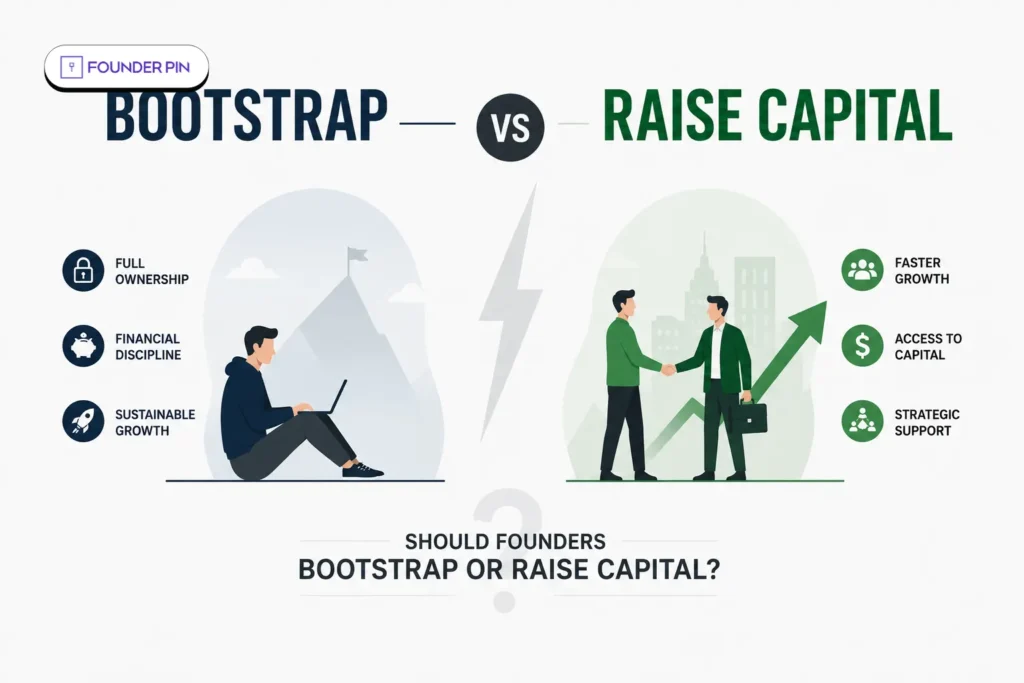
Key Takeaways
- Bootstrapping gives founders full ownership and control, while raising capital provides the resources needed to scale faster and capture larger market opportunities.
- The right choice depends on factors such as business model, market size, capital requirements, and growth objectives.
- Startups with early revenue and low operating costs can often succeed through bootstrapping, whereas capital-intensive businesses may require external funding.
- Raising investment can accelerate growth, but it comes with equity dilution, investor expectations, and reduced decision-making control.
- Many successful startups follow a hybrid approach—bootstrapping initially to validate the business and then raising capital to scale efficiently.
Introduction
One of the biggest decisions every entrepreneur faces is whether to bootstrap their startup or raise external funding. The debate around Bootstrap vs Raise Capital has become increasingly relevant as founders seek sustainable growth while balancing ownership, control, and speed of execution.
There is no universal answer. Some of the world’s most successful companies grew without outside investment, while others achieved rapid scale through venture capital and angel funding. The right choice depends on your business model, market opportunity, growth objectives, and risk tolerance.
Understanding the advantages and limitations of both approaches can help founders make informed decisions that align with their long-term vision.
What Is Bootstrapping?
Bootstrapping is the process of starting and growing a business using your own financial resources instead of raising money from external investors. Founders typically rely on personal savings, business profits, loans, or credit to fund operations and support growth.
Rather than depending on venture capital or angel investment, bootstrapped startups reinvest their revenue back into the business. This approach encourages founders to manage cash flow carefully, focus on profitability, and build a sustainable business from the beginning.
The fact that entrepreneurs keep complete control of their business is one of the main benefits of bootstrapping.Since no equity is given to outside investors, the founders maintain complete control over the company’s decisions, strategy, and future growth.
Although bootstrapping can be financially challenging during the early stages, it also provides greater independence. If the business becomes successful, founders enjoy the full rewards of their efforts without shareholder obligations, investor interference, or equity dilution. This allows them to grow the company on their own terms while keeping full control of its direction.
When Should You Bootstrap?
Bootstrapping is a suitable option if your primary objective is to grow your business independently while maintaining full control.
Maintain Complete Ownership
When you bootstrap your startup, you retain 100% ownership and make all strategic decisions without outside investor influence. This allows you to focus on building the company according to your vision.
Build Financial Discipline
Since growth is funded through personal savings or business revenue, bootstrapping encourages careful spending, healthy cash flow management, and strong unit economics from the beginning.
Grow at Your Own Pace
Without external investors, you can scale the business based on customer demand rather than aggressive growth targets or predefined exit timelines.
Benefits of Bootstrapping
Full Ownership and Control
One of the biggest advantages of bootstrapping is retaining equity. Founders maintain complete control over strategic decisions without pressure from investors.
Strong Financial Discipline
Limited resources often force founders to focus on profitability, efficient spending, and sustainable growth.
Long-Term Flexibility
Bootstrapped companies can pursue long-term goals without the pressure of meeting aggressive investor growth targets.
Challenges of Bootstrapping
Limited Growth Capital
Without external funding, scaling can take longer. Hiring, marketing, and product development may be constrained by available cash flow.
Higher Personal Risk
Founders often invest their own savings, increasing financial exposure if the business struggles.
Bootstrap First, Raise Funding Later
Many successful startups begin their journey by bootstrapping before seeking external investment. This approach allows founders to validate their business model, build customer traction, and increase their company’s value before giving up equity.
A great example is Atlassian, one of Australia’s most successful technology companies. The founders bootstrapped the business for eight years, focusing on sustainable growth before raising external capital. Over the following four years, the company secured more than $200 million in funding to accelerate its expansion.
Another inspiring example is Bean Ninjas. Founder Meryl Johnston launched the business in just seven days with an initial investment of only $1,000. Instead of spending months searching for investors, the company focused on acquiring paying customers and building steady revenue. After establishing a strong business foundation, Bean Ninjas later raised external funding and continued to scale successfully.
These examples demonstrate that bootstrapping and fundraising are not mutually exclusive. Many founders choose to self-fund during the early stages and raise capital later, once they have proven their business model and strengthened their position for investor negotiations.
What Is a Capital Raise?
A capital raise is the process of securing funds from external investors in exchange for an ownership stake, or equity, in your startup. Investors provide financial support to help the business grow, while receiving shares that represent partial ownership of the company.
For many startups, raising capital is an important step toward accelerating growth. It enables founders to invest in product development, expand their team, increase marketing efforts, and enter new markets more quickly than they could through self-funding alone.
However, raising investment also means sharing ownership and decision-making with investors. Therefore, founders should carefully evaluate their funding needs, choose the right investors, and develop a clear fundraising strategy before beginning the capital-raising process.
When Should You Raise Capital?
External funding can accelerate growth when your startup requires additional resources to compete or innovate.
Scale Quickly
If your industry is highly competitive, raising capital enables you to expand faster, hire key talent, and capture market share before competitors.
Fund Research and Product Development
Startups in sectors such as deep tech, biotechnology, artificial intelligence, or advanced manufacturing often require substantial investment before generating revenue. External funding helps cover these early development costs.
Gain Strategic Support
Investors often provide more than capital. They can offer industry expertise, mentorship, strategic partnerships, customer introductions, and access to valuable business networks that support long-term growth.
Benefits of Raising Capital
Faster Growth
Access to external funding enables startups to invest aggressively in talent, technology, product development, and customer acquisition.
Competitive Advantage
In fast-moving markets, capital can help founders capture market share before competitors.
Access to Expertise
Investors often bring valuable networks, industry experience, mentorship, and strategic guidance.
Challenges of Raising Capital
Equity Dilution
The most significant trade-off is ownership dilution. Each funding round reduces the founder’s equity stake.
Investor Expectations
Investors typically expect rapid growth, strong returns, and regular performance updates.
Fundraising Takes Time
Securing investment often requires months of preparation, meetings, negotiations, and due diligence.
Bootstrap vs Raise capital comparison table
| Feature | Bootstrapping | Raising Capital |
|---|---|---|
| Ownership | 100% ownership and full control. | Equity is shared with investors. |
| Growth Speed | Steady, revenue-driven growth. | Rapid expansion with external funding. |
| Financial Risk | Founder bears the financial risk. | Risk is shared with investors. |
| Mentorship | Build your own network. | Access investor guidance and connections. |
| Business Focus | Profitability and sustainable growth. | Scaling and market expansion. |
| Best For | SaaS, agencies, consulting, service businesses. | DeepTech, Biotech, FinTech, Manufacturing. |
Bootstrap vs Raise Capital: Key Factors to Consider
Business Model
Certain businesses are naturally better suited for bootstrapping.
Examples include:
- Service-based businesses
- Consulting firms
- Digital agencies
- SaaS products with low operational costs
Businesses requiring substantial upfront investment may need external funding.
Examples include:
- DeepTech startups
- Biotechnology ventures
- Hardware companies
- Space technology startups
Market Opportunity
Large and rapidly growing markets often reward speed.
If competitors are aggressively funded, raising capital may help secure market leadership before opportunities disappear.
Revenue Potential
Startups generating revenue early may be able to bootstrap successfully.
Companies with long development cycles often require external capital before becoming profitable.
Hybrid Approach: The Best of Both Worlds
Many successful startups adopt a hybrid strategy.
They initially bootstrap to:
- Validate the market
- Build an MVP
- Acquire early customers
- Demonstrate traction
Once key milestones are achieved, they raise capital to accelerate growth.
This approach often results in stronger valuations and better negotiation power.
Common Mistakes Founders Make
Raising Money Too Early
Seeking investment before validating the product can result in unfavorable terms and unnecessary dilution.
Bootstrapping for Too Long
Some founders avoid fundraising even when capital could significantly accelerate growth.
Choosing Funding Based on Trends
Funding decisions should align with business needs, not startup ecosystem trends.
The best choice depends on the company’s objectives, market conditions, and growth strategy.
Learn More About | Fundraising Mistakes Indian Founders Make (And How to Avoid Them)
How Investors View Bootstrap vs Raise Capital
Investors often appreciate founders who have successfully bootstrapped because it demonstrates:
- Resourcefulness
- Financial discipline
- Customer validation
- Execution capability
At the same time, investors recognize that some markets require substantial capital to achieve scale.
Ultimately, they focus on whether the chosen funding strategy supports long-term success.
Conclusion
The debate around Bootstrap vs Raise Capital is not about determining which option is universally better. It is about identifying which approach best fits your startup’s goals, industry, and growth stage.
Bootstrapping offers control, ownership, and financial discipline, while raising capital provides resources, expertise, and speed. The most successful founders evaluate both options carefully and choose the strategy that maximizes long-term value creation.
Whether you decide to bootstrap, raise capital, or combine both approaches, the key is ensuring that your funding strategy supports sustainable growth and business success.
Contact FounderPin for Startup Fundraising Guidance
Choosing the right funding path can shape your startup’s future.
At FounderPin, we help founders evaluate funding options, prepare investor materials, and develop fundraising strategies tailored to their business goals.
Contact us for a consultation today and discover the best growth strategy for your startup.
Frequently Asked Questions (FAQs)
1. What is the difference between bootstrapping and raising capital?
Bootstrapping means funding your startup using personal savings or business revenue, while raising capital involves securing funds from investors in exchange for equity. The choice depends on your growth goals, funding needs, and willingness to share ownership.
2. Should first-time founders bootstrap or raise capital?
First-time founders should evaluate their business model, market opportunity, and capital requirements. If the startup can generate revenue early, bootstrapping may be a good option. If rapid scaling is essential, raising capital may be more effective.
3. What are the advantages of bootstrapping a startup?
Bootstrapping allows founders to maintain full ownership, retain decision-making control, and build financial discipline. It also eliminates investor pressure and enables startups to grow at a sustainable pace based on customer demand.
4. When should a startup consider raising capital?
A startup should consider raising capital when it has validated market demand, achieved early traction, and needs additional resources to accelerate growth, expand into new markets, hire talent, or develop products faster than organic growth allows.
5. Can a startup bootstrap first and raise capital later?
Yes, many successful startups follow this approach. Founders often bootstrap during the validation stage, build traction and revenue, and then raise capital at a higher valuation. This strategy helps reduce dilution and improves negotiating power with investors.
SHARE