MSME vs Startup India (DPIIT): Which Registrations Should Founders Actually Get?
Table of Contents
Toggle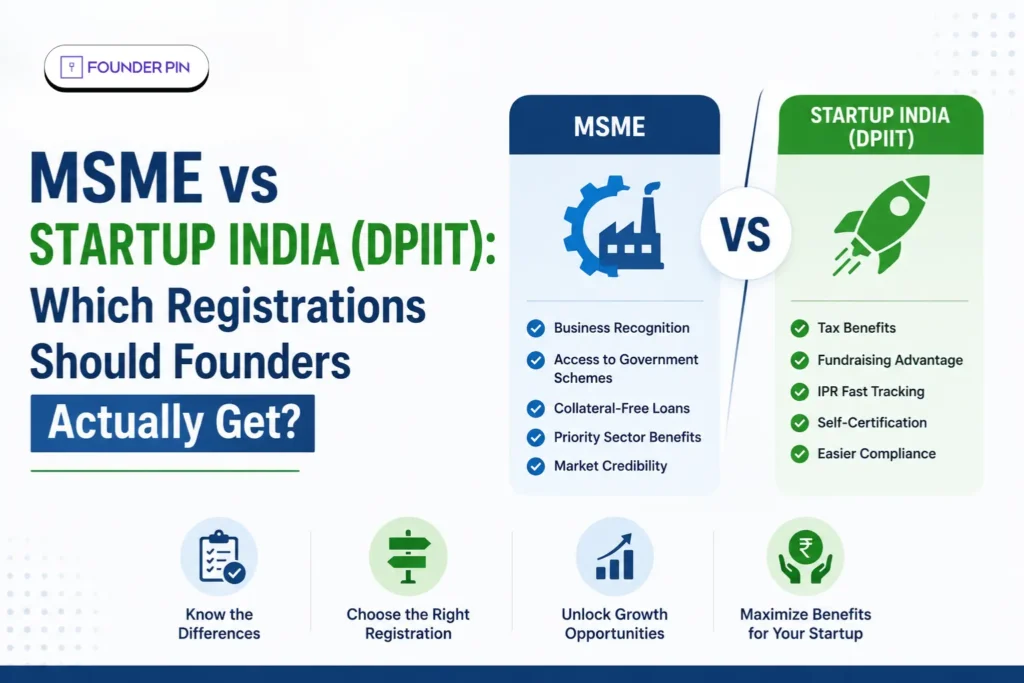
Key Takeaways
Understanding MSME vs Startup India is essential for founders looking to maximize government benefits and growth opportunities. While both registrations offer unique advantages, many startups can benefit from having both.
- MSME registration helps businesses access loans, subsidies, and government tenders.
- Startup India (DPIIT) registration provides funding opportunities, tax benefits, and startup-specific support.
- MSME focuses on business size and operations, while Startup India focuses on innovation and scalability.
- Many startups are eligible for both registrations and can leverage benefits from each.
- Choosing the right registration strategy can improve funding access, business growth, and long-term success.
Starting a business in India has never been more exciting. With government-backed initiatives, startup-friendly policies, and increasing access to funding, entrepreneurs today have more opportunities than ever before. One question, though, still baffles a lot of founders: which registration is better, MSME or Startup India (DPIIT)?
Many entrepreneurs mistakenly believe that MSME and Startup India registrations serve the same purpose. In reality, they offer different benefits and are designed to support businesses in different ways. Choosing the right registration can help founders access funding, tax benefits, government schemes, easier compliance, and business growth opportunities.
At FounderPin, we often advise startup founders that the answer isn’t always choosing one over the other. In many cases, businesses can benefit from both registrations simultaneously. This guide explains the differences, advantages, eligibility requirements, and practical scenarios where each registration makes sense.
What Is MSME Registration?
Micro, Small, and Medium-Sized Businesses are referred to as MSMEs. Businesses can register under the Ministry of MSME through the Udyam Registration Portal.
The primary purpose of MSME registration is to support small businesses through financial assistance, credit access, government subsidies, and operational benefits.
Key Benefits of MSME Registration
MSME-registered businesses can access various government support programs that help improve financial stability and operational efficiency.
Benefits include:
- Easier access to business loans
- Lower interest rates on certain credit schemes
- Protection against delayed payments
- Subsidies for patents and trademarks
- Government tender participation opportunities
- Support for technology upgrades
For traditional businesses and service companies, MSME registration can provide immediate practical advantages.
What Is Startup India (DPIIT) Registration?
Startup India is a flagship initiative launched by the Government of India to encourage innovation and entrepreneurship. Under this program, eligible businesses can receive recognition from the Department for Promotion of Industry and Internal Trade (DPIIT).
Unlike MSME registration, Startup India focuses specifically on innovative and scalable startups.
Key Benefits of Startup India Registration
DPIIT-recognized startups receive benefits designed to accelerate innovation and growth.
These include:
- Access to Startup India Seed Fund Scheme
- Tax exemption opportunities
- Easier compliance requirements
- Fast-track patent filing
- Access to government grants
- Startup networking and mentorship support
For technology startups and innovation-driven ventures, Startup India registration often creates opportunities that traditional businesses may not receive.
MSME vs Startup India (DPIIT)
Understanding the key differences between MSME and Startup India registration.
| Feature | MSME (Udyam Registration) | Startup India (DPIIT Recognition) |
|---|---|---|
| Primary Objective | Business stability, easier credit access, and protection against delayed payments. | Promotes innovation, scalability, job creation, and startup growth. |
| Eligibility Requirements | Based on investment in plant, machinery, and annual turnover limits. | Must be less than 10 years old, have turnover below ₹100 Crore, and offer an innovative or scalable solution. |
| Eligible Business Structures | Sole Proprietorship, Partnership, LLP, Private Limited Company, and others. | Only Private Limited Companies, LLPs, and Registered Partnership Firms. |
| Registration Process | Online registration through the Udyam Registration Portal. | Recognition through the National Single Window System (NSWS). |
Eligibility Criteria: MSME vs Startup India
MSME Eligibility
Most businesses operating in India can register as MSMEs if they meet investment and turnover requirements.
Eligible entities include:
- Proprietorships
- Partnerships
- LLPs
- Private limited companies
Startup India Eligibility
To qualify for DPIIT recognition, businesses must generally:
- Be less than 10 years old
- Be incorporated in India
- Have annual turnover below prescribed limits
- Focus on innovation or scalable business models
- Demonstrate potential for growth and employment generation
Not every MSME qualifies as a startup, but many startups qualify as MSMEs.
Can Startups Have Both Registrations?
The Short Answer Is Yes
One of the biggest misconceptions among founders is that they must choose between MSME and Startup India registration.
In reality, many startups benefit from having both.
A technology startup can:
- Register as an MSME
- Obtain DPIIT recognition
- Access benefits from both ecosystems
This dual-registration approach often provides maximum support during the early stages of growth.
When Should Founders Prioritize MSME Registration?
MSME registration may be more important if your business:
- Operates in manufacturing
- Requires working capital loans
- Participates in government tenders
- Needs protection against delayed payments
- Focuses on steady operational growth
Traditional businesses often gain immediate financial advantages from MSME registration.
When Should Founders Prioritize Startup India Registration?
Startup India registration should be prioritized if your business:
- Is innovation-driven
- Plans to raise investor funding
- Wants access to government grants
- Requires incubation support
- Has strong scalability potential
Technology startups, SaaS companies, fintech businesses, and AI startups often benefit significantly from DPIIT recognition.
Which Registration Should Founders Actually Get?
For most early-stage startups, the ideal strategy is simple: obtain both registrations whenever possible.
MSME registration provides practical business benefits, easier financing options, and operational support. Startup India recognition opens doors to funding programs, tax incentives, grants, and investor opportunities.
Instead of viewing MSME vs Startup India as a competition, founders should see them as complementary tools that support different aspects of startup growth.
Also Read | Startup India Seed Fund Scheme (SISFS): Complete Guide 2026
Conclusion
The debate around MSME vs Startup India often creates confusion among entrepreneurs, but the answer is rarely one-size-fits-all. MSME registration helps businesses improve operational efficiency and access financial support, while Startup India (DPIIT) recognition focuses on innovation, funding, and scalability.
For founders looking to maximize growth opportunities in 2026, securing both registrations is often the smartest approach. By leveraging the strengths of each program, startups can build stronger foundations, access government support, and improve their chances of long-term success.
Ready to Build and Scale Your Startup?
At FounderPin, we help entrepreneurs navigate startup registrations, funding opportunities, branding, and growth strategies.
Contact us for a consultation and discover how to position your startup for faster growth, better funding opportunities, and long-term success.
Frequently Asked Questions (FAQs)
1. What is the difference between MSME and Startup India registration?
The main difference is that MSME registration supports businesses based on their size and turnover, while Startup India (DPIIT) registration is designed for innovative and scalable startups seeking funding, tax benefits, and government support.
2. Can a startup have both MSME and Startup India registration?
Yes. A startup can register as an MSME and also obtain DPIIT recognition under Startup India. In actuality, a lot of founders select both registrations in order to take advantage of financial opportunities and government incentives.
3. Which registration is better: MSME or Startup India?
There is no one-size-fits-all answer. MSME registration is ideal for accessing loans, subsidies, and tender benefits, while Startup India registration is better for startups seeking grants, tax exemptions, incubation support, and investor funding.
4. Do Startup India benefits require DPIIT recognition?
Yes. To access most Startup India benefits, including government funding schemes and startup-specific incentives, founders must obtain DPIIT recognition.
5. Can traditional businesses apply for Startup India registration?
Not always. Startup India registration is primarily intended for innovative businesses with scalability potential. Traditional businesses may qualify for MSME registration but may not meet the eligibility criteria for DPIIT recognition.