SAFE vs Convertible Note Agreements Explained: Which Is Better for Startups?
Table of Contents
Toggle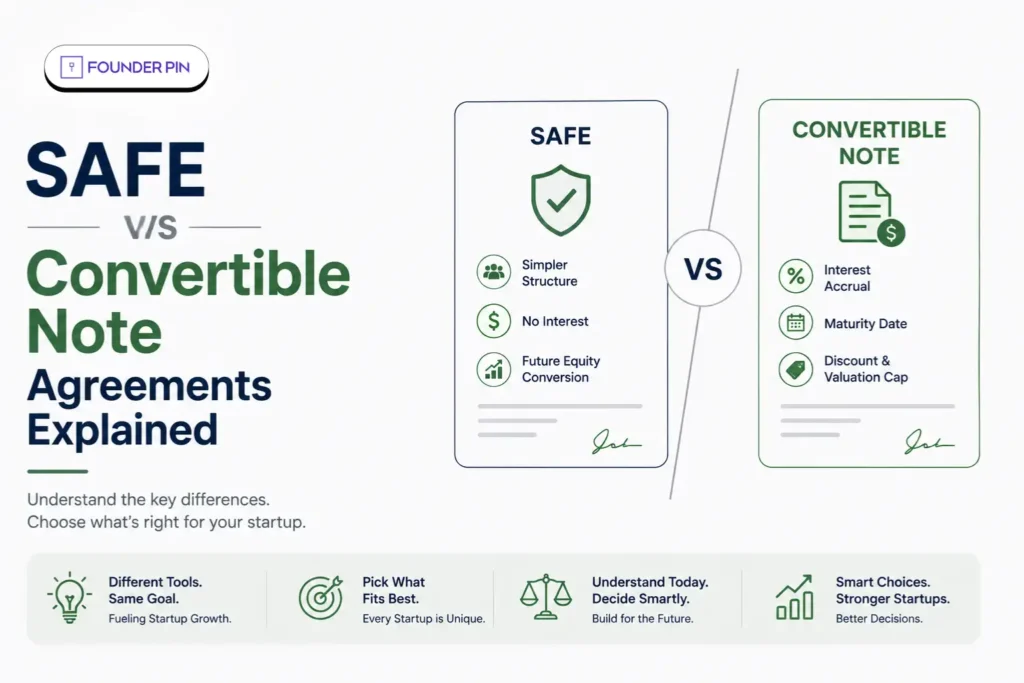
Key Takeaways
- SAFE vs Convertible Note is a common startup fundraising decision, with both instruments allowing founders to raise capital before determining a company valuation.
- SAFE agreements are generally simpler, faster, and more founder-friendly because they do not include debt, interest payments, or maturity dates.
- Convertible Notes provide greater investor protection through debt-based terms, interest accrual, and repayment obligations if conversion does not occur.
- Founders should carefully evaluate future dilution, investor preferences, legal costs, and fundraising timelines before choosing either option.
- The right fundraising instrument depends on the startup’s stage, growth plans, and long-term financing strategy.
Introduction
Early-stage fundraising is often one of the most challenging aspects of building a startup. Founders need capital to develop products, hire talent, and validate their business model, but determining a fair valuation at an early stage can be difficult. To solve this problem, startups and investors commonly use alternative funding instruments that delay valuation discussions until a future financing round.
Two of the most popular options are SAFE agreements and Convertible Notes. While both allow startups to raise capital without immediately issuing equity, they differ significantly in structure, risk, investor rights, and founder implications.
At FounderPin, we help startups understand fundraising mechanisms and investor agreements before entering negotiations. In this guide, we’ll break down the safe vs convertible note debate and help founders determine which option aligns best with their fundraising strategy.
What Is a SAFE Agreement?
SAFE stands for “Simple Agreement for Future Equity.”
Created by startup accelerator Y Combinator, SAFE agreements allow investors to provide capital today in exchange for the right to receive equity during a future funding round.
Key Features of SAFE Agreements
A SAFE typically includes:
- Future equity conversion
- Valuation cap
- Discount rate
- No maturity date
- No interest payments
Because SAFEs are relatively simple and founder-friendly, they have become increasingly popular among early-stage startups.
What Is a Convertible Note?
A Convertible Note is a debt instrument that converts into equity during a future financing round.
Unlike a SAFE, a Convertible Note begins as a loan that eventually converts into ownership shares.
Key Features of Convertible Notes
Convertible Notes generally include:
- Principal amount
- Interest rate
- Maturity date
- Valuation cap
- Conversion discount
Because they are debt-based instruments, Convertible Notes create additional legal and financial obligations.
Also Read | Startup Equity Distribution: How Much Equity Should First-Time Founders Give Away?
SAFE vs Convertible Note: Key Differences
| Feature | Convertible Notes | SAFE Agreements |
|---|---|---|
| Valuation | Usually includes a valuation cap that determines the maximum company valuation at which the debt converts into equity during the next qualified funding round. | Generally postpones valuation until the next financing round, allowing the investment to convert using the same pricing terms offered to new investors. |
| Discount | Typically offers investors a conversion discount, enabling them to purchase shares at a lower price than future investors. | May include a discount clause, although it is optional and depends on the investment agreement. |
| Interest | Generally accrues an annual interest rate, which is added to the outstanding amount before conversion. | Normally does not accrue interest because SAFE agreements are not structured as debt instruments. |
| Maturity Period | Includes a fixed maturity date. If conversion does not occur before this deadline, investors may request repayment. | Has no maturity date, so startups are not required to repay the investment within a specific timeframe. |
| Investor Protection | Provides stronger investor protection because repayment can be requested if qualifying funding is not secured before maturity. | Offers less repayment protection since SAFE agreements do not create a debt obligation. |
| Equity Conversion | Converts into equity once a predefined financing event or investment milestone is achieved. | Automatically converts into equity when a future funding event satisfies the conditions outlined in the SAFE agreement. |
When Should You Use a SAFE Note?
A SAFE (Simple Agreement for Future Equity) is best suited for early-stage startups that want to raise capital quickly without negotiating a company valuation upfront. Since SAFE notes are simple and founder-friendly, they are widely used during the pre-seed and seed stages.
Situations Where a SAFE Note Works Best
1. Early-Stage Startups
SAFE notes are ideal for startups that are still validating their business idea, building a prototype, or entering the market. At this stage, determining an accurate company valuation can be challenging.
2. Uncertain Business Valuation
If your startup’s valuation is difficult to establish, a SAFE note allows both founders and investors to postpone valuation discussions until a future funding round when the business has demonstrated greater traction.
3. Founder-Friendly Fundraising
Unlike convertible notes, SAFE agreements typically do not include interest charges or maturity dates. This reduces financial obligations for founders and allows them to focus on growing the business.
4. Faster Investment Process
SAFE agreements use standardized terms, making negotiations simpler and reducing legal documentation. As a result, startups can complete fundraising rounds more quickly and at a lower cost.
5. Long-Term Growth Strategy
If you expect to raise multiple funding rounds in the future, a SAFE note provides flexibility by delaying equity pricing until your startup reaches important growth milestones.
Tip: Before choosing a SAFE agreement, founders should consult legal and financial advisors to ensure it aligns with their fundraising strategy and investor expectations.
When Should You Use a Convertible Note?
A Convertible Note is often the preferred option for startups seeking short-term funding before a larger priced investment round. It combines features of debt and equity, offering investors additional protection while allowing future conversion into company shares.
Situations Where a Convertible Note Is Suitable
1. Startups with Market Traction
Convertible notes are better suited for startups that have already gained customers, generated revenue, or established a clearer market position. These businesses generally have a more predictable valuation.
2. Custom Investment Terms
If founders and investors want to negotiate specific conditions—such as valuation caps, conversion discounts, or interest rates—a convertible note provides greater flexibility than a SAFE agreement.
3. Short-Term Bridge Financing
Convertible notes are a good choice when a startup requires temporary funding before raising a larger investment round. If no qualifying funding event occurs before the maturity date, the amount may need to be repaid according to the agreed terms.
4. Investor Preference
Some investors prefer convertible notes because they include additional protections, such as maturity dates, valuation caps, and conversion discounts, which can help reduce investment risk.
5. Planned Exit or Future Funding
If the startup expects a future acquisition, IPO, or a significant funding round, a convertible note can provide a more structured framework for converting debt into equity based on predefined terms.
Main Thoughts
Both SAFE notes and Convertible Notes are popular fundraising instruments for startups, but each serves a different purpose. SAFE notes are generally better for early-stage startups seeking simple, fast, and founder-friendly funding, while convertible notes are more suitable for businesses with traction that require customized investment terms and short-term bridge financing. Choosing the right instrument depends on your startup’s growth stage, fundraising objectives, and long-term business strategy.
Also Read | Government Grants for Women-Led Tech Startups in India
Advantages of SAFE Agreements
Founder-Friendly Structure
SAFE agreements reduce administrative complexity and legal costs.
Founders benefit from:
- Faster fundraising
- Simpler documentation
- No debt obligations
- Greater flexibility
This is one reason why many technology startups prefer SAFEs during pre-seed fundraising rounds.
Reduced Financial Pressure
Since there are no repayment obligations or interest payments, founders can focus resources on growth rather than debt management.
Advantages of Convertible Notes
Greater Investor Protection
Investors often appreciate Convertible Notes because they provide:
- Debt protection
- Interest accrual
- Defined maturity timelines
These features help reduce investor risk.
Familiar Legal Framework
Many investors are accustomed to debt-based investment structures and may feel more comfortable using Convertible Notes.
This can sometimes make fundraising negotiations easier.
Risks of SAFE Agreements
Founder Dilution Uncertainty
Because conversion occurs later, founders may underestimate future dilution.
Multiple SAFE agreements can significantly impact ownership percentages after a priced funding round.
Investor Concerns
Some investors prefer the stronger protections available through Convertible Notes.
This may limit flexibility when negotiating with certain investor groups.
Risks of Convertible Notes
Debt Obligations
Although conversion is expected, Convertible Notes remain debt until converted.
If conversion does not occur, repayment obligations may arise.
Increased Complexity
Convertible Notes require more legal documentation and administration compared to SAFEs.
This can increase transaction costs for startups.
Also Read | Bootstrapped Startup Funding: Can Startups Get Government Funding?
Which Option Is Better for Early-Stage Startups?
SAFE Agreements Are Often Better When:
- The startup is very early stage
- Valuation is difficult to determine
- Founders want simplicity
- Fundraising speed is important
- Investor relationships are strong
Convertible Notes Are Often Better When:
- Investors want stronger protections
- Financing timelines are clearer
- The startup has more predictable growth
- Parties prefer a traditional debt structure
The best choice depends on the startup’s fundraising stage and investor expectations.
Factors Founders Should Consider Before Choosing
Future Fundraising Plans
Founders should understand how future funding rounds may affect ownership and dilution.
Investor Preferences
Some investors strongly prefer one structure over the other.
Understanding expectations can improve negotiations.
Legal Costs
SAFE agreements generally involve lower legal and administrative expenses.
Growth Timeline
Startups expecting rapid fundraising may benefit from the flexibility of SAFEs, while those with defined financing milestones may find Convertible Notes suitable.
Common Startup Fundraising Mistakes
Many founders focus solely on securing capital without fully understanding the long-term implications of funding agreements.
Before signing any SAFE or Convertible Note, founders should evaluate:
- Ownership impact
- Future dilution
- Investor rights
- Fundraising strategy
- Legal obligations
A well-informed decision can prevent costly issues later.
Conclusion
The safe vs convertible note decision is one of the most important choices early-stage founders face during fundraising. While both instruments allow startups to raise capital without immediately setting a valuation, they differ significantly in terms of complexity, investor protection, and founder flexibility.
SAFE agreements are often preferred for their simplicity and founder-friendly structure, while Convertible Notes offer stronger investor protections through debt-based terms. The right choice depends on your startup’s stage, fundraising goals, and investor relationships.
Contact FounderPin for Expert Fundraising Guidance
Understanding fundraising agreements is critical for protecting founder ownership and building a sustainable financing strategy. At FounderPin, we help startups evaluate investment structures, negotiate with investors, and make informed fundraising decisions.
Contact us for a consultation today and discover the best fundraising approach for your startup.
Frequently Asked Questions (FAQs)
1. What is the difference between a SAFE and a Convertible Note?
A SAFE (Simple Agreement for Future Equity) is not debt and converts into equity during a future funding round without interest or a maturity date. A Convertible Note is a debt instrument that accrues interest and includes a maturity date before converting into equity.
2. Is a SAFE better than a Convertible Note for early-stage startups?
A SAFE is often preferred by early-stage startups because it is simpler, faster, and involves lower legal costs. However, the best choice depends on the startup’s fundraising strategy, investor preferences, and future financing plans.
3. Do SAFE agreements cause founder dilution?
Yes, SAFE agreements can lead to founder dilution when they convert into equity during a future funding round. Founders should carefully model ownership scenarios to understand how multiple SAFEs may affect their long-term equity stake.
4. Why do investors sometimes prefer Convertible Notes?
Investors may prefer Convertible Notes because they provide additional protection through debt-based terms, interest accrual, and a maturity date. These features can reduce risk and provide greater certainty compared to a SAFE agreement.
5. When should a startup choose a SAFE instead of a Convertible Note?
Startups often choose a SAFE when they want a simple fundraising process, lower legal complexity, and flexibility regarding future financing timelines. SAFEs are particularly popular for pre-seed and seed-stage startups that have not yet established a clear valuation.