Introduction
A brilliant startup idea alone won’t attract investors—getting it in front of the right audience will.
One of the biggest questions every entrepreneur asks is “Where to Pitch Your Startup?” Pitching at the wrong place can waste months, while pitching at the right platform can lead to funding, mentorship, enterprise partnerships, and valuable customer feedback.
In this guide, you’ll discover the best places to pitch your startup, how to choose the right platform for your startup stage, and practical strategies that help first-time founders make a lasting impression.
Where Should First-Time Founders Pitch Their Startup?
Finding the right investors is one of the biggest challenges for first-time founders. While it’s tempting to approach well-known venture capital firms, that’s rarely the best place to start. Most Tier-1 VCs prefer startups that already have traction, revenue, or a proven business model.
Instead, focus on angel investors, micro-VCs, startup accelerators, and incubators. These investors actively support early-stage startups and often provide mentorship, industry connections, and strategic guidance alongside funding.
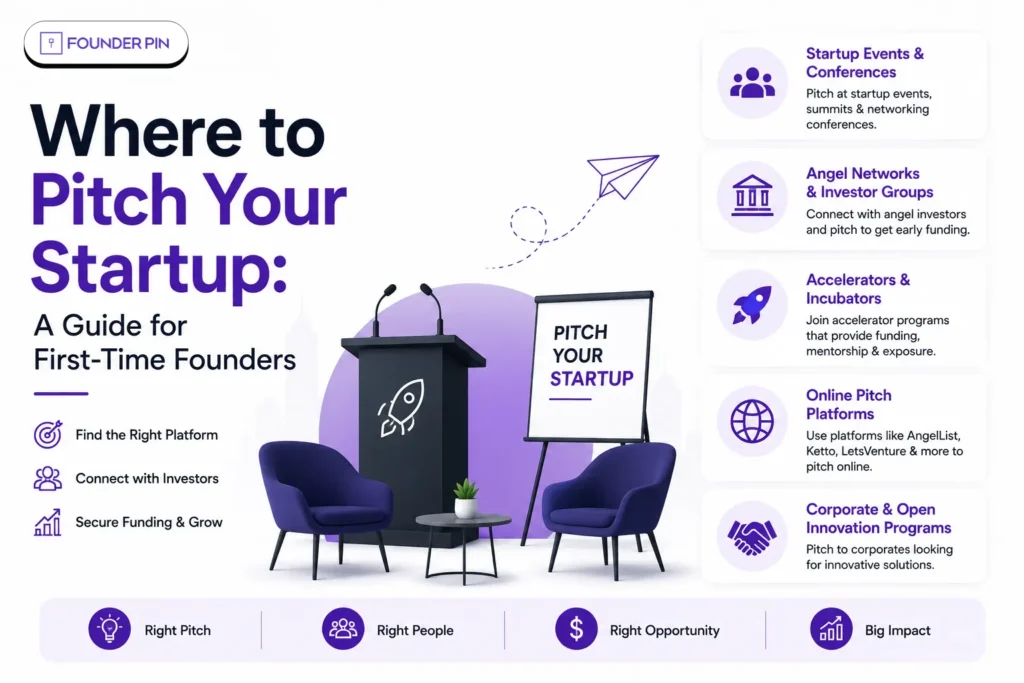
Here are some of the best places to pitch your startup.
1. Online Startup Funding Platforms
Online fundraising platforms make it easier to connect with investors, even if you’re building your startup remotely.
AngelList (Wellfound)
AngelList, now known as Wellfound, is one of the most popular platforms for early-stage fundraising. It helps founders connect with angel investors, startup syndicates, and micro-VCs. Many investors on the platform write initial checks ranging from US$10,000 to US$100,000.
Gust
Gust connects startups with accredited angel investors and organized angel networks. If you’re looking for regional investor groups or structured fundraising opportunities, it’s an excellent platform to explore.
Republic & Wefunder
If you’re considering equity crowdfunding, Republic and Wefunder are worth exploring. These platforms allow startups to raise capital from a large community of supporters, including early customers who want to invest in the business.
2. Startup Accelerators and Incubators
Accelerators do much more than provide funding. They help founders validate ideas, improve their business model, refine their pitch, and connect with experienced investors. Not sure whether a startup reality show or an accelerator is the right choice? Read our comparison of Startup Shows vs Startup Accelerators to make an informed decision.
Y Combinator (YC)
Y Combinator is one of the world’s most recognized startup accelerators. It provides pre-seed funding, intensive mentorship, and access to a powerful founder network. The program concludes with Demo Day, where startups pitch to leading seed and Series A investors.
Techstars
Techstars operates accelerator programs in cities around the world, including Bangalore and London. Participants receive mentorship, funding, and practical support before presenting their startups to investors during Demo Day.
Founder Institute
For first-time founders, Founder Institute offers a structured environment to build a startup from the ground up. The program helps entrepreneurs validate ideas, prepare investor-ready pitch decks, and connect with mentors who have startup-building experience.
After joining an accelerator, participating in Startup Demo Days is one of the best ways to connect with investors and showcase your startup.
3. Startup Networking Events and Pitch Competitions
Pitching your startup isn’t limited to online platforms. Networking events and startup competitions also create valuable opportunities to meet investors and industry leaders.
Kerala Startup Mission (KSUM)
If you’re based in Kerala, Kerala Startup Mission (KSUM) regularly organizes startup meetups, investor networking sessions, hackathons, and seed-funding events. These programs offer founders a practical way to connect with the local startup ecosystem.
Global Startup Competitions
International competitions such as MassChallenge and TiE pitch events allow startups to present their ideas before investors, mentors, and corporate leaders. Besides funding opportunities, these events help founders gain visibility and expand their professional network.
Many enterprise innovation programs featured in our guide to Corporate Startup Challenges That Offer Funding provide pilot projects, grants, and strategic partnerships for startups.
4. Connect with Investors Directly
Many founders successfully raise their first investment by reaching out to investors personally.
LinkedIn is one of the best platforms for finding angel investors and partners at micro-VC firms. Before sending a message, research the investor’s portfolio to understand their interests. If you have a mutual connection, ask for a warm introduction. Otherwise, send a concise and personalized message that highlights your startup’s traction, such as customer growth, revenue, or user engagement.
Why Choosing the Right Pitching Platform Matters
Not every startup should pitch to venture capital firms on day one.
Your pitching strategy should match your startup’s maturity.
For example:
- Idea-stage founders benefit from incubators and university competitions.
- MVP-stage startups often succeed at accelerators and demo days.
- Revenue-generating startups are better suited for angel investors, VCs, and corporate innovation challenges.
Founders who pitch at the right stage significantly improve their chances of receiving positive responses. Programs also receive hundreds or even thousands of applications per cohort, making alignment between startup stage and program expectations critical.
How to Prepare Before Pitching Your Startup
Even the best pitching platform won’t help if you’re unprepared. Investors, mentors, and judges expect founders to present a clear vision backed by real data.
Preparation is what separates memorable pitches from forgotten ones.
Build a Strong Pitch Deck
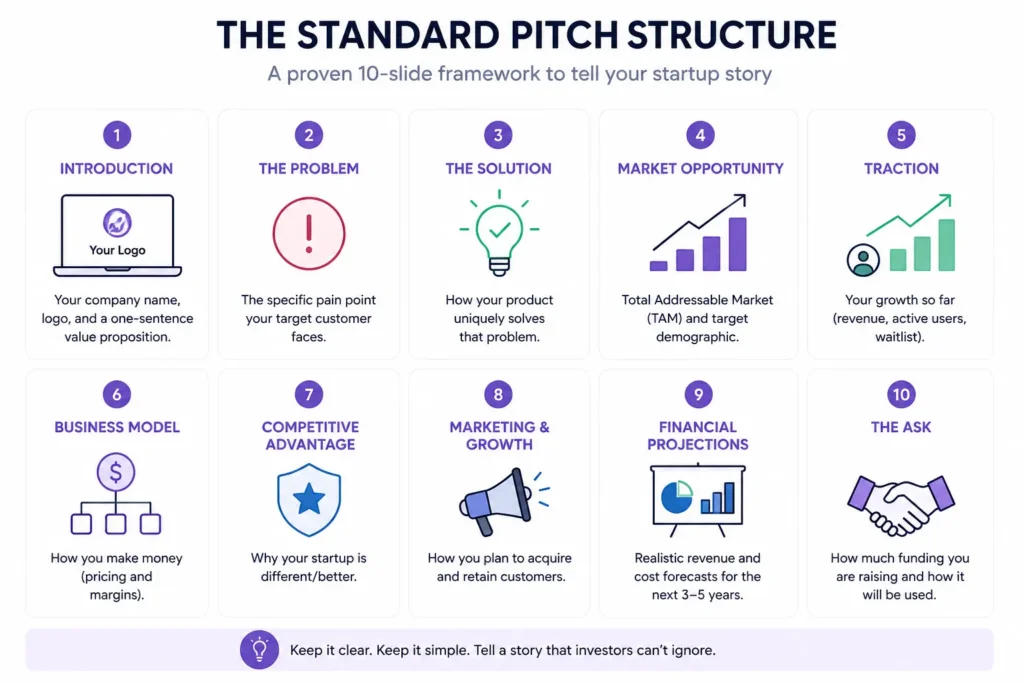
Your pitch deck should answer the most important investor questions within 10–12 slides.
Include:
- Problem
- Solution
- Product
- Market opportunity
- Business model
- Competition
- Traction
- Financial projections
- Team
- Funding ask
Keep your slides simple, visual, and supported by data rather than excessive text.
Know Your Numbers
Investors almost always ask about financial performance.
Before pitching, understand:
- Revenue
- Gross margin
- Customer Acquisition Cost (CAC)
- Lifetime Value (LTV)
- Burn rate
- Monthly growth
- Runway
Founders who confidently explain their metrics build greater investor trust.
Practice Your Elevator Pitch
You should be able to explain your startup in less than one minute.
A strong elevator pitch should clearly answer:
- What problem do you solve?
- Who are your customers?
- What makes your solution unique?
- Why now?
This concise explanation is useful at networking events, investor meetings, and startup competitions.
Prepare for Investor Questions
Expect challenging questions such as:
- Why is your solution different?
- Who are your competitors?
- Why will customers choose you?
- How will you scale?
- Why is your team the right team to solve this problem?
Practicing these questions in advance increases confidence during live pitches.
Common Pitching Mistakes to Avoid
Many first-time founders lose investor interest because of avoidable mistakes.
Talking Too Much About Features
Investors care less about features and more about outcomes.
Instead of explaining every feature, focus on:
- Customer pain points
- Business impact
- Market opportunity
- Competitive advantage
Always connect your product to measurable value.
Ignoring Customer Validation
Ideas alone rarely convince investors.
Show evidence such as:
- Paying customers
- Pilot projects
- User feedback
- Waitlists
- Revenue growth
Validation demonstrates that the market genuinely wants your solution.
Unrealistic Financial Projections
Avoid presenting aggressive forecasts without supporting assumptions.
Investors prefer realistic growth supported by:
- Historical performance
- Market research
- Customer demand
- Sales strategy
Credibility matters more than optimism.
Poor Storytelling
The best startup pitches are memorable because they tell a compelling story.
Explain:
- Why the problem matters
- Why you decided to solve it
- Why your team is uniquely positioned
- How customers benefit
Strong storytelling creates emotional connection while reinforcing business logic.
FounderPin Perspective
We have assisted founders at FounderPin in getting ready for venture capital fundraising, angel investor meetings, accelerator Demo Days, and business contests. One lesson that always sticks out is that, while where you pitch is important, how you pitch is even more crucial. Investors remember founders that are straightforward in their communication, provide evidence to back up all of their claims, and exhibit a thorough comprehension of both customers and business principles. While inadequate preparation nearly always results in rejection, excellent preparation does not ensure financing.
Conclusion
Understanding Where to Pitch Your Startup is one of the most important decisions a first-time founder can make.
From startup competitions and incubators to accelerators, Demo Days, angel investor networks, corporate innovation challenges, and venture capital firms, every platform serves a different purpose in the startup journey.
The best places to pitch your startup depend on your stage of growth, product maturity, and fundraising goals. Rather than pitching everywhere, focus on the platforms that align with your current progress. Combined with a compelling pitch deck, validated traction, and strong storytelling, the right pitching strategy can open doors to funding, partnerships, and long-term business growth.
Contact FounderPin for Expert Startup Guidance
Finding the right platform is only the first step—winning investor confidence requires preparation.
At FounderPin, we help founders with:
- Startup Registration
- DPIIT Recognition
- Pitch Deck Preparation
- Investor Readiness
- Fundraising Strategy
- Business Planning
- Startup Competition Applications
- Accelerator & Incubator Guidance
- Growth Consulting
Whether you’re preparing for your first investor meeting or deciding where to pitch your startup, our experts can help you build an investor-ready business.
Contact us today for a consultation and let FounderPin help you pitch with confidence and accelerate your startup journey.
FAQs
1. Where should first-time founders pitch their startup?
First-time founders should pitch their startup at platforms that match their stage of growth, such as startup incubators, accelerators, Demo Days, startup competitions, angel investor networks, and corporate innovation challenges. Choosing the right platform increases the chances of receiving funding, mentorship, and valuable feedback.
2. What are the best places to pitch your startup?
Some of the best places to pitch your startup include Y Combinator, Techstars, Startup India competitions, Startup Mahakumbh, angel investor networks, corporate startup challenges, university startup competitions, and accelerator Demo Days. Each platform offers unique opportunities depending on your startup’s maturity.
3. How do I prepare before pitching my startup to investors?
Before pitching, prepare a strong pitch deck, understand your financial metrics, validate your business idea with customers, practice your elevator pitch, and be ready to answer questions about your market, competition, traction, and growth strategy. Preparation significantly improves fundraising success.
4. Should I pitch to angel investors or venture capital firms first?
Most first-time founders should approach angel investors before venture capital firms. Angel investors are generally more open to backing early-stage startups, while VCs typically look for startups with proven traction, scalable business models, and consistent revenue growth.
5. What mistakes should founders avoid when pitching their startup?
Common mistakes include overvaluing the startup, lacking financial knowledge, focusing only on product features, ignoring customer validation, and delivering unclear or overly technical presentations. Investors prefer founders who communicate clearly, support claims with data, and demonstrate strong execution capability.