
Why Indian Startup Funding Is Changing in 2026 and What Founders Must Do Now
Table of Contents
Toggle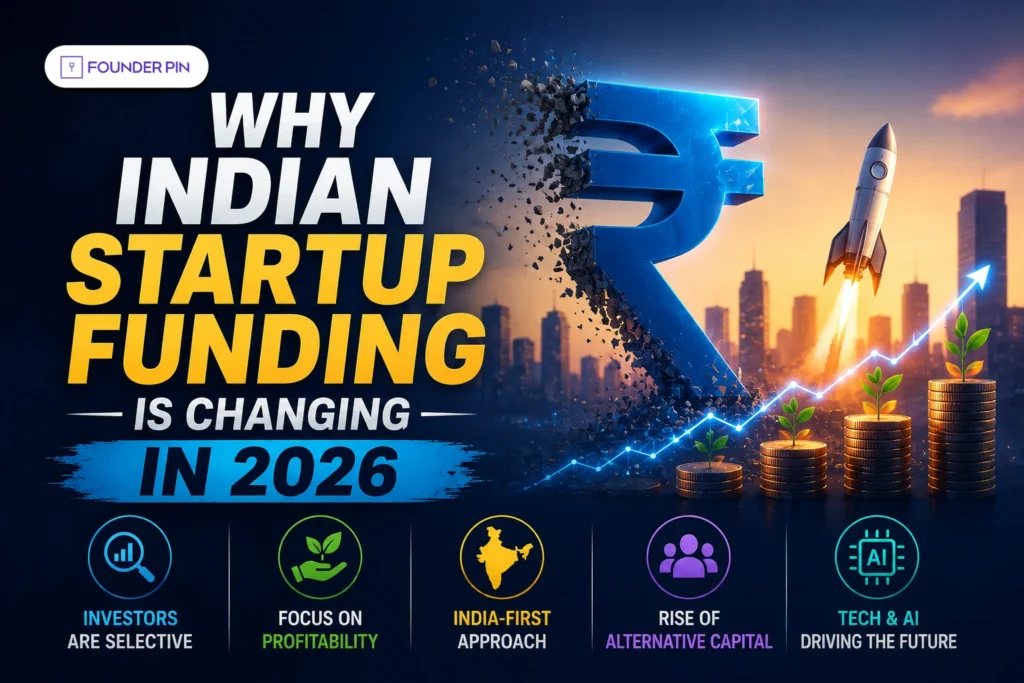
We at FounderPin think that the Indian startup funding scene will undergo a significant change in 2026. Although funding regulations have evolved, investors continue to support promising startups with strong business fundamentals. However, the “growth at any cost” strategy no longer dominates the market.
Today, investors focus more on sustainable growth, profitability, and efficient business models. As a result, founders must demonstrate stronger unit economics, transparent operations, and realistic growth strategies to secure startup funding in India.
Moreover, venture capital firms now prefer startups with practical monetization plans and long-term scalability. Companies that solve real problems and generate measurable value attract greater investor confidence in 2026.
The maturity of India’s startup scene is reflected in this change. Therefore, entrepreneurs must understand the latest startup funding trends in India before approaching investors.
In this guide, we explain the biggest startup funding trends shaping India in 2026. In addition, we explore what investors expect from founders and how startups can improve their chances of raising capital successfully.
Key Indian Startup Funding Trends 2026
The Shift Toward Quality Over Hypergrowth
One of the biggest startup funding trends in India is the growing focus on business quality rather than rapid expansion alone. In early 2026, overall startup funding declined by nearly 26% year-over-year. As a result, investors became far more selective while evaluating new opportunities.
Earlier, many startups raised capital primarily through aggressive user growth and market expansion strategies. However, investors now prioritize sustainable business models, healthy unit economics, and realistic profitability plans. In addition, venture capital firms increasingly expect startups to demonstrate a clear path toward EBITDA-positive growth instead of relying only on vanity metrics.
Therefore, founders must now focus on operational efficiency, customer retention, and revenue stability to attract investor confidence.
Fewer Deals but Larger Investment Rounds
Another major trend shaping startup funding in India is the reduction in the number of funded startups. Although fewer companies are receiving investment, the startups that secure funding are raising significantly larger rounds.
Average deal sizes and median investment ticket values continue to increase because investors prefer backing companies with proven traction and scalable business models. As a result, firms with solid fundamentals frequently get more funding to boost expansion and take the lead in the market.
This trend reflects a more cautious investment environment. Instead of spreading capital across numerous early-stage startups, investors now concentrate resources on businesses with stronger execution capabilities and long-term growth potential.
Rapid Growth of AI and Deep Tech Startups
Artificial intelligence and deep tech startups have emerged as major winners in India’s evolving funding ecosystem. AI startups now capture a record share of venture capital investments, and several companies have raised hundreds of millions of dollars within single funding quarters.
The rapid adoption of generative AI, automation tools, and enterprise intelligence platforms continues to drive investor interest across multiple industries. Furthermore, sectors such as healthcare AI, fintech automation, cybersecurity, education technology, and enterprise software are attracting significant funding attention.
Because of this momentum, AI startup ideas in India have become one of the most attractive opportunities for founders and investors in 2026.
Expansion Beyond Traditional Startup Hubs
India’s startup ecosystem is no longer limited to Bengaluru, Mumbai, and Delhi-NCR. Investors are increasingly exploring opportunities in Tier 2 and Tier 3 cities where startup ecosystems continue to grow rapidly.
Cities such as Jaipur, Indore, Coimbatore, Ahmedabad, and Kochi are attracting attention because of lower operating costs, improving digital infrastructure, and rising entrepreneurial activity. In addition, founders from emerging regions often build highly efficient businesses with strong local market understanding.
As a result, venture capital firms are expanding their investment mandates beyond traditional metropolitan hubs and actively searching for scalable startups across new regional markets.
What Investors Want Now
The most important question founders should ask is: What investors want now? The answer has shifted from pure growth to measurable business quality.
Strong Unit Economics
Investors want evidence that each customer generates meaningful long-term value relative to acquisition costs. Sustainable economics suggest that growth can be scaled efficiently.
Clear Product-Market Fit
Startups with high retention and strong customer satisfaction are more attractive because they demonstrate real demand. Consistent usage is often a stronger signal than headline growth.
Large Addressable Markets
Venture capital requires the potential to build substantial businesses. Investors look for startups solving meaningful problems in large and expanding markets.
Exceptional Founders
A compelling founding team remains one of the most important investment criteria. Investors back entrepreneurs who combine vision, resilience, and execution ability.
How Founders Should Adapt
Understanding how founders should adapt is crucial in today’s fundraising environment.
Focus on Metrics That Matter
Track retention, gross margins, payback periods, and customer lifetime value. These metrics provide a clearer picture of business quality than vanity indicators.
Build a Strong Personal Brand
Founders with visible expertise often attract more opportunities from investors, customers, and media. A credible online presence can significantly strengthen fundraising outcomes.
Tell a Data-Driven Story
Your pitch should combine a compelling vision with concrete evidence of traction. Investors want both narrative and numbers.
Prepare for Longer Fundraising Cycles
Raising capital may take more time than in previous years. Founders should manage cash carefully and begin outreach well before funds are urgently needed.
Despite tighter standards, several categories continue to receive strong investor attention:
- Artificial intelligence and automation
- Fintech infrastructure
- Climate and sustainability technology
- Healthcare innovation
- B2B SaaS
- Deep technology
Startups in these sectors are attracting capital because they address large markets and deliver measurable value.
The FounderPin Perspective
At FounderPin, we believe the best fundraising strategy in 2026 is simple: build a real business. Capital increasingly flows to startups with disciplined execution, strong customer demand, and founders who communicate with clarity and credibility.
This environment may be more demanding, but it also rewards substance over hype. For serious entrepreneurs, that is a positive shift.
Helpful External Resource
For additional insights into the Indian startup ecosystem, explore Startup India, the Government of India’s official initiative supporting entrepreneurship and innovation.
Conclusion: India Startup Funding Rewards Strong Fundamentals
The landscape of India startup funding is changing rapidly. The most significant Indian startup funding trends for 2026 indicate a market where investors prioritise founder quality, product-market fit, and profitability.
If you understand what investors want now and act on how founders should adapt, you will be far better positioned to raise capital and build a resilient company.
Ready to Position Your Startup for Funding?
At FounderPin, we help founders build authoritative personal brands, sharpen their narratives, and create content strategies that attract investors and media attention.
Contact us for a consultation and prepare your startup for the new funding era.