Can AI Replace Co-Founders and Marketing Teams in Startups?
Table of Contents
Toggle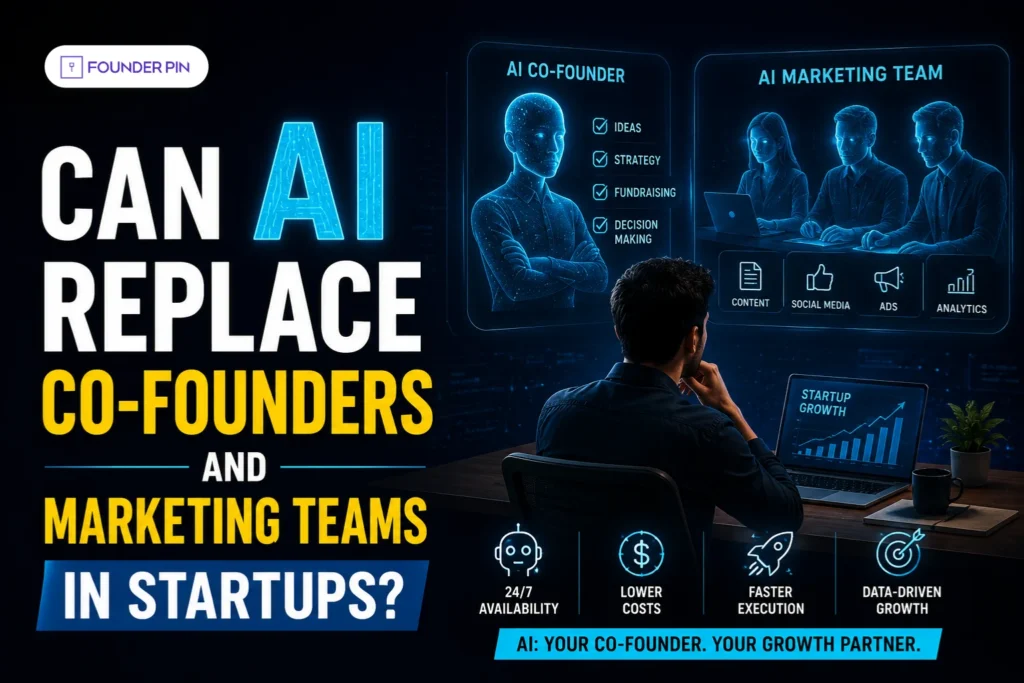
At FounderPin, we closely monitor how emerging technologies are changing the startup landscape. One question continues to spark debate among founders: Can AI replace co-founders and marketing teams in startups?
Startups are utilising AI for a variety of purposes as it advances. These include content creation, customer support, data analysis, software development, and marketing automation. As a result, many entrepreneurs wonder if they can build and grow a business with a much smaller team.
Today, AI tools can generate business plans, create marketing campaigns, analyze customer behavior, and automate routine operations. In many cases, startups can complete work that previously required multiple employees. This shift has made AI an essential part of modern business operations.
However, AI still has limitations. While it can improve efficiency and reduce costs, it cannot fully replace human leadership, strategic thinking, creativity, and relationship-building. These qualities remain critical for long-term business success.
In this article, we examine whether AI can replace co-founders and marketing teams, explore the benefits and limitations of AI in startups, and discuss what the future of entrepreneurship may look like in an AI-driven world.
Can AI Replace a Co-Founder?
Artificial intelligence cannot completely replace a human co-founder. However, it can serve as a highly effective business assistant that helps founders work faster and more efficiently. While AI can automate tasks and improve productivity, it still lacks the human qualities needed to build and lead a successful company.
What AI Can Do for Founders
AI can help solo entrepreneurs handle many day-to-day business activities that previously required additional team members. This allows founders to launch and grow startups with fewer resources.
Product Development and Engineering
AI-powered development tools can help founders build MVPs, generate code, identify bugs, and accelerate software development. As a result, startups can launch products more quickly and reduce development costs.
Marketing and Content Creation
AI can assist with creating landing page content, social media posts, email campaigns, ad copy, and other marketing materials. This helps founders execute marketing strategies without hiring large content teams.
Research and Business Analysis
AI tools can analyze competitors, summarize industry trends, identify market opportunities, and gather business insights. These capabilities help founders make informed decisions more efficiently.
What AI Cannot Replace
Although AI excels at automation and data processing, several critical startup functions still require human involvement.
Emotional Support and Partnership
Building a startup can be challenging and stressful. A co-founder provides motivation, accountability, and emotional support during difficult periods, something AI cannot replicate.
Investor Relationships
Investors typically back founders rather than technology alone. Trust, credibility, communication skills, and personal relationships remain essential components of fundraising.
Strategic Decision-Making
AI can provide recommendations based on data. However, it cannot fully understand complex business situations or make high-stakes decisions that require intuition, experience, and long-term vision.
Networking and Distribution
Launching a product is only one part of building a successful startup. Founders still need to establish partnerships, build communities, attract customers, and create meaningful relationships. These activities rely heavily on human interaction and communication.
The Rise of the “Solo Founder + AI” Model
Traditionally, startups relied on multiple co-founders to divide responsibilities and accelerate growth. Today, AI allows solo founders to accomplish much more independently.
By using AI for development, marketing, research, and operations, entrepreneurs can increase productivity significantly and reach their first customers faster. This approach enables founders to validate ideas, generate revenue, and build momentum before expanding their teams or seeking external funding.
As a result, the “Solo Founder + AI” model is becoming an increasingly popular startup strategy in 2026.
Can AI Replace Marketing Teams?
Artificial intelligence is transforming the way marketing teams operate, but it is unlikely to replace them entirely. Instead of eliminating marketing roles, AI is automating repetitive and time-consuming tasks. This enables marketers to concentrate more on strategy, innovation, and client interaction.
Many experts believe that AI will not replace marketers. Rather, marketers who effectively use AI will have a significant advantage over those who do not.
Where AI Delivers the Most Value
Modern AI tools help businesses improve efficiency by handling routine marketing activities quickly and accurately.
Data Analysis and Insights
AI can process large volumes of customer data and identify meaningful patterns. It assists marketers in organising keywords, analysing performance metrics, and finding possibilities that might otherwise take hours to locate by hand.
Content Creation at Scale
Marketing teams use AI to create blog articles, email campaigns, product descriptions, and advertising copy. This speeds up content production and helps businesses maintain a consistent publishing schedule.
Personalized Customer Experiences
AI is able to tailor marketing campaigns according on user preferences and behaviour. Businesses can automatically optimize email delivery times, personalize website content, and recommend relevant products to different customer segments.
What Human Marketers Still Do Best
Although AI can automate many tasks, it cannot fully replace the human qualities that drive successful marketing campaigns.
Understanding Human Emotions
Successful marketing depends on understanding customer emotions, motivations, and cultural influences. Human marketers can interpret these factors and create messages that resonate with audiences on a deeper level.
Strategic Planning
AI can provide recommendations, but people make the final strategic decisions. Marketers determine campaign objectives, brand positioning, and long-term business goals based on experience and market understanding.
Creative Thinking
AI can generate variations of existing content, but breakthrough ideas often come from human creativity. Innovative campaigns, unique brand stories, and original concepts still rely heavily on human imagination.
Relationship Building
Strong marketing requires collaboration with customers, partners, influencers, and internal teams. Building trust and maintaining meaningful relationships remain tasks that require a human touch.
How Marketing Teams Are Evolving
The role of modern marketers is changing rapidly. Instead of spending most of their time on manual execution, they are increasingly focusing on strategy, oversight, and creative leadership.
AI handles repetitive tasks such as reporting, content generation, and data analysis. In the meantime, marketing experts concentrate on client relations, campaign planning, brand development, and business expansion.
As a result, the most successful companies are adopting a hybrid approach. They combine AI-driven automation with human creativity and strategic thinking to achieve better marketing results.
The Emergence of Lean AI-Powered Startups
Smaller Teams, Bigger Results
One major trend in 2026 is the rise of lean startups powered by AI.
Instead of hiring large teams, founders are using AI tools for:
- Content marketing
- Graphic design
- Customer service
- Market research
- Project management
This allows startups to remain agile while reducing overhead costs.
The New Startup Operating Model
The future startup model may look different from traditional businesses.
A small team of skilled professionals supported by AI can often achieve the same output as a much larger organization.
This shift is changing how founders think about hiring, scaling, and operational efficiency.
The Risks of Over-Reliance on AI
Lack of Original Thinking
AI uses pre-existing data patterns to develop replies. It does not possess genuine creativity or independent thinking.
Startups that rely entirely on AI may struggle to create unique products, brands, or strategies.
Ethical and Data Concerns
Using AI extensively introduces challenges such as:
- Data privacy risks
- Intellectual property issues
- Bias in AI-generated outputs
- Regulatory compliance concerns
Founders must carefully balance automation with responsible business practices.
Human Relationships Still Matter
Investors, customers, employees, and partners ultimately trust people, not algorithms.
Building relationships, leading teams, and inspiring confidence remain fundamentally human responsibilities.
The Future: AI as a Co-Pilot, Not a Replacement
The most realistic future is not one where AI replaces founders and marketing teams entirely. AI will act as a potent co-pilot instead.
Successful startups will combine:
- AI-driven efficiency
- Human creativity
- Strategic leadership
- Emotional intelligence
Founders who learn how to work alongside AI will gain a significant competitive advantage.
Rather than replacing people, AI is reshaping how people work.
What Startup Founders Should Do Today
To stay competitive, founders should:
- Learn AI tools relevant to their industry
- Automate repetitive workflows
- Use AI for research and productivity
- Focus human efforts on strategy and innovation
- Build teams that can collaborate effectively with AI
The goal is not to eliminate people but to maximize the value each person brings.
Conclusion
So, can AI replace co-founders? The answer is largely no. AI can support decision-making, automate research, and improve efficiency, but it cannot replicate leadership, trust, and human judgment.
Similarly, while can AI replace marketing teams is a valid question, the reality is that AI works best as an enhancement rather than a replacement. Human creativity, storytelling, and strategic thinking continue to drive successful marketing.
The startups that thrive in the coming years will not be those that replace people with AI. Instead, they will be the companies that combine human talent with AI-powered capabilities to build smarter, faster, and more innovative businesses.
Ready to Build an AI-Powered Startup?
At FounderPin, we help founders grow through SEO, content strategy, startup branding, and digital visibility.
Contact us for a consultation and discover how your startup can leverage AI while building a sustainable competitive advantage.
Frequently Asked Questions (FAQs)
1. Can AI replace co-founders in a startup?
No, AI cannot fully replace co-founders. While AI can assist with research, planning, and data analysis, it lacks leadership skills, emotional intelligence, strategic judgment, and the ability to build relationships with investors, customers, and team members.
2. Can AI replace marketing teams completely?
AI can automate many marketing tasks, including content creation, SEO analysis, email campaigns, and social media management. However, human marketers are still essential for brand strategy, creative storytelling, customer psychology, and campaign innovation.
3. How are startups using AI today?
Startups use AI for content generation, market research, customer support, data analysis, product development, workflow automation, and digital marketing. These tools help founders operate more efficiently while reducing costs.
4. What are the benefits of using AI in startups?
AI helps startups save time, lower operational expenses, improve productivity, automate repetitive tasks, and make data-driven decisions. It enables lean teams to scale faster without significantly increasing headcount.
5. What is the future of AI in startup businesses?
The future of AI in startups is likely to be collaborative rather than replacement-focused. AI will act as a powerful business assistant, while founders and teams continue to provide leadership, creativity, strategic thinking, and relationship management.