
How DeepTech Startups Can Access Government Funding in India
Table of Contents
Toggle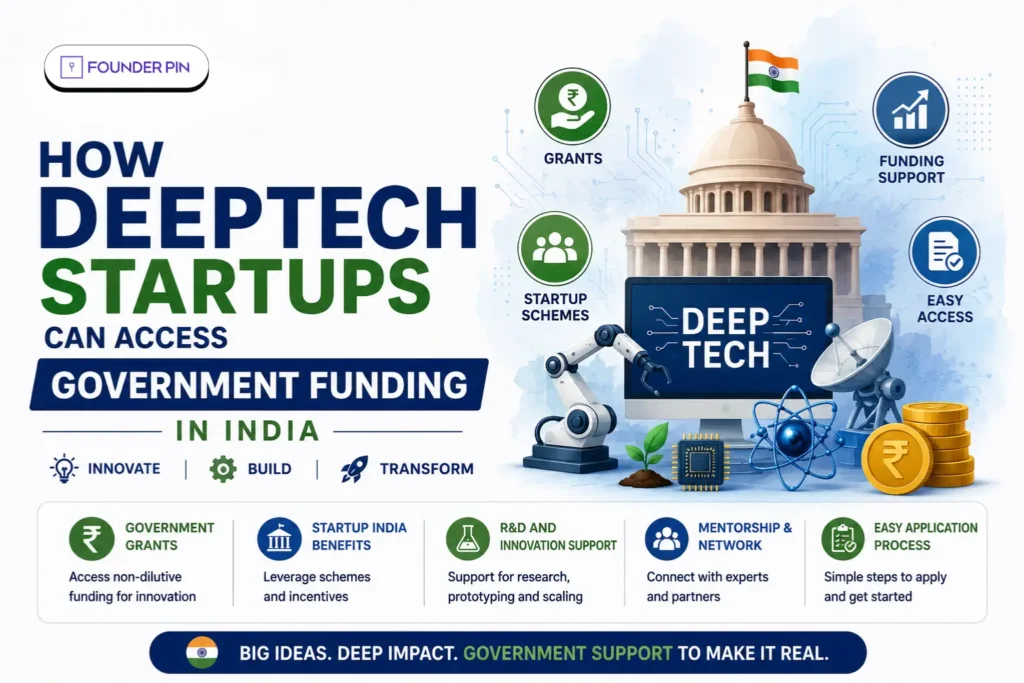
Key Takeaways
- Government funding for DeepTech startups India provides critical non-dilutive capital for research, product development, and commercialization.
- Programs such as the Startup India Seed Fund Scheme, NIDHI PRAYAS, Technology Development Board (TDB), Biotechnology Ignition Grant (BIG), and Atal Innovation Mission support DeepTech innovation.
- Strong intellectual property, scalable technology, and clear commercial applications can significantly improve funding approval chances.
- Government-backed incubators offer valuable resources, including mentorship, research infrastructure, networking opportunities, and investor access.
- DeepTech startups can combine government grants with private investment to accelerate growth while minimizing equity dilution.
- Strategic use of government grants for DeepTech startups helps founders overcome long development cycles and high research costs.
- Leveraging DeepTech startup funding India programs can help innovators transform breakthrough technologies into globally competitive businesses.
DeepTech startups are redefining India’s innovation landscape by developing breakthrough technologies in artificial intelligence, robotics, quantum computing, semiconductors, biotechnology, space technology, advanced materials, and clean energy. Unlike traditional startups, DeepTech ventures often require substantial research, longer development cycles, and significant capital before generating commercial revenue.
This creates a major funding challenge. Many investors hesitate to back technologies that require years of research and validation. Fortunately, the Indian government has introduced multiple funding initiatives designed to support innovation-driven businesses and strengthen the country’s technology ecosystem.
At FounderPin, we help startups identify funding opportunities and navigate government support programs. In this guide, we’ll explore how founders can access government funding for DeepTech startups India, the most relevant funding schemes available, and strategies to improve funding success.
Why Government Funding Is Critical for DeepTech Startups
DeepTech companies operate differently from conventional startups. Developing advanced technologies often requires investment in research infrastructure, intellectual property, testing, prototyping, regulatory approvals, and specialized talent.
Government funding helps address these challenges by offering:
- Non-dilutive capital
- Research and development support
- Prototype funding
- Commercialization assistance
- Intellectual property incentives
- Incubation and mentorship opportunities
For many founders, government support provides the runway needed to transform innovative research into scalable businesses.
Understanding the DeepTech Funding Landscape in India
India has increasingly prioritized technological innovation as part of its long-term economic strategy. As a result, several programs now focus on supporting emerging technologies and research-led startups.
What Qualifies as a DeepTech Startup?
DeepTech startups typically work in areas such as:
- Artificial Intelligence (AI)
- Machine Learning
- Robotics
- Space Technology
- Semiconductor Innovation
- Biotechnology
- Quantum Computing
- Advanced Manufacturing
- Clean Technology
- Cybersecurity
These businesses are often built around proprietary technology, scientific discoveries, or significant research breakthroughs.
How DeepTech Startups Can Access Government Funding
DeepTech startups in India can secure government funding through specialized Fund of Funds programs, ministry-backed grant schemes, research commercialization initiatives, and sector-specific missions. These programs are designed to support startups working in areas such as artificial intelligence, quantum computing, semiconductors, biotechnology, and advanced manufacturing.
1. Thematic Fund of Funds (FoF)
Rather than investing directly in startups, the government allocates capital to approved Alternative Investment Funds (AIFs) that focus on high-risk, innovation-driven sectors.
Startup India Fund of Funds 2.0
Funding: Backed by a ₹10,000 crore corpus dedicated to supporting startups operating in emerging technologies such as AI, quantum computing, biotechnology, and deep-tech innovation.
How to Access
DeepTech startups cannot apply directly to the government for this funding. Instead, founders must raise investment from SEBI-registered venture capital funds and AIFs that participate in the Fund of Funds program.
2. Direct Grants and Early-Stage Support
Several government departments provide direct funding to help startups move from research and development to commercial product development.
NIDHI (National Initiative for Developing and Harnessing Innovations)
Managed by the Department of Science and Technology (DST), NIDHI offers early-stage support through Proof of Concept (PoC) grants and the Seed Support System for technology startups.
GENESIS (Gen-Next Support for Innovative Startups)
Operated by MeitY, GENESIS provides funding, incubation assistance, acceleration programs, and mentorship for innovative technology ventures.
How to Access
Eligible startups must apply through approved Technology Business Incubators (TBIs) or implementation partners associated with these programs.
3. Academic Research and Technology Commercialization
A significant portion of India’s DeepTech startups originate from universities, research institutions, and innovation centers. To support this ecosystem, the government funds programs that help convert academic research into commercial businesses.
Anusandhan National Research Foundation (ANRF)
ANRF focuses on bridging the gap between academic research and commercial innovation by supporting technology transfer, research commercialization, and startup creation.
How to Access
Founders working on university-developed intellectual property should coordinate with their institution’s Technology Transfer Office (TTO) to explore available grants and co-development opportunities.
4. Sector-Specific DeepTech Missions
The government also operates dedicated programs for strategic technology sectors.
National Quantum Mission
Provides targeted funding, infrastructure support, and ecosystem development for startups working in quantum computing, quantum communication, and related technologies.
Indian Semiconductor Mission (ISM)
Offers financial assistance, fiscal incentives, and collaborative infrastructure support for semiconductor startups, chip design companies, and fabless technology ventures.
How to Access
Startups can apply through the designated mission portals and implementation agencies managing these sector-specific programs.
Essential First Steps Before Applying
DPIIT Recognition
Before applying for most startup-focused government programs, founders should obtain DPIIT recognition through Startup India. This recognition unlocks access to startup benefits such as tax exemptions, funding opportunities, government tenders, and startup support networks.
Follow National Deep Tech Startup Policy (NDTSP) Guidelines
DeepTech founders should stay aligned with the National Deep Tech Startup Policy (NDTSP), which provides standardized definitions, policy guidance, and compliance frameworks for technology-driven startups.
By leveraging these funding programs and support initiatives, DeepTech startups can access the capital, infrastructure, and ecosystem support needed to accelerate innovation and scale their businesses.
How DeepTech Startups Can Improve Funding Approval Chances
Build Strong Intellectual Property
- Patents and proprietary technologies demonstrate defensibility and innovation.
- Government evaluators often view intellectual property as an indicator of long-term competitive advantage.
Demonstrate Real-World Applications
Even highly advanced technologies require clear commercial use cases.
Founders should explain:
- The problem being solved
- Industry applications
- Market demand
- Economic impact
Focus on Scalability
- Funding agencies prioritize startups capable of generating meaningful economic value.
- Demonstrating large market opportunities and commercialization potential significantly improves funding prospects.
Common Challenges DeepTech Founders Face
Long Development Timelines
- Many DeepTech startups require years of research before commercialization.
- Government grants help reduce pressure during this phase.
Limited Access to Private Capital
- Investors often prefer businesses with faster revenue generation.
- Government funding provides an alternative source of capital while technology matures.
High Research Costs
- Specialized equipment, testing facilities, and technical talent can create significant financial burdens.
- Strategic use of grants and incubator resources can help manage these costs.
Combining Government Grants with Private Investment
One of the most effective funding strategies involves combining government grants for DeepTech startups with private investment.
Government funding can help startups:
- Build prototypes
- Validate technology
- Secure patents
- Demonstrate market demand
These milestones often make startups more attractive to angel investors and venture capital firms.
The Future of DeepTech Startup Funding India
India’s focus on innovation, digital transformation, advanced manufacturing, and strategic technologies is expected to increase substantially in the coming years.
As policymakers prioritize research commercialization and global competitiveness, opportunities for DeepTech startup funding India will continue expanding. Founders who actively leverage government support programs will be better positioned to scale breakthrough innovations and compete internationally.
Conclusion
Accessing government funding for DeepTech startups India can be a game-changing advantage for innovation-driven businesses. From seed funding and prototype development support to commercialization grants and incubator programs, government initiatives play a crucial role in helping DeepTech founders overcome financial barriers.
By understanding available opportunities, building strong applications, and aligning innovation with market needs, startups can unlock funding that accelerates growth while preserving equity.
Contact FounderPin for Expert Funding Support
Navigating government grants, DeepTech innovation programs, and startup funding schemes can be complex. At FounderPin, we help founders identify suitable opportunities, prepare compelling applications, and build funding strategies that support long-term success.
Contact us for a consultation today and discover the best government funding opportunities available for your DeepTech startup.
Frequently Asked Questions (FAQs)
1. What are the best government funding programs for DeepTech startups in India?
Some of the leading programs include the Startup India Seed Fund Scheme (SISFS), NIDHI PRAYAS, Technology Development Board (TDB), Biotechnology Ignition Grant (BIG), and Atal Innovation Mission (AIM). These initiatives provide funding, incubation support, and commercialization assistance for innovation-driven startups.
2. How can DeepTech startups qualify for government grants in India?
To qualify for government grants for DeepTech startups, founders typically need to demonstrate technological innovation, scalability, intellectual property potential, market relevance, and a clear commercialization strategy. The qualifications for eligibility differ according on the plan.
3. Are government grants for DeepTech startups non-dilutive?
Yes, most government grants are non-dilutive, meaning startups can receive financial support without giving up equity or ownership. This makes them an attractive funding option for research-intensive DeepTech ventures.
4. Can DeepTech startups combine government funding with venture capital investment?
Yes, many startups use government funding for DeepTech startups India to develop prototypes, secure patents, and validate technology before raising angel investment or venture capital. Government support often enhances credibility and investor confidence.
5. Which sectors are eligible for DeepTech innovation funding in India?
DeepTech innovation funding is commonly available for startups working in artificial intelligence (AI), machine learning, robotics, biotechnology, semiconductor technology, cybersecurity, quantum computing, advanced manufacturing, clean energy, and space technology.
SHARE

25 Hidden Government Schemes for Startups in India Key Takeaways Many valuable government schemes for startups in India remain underutilized due to …
MSME Grants and Subsidies Available for Startups in 2026 Key Takeaways MSME grants for startups provide non-dilutive funding, helping founders grow their …

Grants for Student Startups in India: Complete Funding Guide Key Takeaways Grants for Student Startups in India provide non-dilutive funding, helping young …

15 Government Funding Schemes for Startups in India Key Takeaways Government funding schemes for startups provide valuable non-dilutive capital, helping founders grow …