
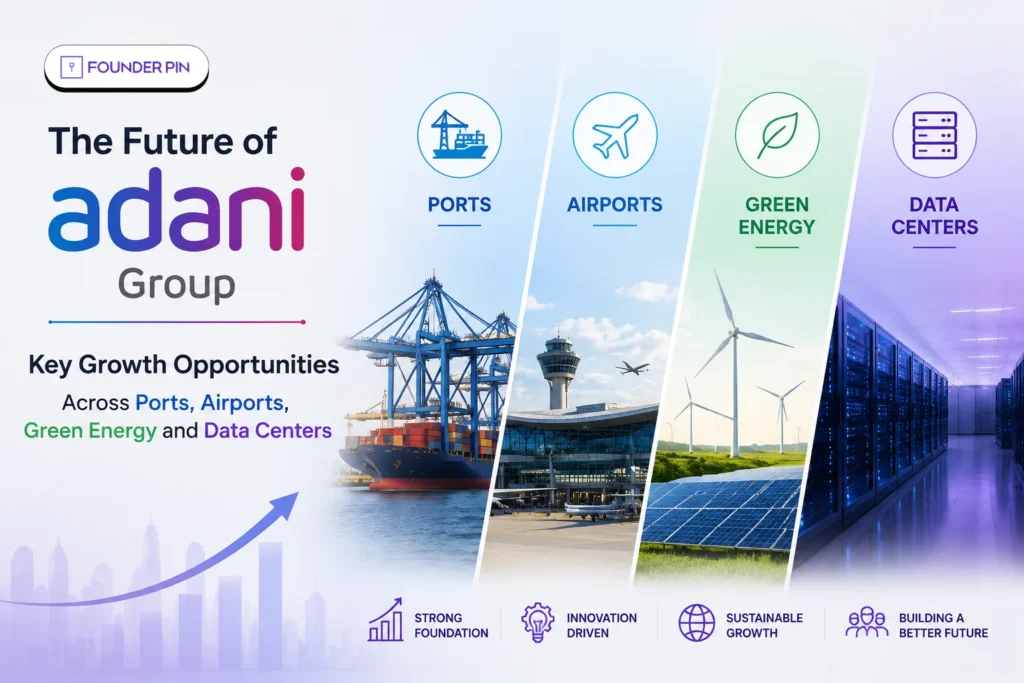
The Future of Adani Group: Key Growth Opportunities Across Ports, Airports, Green Energy and Data Centers
Table of Contents
Toggle
Key Takeaways
- The future of the Adani Group depends on strategic expansion across ports, airports, renewable energy, and AI-powered data centres.
- Adani Ports handled 420 MMT of cargo. Meanwhile, its airport business manages over 1 million tonnes of air cargo, strengthening India’s trade and logistics network.
- Adani Green Energy plans to increase its capacity from 8.1 GW to 45 GW by 2030. In addition, the company has committed more than US$55 billion to renewable energy investments.
- The Group has announced a US$100 billion investment in AI infrastructure. Furthermore, the expansion of AdaniConneX is strengthening its position in India’s growing digital economy.
- Overall, the Adani Group continues to diversify its infrastructure portfolio. As a result, its long-term growth opportunities remain closely aligned with India’s economic and infrastructure development.
Introduction
The future of Adani Group is closely tied to India’s ambitious infrastructure and economic transformation. Over the past three decades, the Adani Group has evolved from a commodity trading company into one of India’s largest infrastructure conglomerates, operating across ports, airports, renewable energy, logistics, power transmission, cement, gas distribution, and digital infrastructure.
Today, the Group is entering another phase of expansion. For official updates on the Group’s latest projects and long-term strategy, visit the Adani Group Newsroom. Massive investments in ports, airports, green energy, and AI-ready data centers are positioning Adani to benefit from India’s long-term growth story. According to official company announcements, the Group has already raised approximately US$9 billion from global investors to support infrastructure development and has announced an additional US$100 billion investment toward AI infrastructure and renewable-powered data centers by 2035.
These investments highlight significant Adani Group growth opportunities, making the company one of the most closely watched infrastructure businesses in Asia.
Why the Future of Adani Group Looks Promising
Several macroeconomic trends are supporting Adani Group expansion:
- India’s growing manufacturing sector
- Increasing exports and international trade
- Rising domestic air travel
- Rapid renewable energy adoption
- Artificial Intelligence infrastructure demand
- Government infrastructure spending
- Smart city development
Instead of relying on a single industry, the Adani Group has built an integrated ecosystem where ports, logistics, airports, renewable energy, transmission networks, and digital infrastructure support one another.
This integrated model gives the Group multiple long-term growth drivers.
1. Despite Expansion, the Adani Group Will Continue to Expand Through Its Port Operations
Adani Ports Is Still the Most Significant Port Operator in India
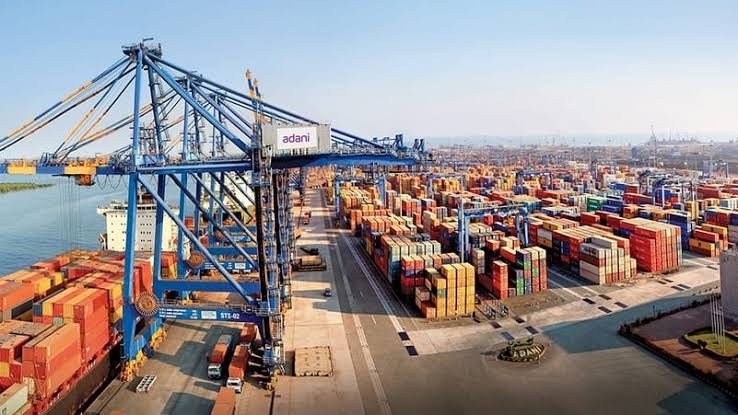
The Adani Group’s ports business is a crucial foundation for its future.
Adani Ports and Special Economic Zone (APSEZ) is the biggest integrated port and logistics company in India. While India’s maritime trade is largely controlled by its network, its growth in the global market remains steady.
According to official company data:
- The global cargo handling capacity of APSEZ was 420 million metric tonnes (MMT) by Q1 2016. FY2024.
- The largest commercial port network in India is still managed by the company.
- The acquisitions have bolstered its presence on both the east and west coasts.
The expansion of India’s international trade affords Adani a significant competitive edge. You can explore every listed company contributing to this ecosystem in our complete guide to the Adani Business Empire.
Strategic Port Acquisitions
Adani has expedited the growth of his business by acquiring facilities instead of building them entirely.
Major additions include:
- Gangavaram Port.
- Gopalpur Port.
- Krishnapatnam Port.
- Dighi Port.
Gangavaram Port provides services for around 64 passengers. One of India’s deepest ports is the one that can handle MMT cargo.
Adani’s project development timelines are reduced due to the acquisition, which also enhance its logistics ecosystem.
Long-Term Port Capacity Expansion
It has been officially declared that approximately 250 units of APSEZ will be constructed in the near future. MMT can increase the capacity of its network’s master-plan.
This expansion supports:
- Higher export volumes.
- Manufacturing growth.
- Container traffic.
- Bulk cargo movement.
- Global supply chain integration.
Adani’s port infrastructure will remain a significant competitive advantage for India as it becomes primarily centered on global manufacturing.
2. The Growth Engine for the Next Era Is Airports
Constructing the Most Extensive Private Airport Network in India

Aviation infrastructure is a significant avenue for growth within Adani Group.
Within a few years, Adani Airport Holdings has become the biggest privately-owned airport in India.
Its portfolio includes:
- Mumbai International Airport.
- The Navi Mumbai International Airport is currently under construction.
- Ahmedabad Airport.
- Lucknow Airport.
- Jaipur Airport.
- Guwahati Airport.
- Mangaluru Airport.
- Thiruvananthapuram Airport.
By partnering with these airports, India’s aviation industry benefits from the millions of passengers it serves each year.
The Expansion of Air Cargo Generates Novel Business Opportunities
The primary function of airport operations is no longer passenger traffic.
According to official company data:
- Over 1 million tonnes of air cargo was processed by Adani Airports in FY2024.
- India’s air cargo market was made up of roughly 30% of this.
- Air cargo volumes increased by 7% year on year.
The airport network in India is seeing a rise due to the increasing demand for cargo, which includes e-commerce and pharmaceuticals, as well as electronics exports and express logistics.
Navi Mumbai International Airport
Navi Mumbai International Airport is possibly the most significant potential upcoming development.
Once operational, it’s expected to:
- Reduce congestion at Mumbai Airport.
- Increase passenger capacity significantly.
- Support international connectivity.
- Produce numerous direct and indirect employment opportunities.
- Boost commercial real estate development.
Over the next few decades, the airport is projected to become one of India’s most crucial aviation hubs.
Airport Cities and Integrated Infrastructure
The Group is constructing integrated airport ecosystems, not standalone terminals.
These include:
- Business parks.
- Logistics hubs.
- Retail districts.
- Hotels.
- Commercial developments.
Adani’s approach creates multiple revenue streams from each infrastructure asset, which generates long-term economic value.
3. Green Energy & Renewable Expansion
Renewable energy is one of the biggest growth pillars for the Adani Group. Today, Adani Green Energy Limited (AGEL) is India’s largest renewable energy company. It operates around 8.1 GW of renewable energy capacity. Moreover, the company plans to expand this capacity to 45 GW by 2030.
The expansion includes:
- Utility-scale solar power projects
- Wind energy farms
- Hybrid renewable energy projects
- Battery energy storage systems
In addition, AGEL is developing the 30 GW Khavda Renewable Energy Park in Gujarat. Once completed, it is expected to become one of the world’s largest renewable energy parks. This project supports India’s clean energy transition while strengthening Adani’s position in the global renewable energy sector.
Furthermore, the Adani Group has announced plans to invest more than US$55 billion in green energy projects by 2035. These investments cover renewable power generation, green hydrogen, battery storage, and modern transmission infrastructure.
As a result, the company is building a diversified clean energy ecosystem instead of focusing only on electricity generation. Overall, strong government support, rising energy demand, and continuous investment in renewable technologies position the Adani Group for long-term growth. Therefore, green energy is expected to remain one of the company’s most important business opportunities in the coming decades.
4. The Next Phase of Adani Group’s Growth Is Likely to Be Facilitated by AI and Data Centers
Entering India’s AI Infrastructure Market
AI is causing an increase in the need for high-performance computing infrastructure.
Recognizing this opportunity, the Adani Group has announced one of its largest infrastructure investments ever.
The company’s official statement states:
By 2035, Adani aims to allocate US$100 billion towards the development of hyperscale data centers in India that are equipped with AI and run on renewable energy.
This investment is a part of the Group’s long-term strategy to merge digital infrastructure with clean energy generation.
Building India’s Largest Data Center Platform Through AdaniConneX
Through its joint venture AdaniConneX and EdgeConneX, Adani is pursuing its digital infrastructure goals.
Current plans include:
- Approximately 2 GW of data center capacity.
- Expansion toward a 5 GW nationwide data center platform.
They are different from traditional data centers in that they use renewable energy generated within the Adani ecosystem.
Operating costs are reduced by this integrated model, which also promotes sustainable digital infrastructure.
Global Partnerships Strengthen Growth
To further develop its data center, Adani has entered into strategic partnerships.
It has announced partnerships with global technology leaders, including:
- Google.
- Flipkart.
- Enterprise cloud providers.
- AI infrastructure partners.
The Group’s growth is anticipated to accelerate the development of AI-ready infrastructure in India, which will be facilitated by the growing digital economy.
What Insights Can Entrepreneurs Gain from Adani’s Growth Strategy?
Learnings for Startup Founders and Business Leaders Regarding the Future of Adani Group
Think Long Term
Rather than investing in the short-term, Adani consistently invests in sectors that have potential for long-lasting success.
Examples include:
- Ports.
- Airports.
- Renewable energy.
- Transmission.
- Data centers.
Similarly, entrepreneurs should seek out industries that have a long-term demand and sustainability. Learn more about these leadership principles in our in-depth guide on Gautam Adani Business Strategy, where we break down the mindset behind the Group’s long-term success.
Build an Integrated Business Ecosystem
Instead of running its own separate businesses, Adani connects its assets.
For example:
- Renewable energy powers data centers.
- Ports support logistics businesses.
- Airports connect commercial developments.
- Transmission networks strengthen energy businesses.
The creation of this ecosystem leads to the development of multiple revenue streams and operational efficiency.
Invest Before Demand Peaks
Amongst Adani’s competitive advantages lies the advantage of investing ahead of demand.
Examples include:
- Green hydrogen.
- AI infrastructure.
- Renewable energy.
- Airport cities.
- Logistics corridors.
Industry leaders are often those that anticipate future demand.
The Future of Adani Group: A Long-Term Growth Story
The Adani Group’s future seems to be in line with India’s economic priorities.
Adani Group’s growth is anticipated to persist in various fields:
- Port infrastructure.
- Airport modernization.
- Renewable energy.
- Green hydrogen.
- Power transmission.
- AI-ready data centers.
- Digital infrastructure.
- Logistics.
- Smart industrial ecosystems.
By investing billions in infrastructure and focusing on high-growth industries, Adani is poised to thrive over the next few decades. Many of these industries also feature in our guide to Future Business Opportunities, highlighting sectors expected to deliver strong growth over the next decade.
Conclusion
The future of the Adani Group extends far beyond traditional infrastructure businesses. Today, the Group is building an integrated ecosystem that supports India’s economic transformation. It continues to invest in ports, airports, renewable energy, green hydrogen, logistics, and AI-powered data centers. At the same time, it is strengthening the country’s digital and infrastructure capabilities.
According to official figures, Adani Ports handled 420 MMT of cargo, while Adani Green Energy operates around 8.1 GW of renewable energy capacity and aims to reach 45 GW by 2030. In addition, Adani Airports processed more than 1 million tonnes of air cargo. The Group has also announced over US$55 billion in green energy investments and plans to invest US$100 billion in AI infrastructure by 2035. Together, these investments highlight the Group’s long-term growth strategy.
As India continues to invest in infrastructure, clean energy, and digital transformation, the Adani Group remains well positioned for future growth. Moreover, its diversified business model creates opportunities across multiple high-growth sectors. Therefore, the company is expected to play a significant role in India’s economic development over the coming decades.
Get in Touch with FounderPin for Practical Business Advice
Large business groups such as Adani offer valuable lessons in long-term planning, infrastructure development, and sustainable growth. Likewise, startups can apply many of these strategies to build scalable businesses.
At FounderPin, we help entrepreneurs register their companies, maintain compliance, raise funding, and develop practical growth strategies. Whether you are launching a startup or expanding an existing business, our team provides expert guidance at every stage of your entrepreneurial journey.
Sources: Official Adani Group press releases and reports.
Frequently Asked Questions (FAQs)
1. What is the future of Adani Group?
The future of Adani Group looks promising as it continues expanding across ports, airports, renewable energy, logistics, power transmission, and AI-powered data centers. Its long-term investments align with India’s infrastructure, clean energy, and digital transformation goals.
2. What are the biggest Adani Group growth opportunities?
The major Adani Group growth opportunities include expanding port capacity, developing new airports, scaling renewable energy projects, investing in green hydrogen, and building AI-ready hyperscale data centers through AdaniConneX.
3. How is Adani Group expanding its renewable energy business?
Adani Green Energy currently operates approximately 8.1 GW of renewable energy capacity and aims to reach 45 GW by 2030. The company is investing in large-scale solar, wind, hybrid energy, battery storage, and green hydrogen projects.
4. Why is Adani investing in data centers and AI infrastructure?
Adani is investing in AI-ready data centers to meet India’s rapidly growing demand for cloud computing, artificial intelligence, and digital services. The Group has announced a US$100 billion investment by 2035 to build renewable-powered hyperscale data centers across the country.
5. How do ports and airports support Adani Group expansion?
Ports and airports form the backbone of Adani Group expansion by improving logistics, international trade, cargo movement, and passenger connectivity. These infrastructure assets also create opportunities for integrated businesses such as logistics parks, airport cities, renewable energy, and digital infrastructure, supporting long-term economic growth.
SHARE