
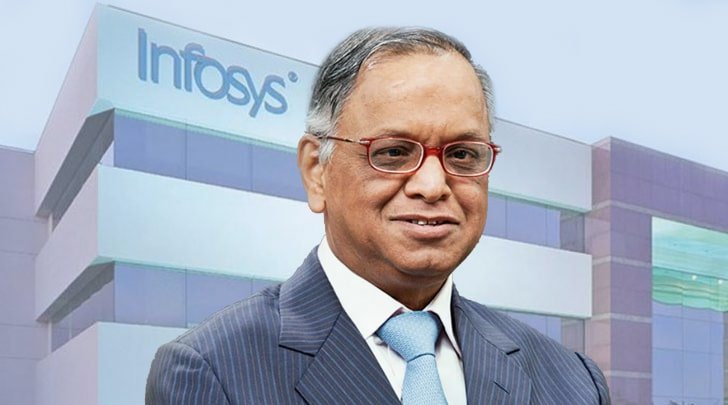
Murthy’s career in computing kicked off at a moment when India’s tech industry barely existed yet. After finishing his master’s at IIT Kanpur, he landed at IIM Ahmedabad’s Computer Centre as Chief Systems Programmer.
That job put him right in the middle of computing and systems work, at a time when owning or even using a computer in India was still pretty rare — nothing close to ordinary.
Later, when he actually started building companies, that technical grounding didn’t disappear. It merged with a genuine sense of management and business thinking, which is probably why his approach ended up looking so different from a lot of his peers.
Murthy’s journey also shows that building a successful company requires more than a good idea. Founders need leadership, communication, financial and problem-solving abilities. Read our guide to 10 Essential Skills for Startup Founders to understand the skills today’s entrepreneurs need.
How did Narayana Murthy start Infosys?
- Narayana Murthy co-founded Infosys in 1981, alongside six other engineers, with just $250 in starting capital — in an India that looked nothing like today’s tech economy
- The founding team included N. R. Narayana Murthy, Nandan Nilekani, S. Gopalakrishnan, S. D. Shibulal, K. Dinesh, N. S. Raghavan, and Ashok Arora
- Infosys was incorporated on July 2, 1981, in Pune, under the name Infosys Consultants Private Limited
- Murthy’s often linked to the story of borrowing ₹10,000 from his wife, Sudha Murty, just to help get the company off the ground
- According to Infosys’ own historical records, the founders committed early to strong financial principles — staying liquid, and borrowing mainly to build assets rather than cover shortfalls
- The early years were genuinely tough: India’s economy was heavily regulated, foreign exchange was hard to come by, and importing technology could turn into a real ordeal
- In short, Infosys wasn’t launching into a ready-made startup ecosystem — the founders were building the business at the same time the ecosystem around it was still taking shape
Infosys is a useful example of how multiple founders can combine different strengths to build a company. For more examples of India’s entrepreneurial ecosystem, explore our guide to Top Startup Founders in India.
What Was Narayana Murthy’s Biggest Business Breakthrough?
Key details:
- Major innovation: Global Delivery Model
- Basic idea: Deliver software services using teams across different locations
- Major advantage: Combine Indian technology talent with international customers
- Target market: Global enterprises
- Impact: Helped establish India as a major software-services destination
The Global Delivery Model became one of Murthy’s most important contributions to the IT industry.
Instead of requiring every part of a project to happen at the customer’s location, Infosys could distribute work between India and overseas offices.
This allowed the company to use India’s growing engineering talent pool while serving customers in developed markets.
It also helped demonstrate that Indian technology companies could deliver complex services to global corporations.
How did Infosys grow from a small company into a global IT giant?
Infosys didn’t grow through one big lucky break. It came together over years, built on international expansion, real process discipline, giving employees genuine ownership, strict quality standards, and a deliberate focus on landing large global customers.
Looking back at the timeline, a few moments stand out:
- 1981: Infosys founded in Pune, starting with $250
- 1987: First international office opens in Boston
- 1993: Infosys goes public in India and rolls out employee stock options
- 1999: Becomes the first Indian IT company to list on NASDAQ, crossing $100 million in revenue
- 2000: Revenue hits $200 million
- 2001: Revenue crosses $400 million
- 2004: Annual revenue crossed US$1 billion.
- 2006: Revenue reached US$2 billion and employee strength crossed 50,000.
- 2009: Annual net profit crossed US$1 billion.

The 1993 IPO deserves special attention here, because it wasn’t just a fundraising event.
According to Infosys’ own historical records, employee stock ownership had already become genuinely significant by 1992 — employees owned 13.6% of shares before the company had even gone public. That’s not a token gesture; that’s real stake.
This approach tied employees directly to how the company performed over the long haul, not just year to year. It also reflects something bigger about how Murthy thought about management overall: if employees help create the value, they should actually share in it, not just watch from the sidelines.
“Growth is painful. Change is painful. But nothing is as painful as staying stuck where you do not belong.”- Narayana Murthy
What Are Narayana Murthy’s Major Achievements?
Murthy’s reach goes well beyond what he built at Infosys. Over the years, that influence has earned him recognition from institutions all over the world — not just in India.
A few of the honours worth mentioning:
- Padma Shri, 2000
- Padma Vibhushan, 2008
- 2003 Ernst & Young World Entrepreneur of the Year
- Officer of France’s Legion of Honour
- Honorary CBE from the United Kingdom
- Named by Fortune among the 12 greatest entrepreneurs of our time
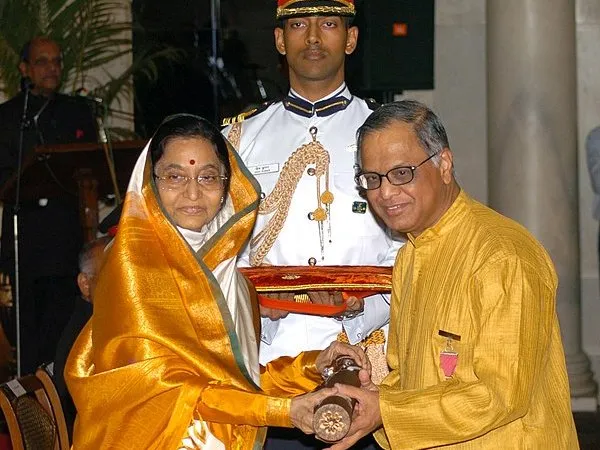
Beyond the awards, he’s also served on or advised a fairly wide range of organisations — HSBC, Unilever, Cornell University, INSEAD, and the United Nations Foundation, among others.
Why Did Narayana Murthy Focus So Much on Corporate Governance?
Key principles:
- Transparency
- Professional management
- Financial discipline
- Meritocracy
- Accountability
- Long-term shareholder value
- Responsible use of company resources
Murthy understood that technology alone would not make Infosys successful.
International customers and investors also needed confidence in the company.
Infosys therefore built corporate governance into its operating philosophy from an early stage.
The company maintained strict financial principles and emphasised transparency and professional management.
That reputation became particularly valuable when Infosys entered international capital markets.
Business lesson: Trust is not a marketing slogan. For a large company, it can become a competitive advantage.
What Was Narayana Murthy’s Leadership Philosophy?
Key leadership principles:
- Put customers first.
- Hire and develop talented employees.
- Reward merit.
- Maintain transparency.
- Invest in training.
- Build professional management systems.
- Focus on long-term growth.
- Create an organisation that can operate without the founder.
Murthy’s approach focused heavily on people and systems.
Infosys invested in employee training, management development, software quality and infrastructure.
He also supported the idea that the company should become an institution rather than remain dependent on its founder.
Murthy stepped down as Infosys chairman in 2006 and retired from the company in 2011.
That transition is an important part of his story.
A founder’s job isn’t only to build the company. It is also to make the company strong enough to continue without them.
How big is Infosys today?
Infosys today looks almost nothing like the company Murthy helped start back in 1981. The FY2026 numbers give a real sense of just how far that original startup has come.
According to the company’s FY2026 integrated report:
- Revenue: ₹1,78,650 crore
- Revenue in US dollars: $20.158 billion
- Net profit: ₹29,440 crore
- Employees: 3,28,594
- Women in workforce: 39.5%
- Countries served: 59
- Free cash flow: ₹33,097 crore
- Large-deal total contract value: $14.9 billion
Infosys also says its AI-led programmes reached 90% of its top 200 clients in FY2026 — a clear sign of how far the company’s pushed into AI-led digital services lately.
Here’s what’s worth sitting with, though: Murthy laid the foundation for all of this around software services decades before anyone was talking about an AI boom. What’s kept Infosys relevant since then isn’t that original idea alone — it’s that the company’s kept adapting its technology portfolio every time the industry shifted underneath it.
Top Holdings in Narayana Murthy’s Portfolio in 2026
Based on the most recent corporate shareholding data available, here’s where Narayana Murthy’s equity holdings currently stand:
- Infosys Ltd: Worth ₹2,000.40 crore, holding 15,145,638 shares — a 0.41% stake
- Arunjyoti Bio Ventures Ltd: Worth ₹384.4 crore, holding 8,918,779 shares — a 19.25% stake
- Apex Frozen Foods Ltd: Worth ₹37.8 crore, holding 35,876,078 shares — a 28.54% stake
- VSF Projects Ltd: Worth ₹8.6 crore, holding 2,226,063 shares — a 13.54% stake
Disclaimer: This information is shared purely for educational purposes and shouldn’t be treated as investment advice or a recommendation to buy or sell anything. Anyone considering an investment decision should do their own research, or talk to a qualified financial advisor first. The data here comes from the Tickertape Stock Screener and may shift as shareholding records get updated.
What makes the Narayana Murthy success story different?
Murthy’s story is compelling because he didn’t just build a successful company; he helped demonstrate that an Indian technology company could compete globally on quality, scale and professional management.
Infosys itself describes its journey as part of India’s emergence as a global destination for software-services talent. It also credits the company with pioneering the Global Delivery Model and becoming the first Indian IT company listed on NASDAQ.
His contribution therefore goes beyond Infosys’ financial performance.
He became part of a broader transformation in India’s technology industry—one that created global opportunities for Indian engineers and helped establish Bengaluru and other Indian cities as major technology centres.
What Challenges Did Narayana Murthy Face?
Major challenges included:
- India’s highly regulated economy in the early years.
- Limited access to technology.
- Foreign-exchange restrictions.
- Difficulty accessing international markets.
- Limited availability of startup capital.
- Building trust with overseas customers.
- Competing against established global technology companies.
Starting Infosys in 1981 was very different from starting a technology company in India today.
Founders couldn’t simply open a cloud account, launch a website and target customers worldwide.
The company had to deal with India’s closed economic environment while simultaneously building international credibility.
Instead of trying to solve everything at once, Infosys focused on software quality, international clients, disciplined finances and employee capabilities.
That patience eventually became a strength.
Narayana Murthy’s Major Controversies Over Work Culture
Infosys co-founder N. R. Narayana Murthy has stirred up plenty of public debate over the years around workplace culture. Nothing’s drawn more attention than his push for young Indians to work 70 to 72 hours a week, along with his mention of China’s “996” schedule.
The 70-to-72-Hour Workweek Debate
- What he actually said: Murthy argued young Indians should be ready to put in around 70 hours a week if the country wants to become more competitive globally. Later, while talking productivity, he brought up China’s “996” culture — 9 a.m. to 9 p.m., six days a week.
- Why people pushed back: The reaction was swift, and not exactly kind. Plenty of employees and critics worried these kinds of expectations could feed straight into burnout, excessive pressure, and a work-life balance that barely exists. Others pointed out something practical too — long hours hit differently for people already dealing with brutal commutes and heavy workloads.
- How he later clarified things: Murthy eventually walked it back somewhat, saying working those hours should be a personal choice, not something forced on anyone. His supporters, meanwhile, read the whole thing differently — as a reflection of the work ethic that helped build India’s early IT industry in the first place.
Comments on Parenting and Lifestyle
Work culture isn’t the only place Murthy’s comments have sparked debate. Parenting and personal discipline have come up too.
- On parenting: He’s advised parents to cut back on entertainment for kids and lean harder into discipline and academics. That drew pushback online, with people asking how realistic that actually is for parents already stretched thin by demanding jobs.
- On his lifestyle: His public reputation for simplicity has become its own talking point. Some critics have asked whether that image squares with the significant wealth tied to his family. Supporters counter that simplicity and financial success aren’t mutually exclusive — and that how someone lives is ultimately their own call.
Taken together, Murthy’s comments have opened up a much bigger conversation — about productivity, ambition, work-life balance, and what India’s young workforce is actually expected to give. Supporters see it as a genuine call for more dedication. Critics argue productivity shouldn’t come at the cost of people’s wellbeing.
What are the biggest business lessons from Narayana Murthy?
The lessons that actually hold up from Murthy’s story aren’t complicated. Solve a problem the whole world has, build real trust, protect your cash, and invest genuinely in people.
1. Start with next to nothing
Infosys began with $250. That’s not really the takeaway, though — nobody’s saying every founder should try to bootstrap on pocket change.
What actually matters is that having almost nothing forces discipline you wouldn’t otherwise develop.
2. Aim at a market bigger than your backyard
Murthy never treated India as the ceiling for Infosys. Going after international clients early gave the company access to a technology-services opportunity that was simply much larger than staying domestic ever could’ve offered.
3. Make trust part of how the business actually runs
Good governance wasn’t some PR move Infosys trotted out for show. Over time, it became genuinely part of the company’s identity, baked into how decisions got made.
4. Put employees inside the growth story
The employee stock-option programme wasn’t just a perk on paper. It was a real statement — Infosys wanted the people building the company to share in what they built, not just watch from outside.
5. Think in decades, not quarters
Infosys started in 1981. Its biggest milestones didn’t arrive overnight — they stretched across years, sometimes over a decade apart from each other.
Patience isn’t a flashy strategy. But it compounds, quietly, in a way that fast wins usually don’t.
6. Build something bigger than yourself
Eventually, Murthy stepped away from Infosys. The company didn’t fall apart. It kept going.
For any founder, that’s arguably the real test — not whether you can build something impressive, but whether it can survive without you standing at the center of it.
Understanding concepts such as valuation, burn rate, runway, equity and product-market fit can also help founders make better decisions. Our 50 Startup Terms Every Founder Should Know guide explains these concepts in simple language.
Final Takeaway: What Can Entrepreneurs Learn From Narayana Murthy?
The biggest lessons are:
- Think long term.
- Solve problems for a large market.
- Build trust before chasing scale.
- Hire talented people and give them ownership.
- Maintain financial discipline.
- Keep adapting to technology.
- Build systems rather than relying on personality.
- Create a company that can outlive its founder.
The Narayana Murthy success story is ultimately about turning a small idea into a lasting institution.
Infosys started in 1981 with seven engineers and US$250. More than four decades later, it generates over US$20 billion in annual revenue and employs more than 328,000 people.
The journey wasn’t built on one lucky break.
It came from technology, talent, global ambition, disciplined execution and trust—the same fundamentals that remain relevant for founders today.
At FounderPin, we believe successful founder stories are most valuable when they explain the decisions behind the numbers. If you’re building your own startup and need help with strategy, positioning or business planning, contact us for a consultation.