
How to Apply for Startup India Seed Fund and Get Up to ₹50 Lakhs
Table of Contents
Toggle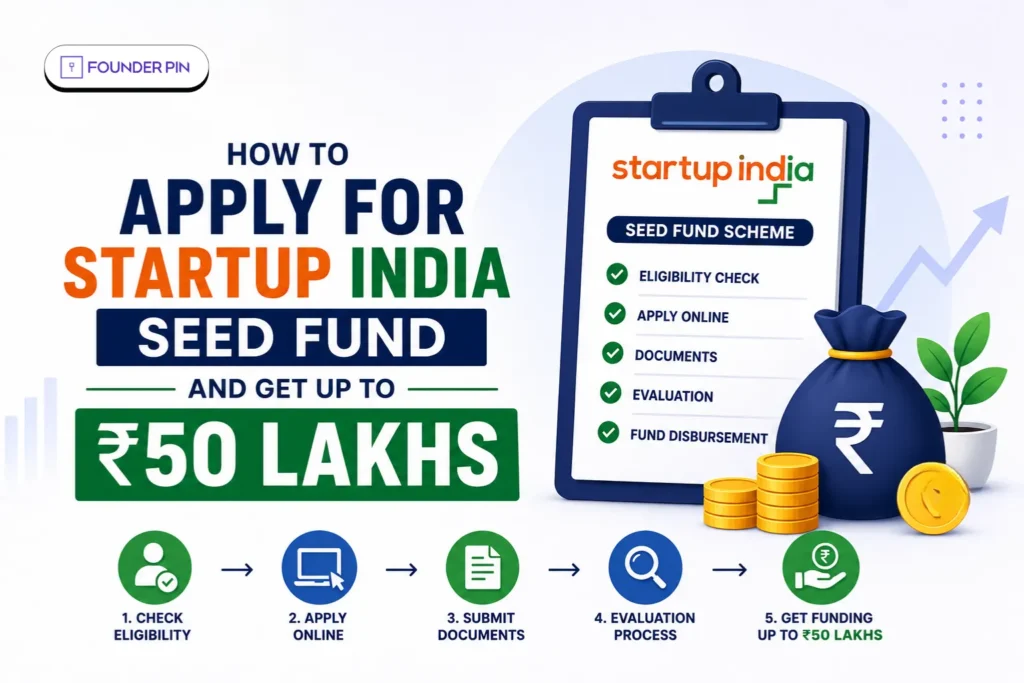
Key Takeaways
The Startup India Seed Fund Scheme (SISFS) provides a valuable funding opportunity for early-stage startups looking to validate ideas, develop products, and enter the market. Understanding how to apply for Startup India Seed Fund can significantly improve your chances of securing up to ₹50 lakhs in support.
- DPIIT recognition is mandatory to apply for the Startup India Seed Fund Scheme.
- Eligible startups can receive up to ₹20 lakhs for prototype development and up to ₹50 lakhs for commercialization and scaling.
- A strong pitch deck, clear business plan, and market validation improve approval chances.
- Applications are submitted through approved incubators on the Startup India platform.
- Proper preparation and a scalable business model can help founders secure government-backed startup funding.
For Indian entrepreneurs, obtaining early-stage investment continues to be a major obstacle. While venture capital firms and angel investors frequently concentrate on startups that are gaining traction, many creative companies find it difficult to secure money during the idea and prototype stages. The Startup India Seed Fund Scheme (SISFS) is very useful in this situation.
The program provides a special chance for entrepreneurs looking to apply for Startup India Seed Fund to obtain government-backed funding without sacrificing a substantial portion of their equity Eligible startups can receive funding of up to ₹50 lakhs to validate ideas, develop prototypes, launch products, and scale operations.
At FounderPin, we’ve seen many early-stage startups overlook government funding opportunities while focusing solely on private investors. However, founders who understand how to leverage government schemes often gain a significant advantage during their startup journey.
In this guide, we’ll explain how to apply for Startup India Seed Fund, eligibility requirements, funding structure, application steps, and practical tips to improve your chances of approval.
What Is SISF?
The Indian government established the Startup India Seed Fund Scheme to assist entrepreneurs in their initial phases. The objective is to bridge the funding gap between idea validation and investor readiness.
Unlike traditional loans, the scheme provides financial assistance through approved incubators that evaluate startup potential and guide founders through the growth process.
The fund supports startups working on innovative products, technology-driven solutions, and scalable business models that have the potential to create jobs and drive economic growth.
Why the Startup India Seed Fund Matters
Many startups fail because they run out of capital before reaching product-market fit. Investors often prefer businesses with proven traction, leaving founders struggling to fund product development.
The Startup India Seed Fund helps solve this challenge by providing capital for:
- Proof of concept validation
- Prototype development
- Product testing
- Market entry
- Commercialization activities
This allows founders to focus on building and validating their solutions rather than constantly searching for funding.
Funding Structure: How Much Can Startups Receive?
One of the most attractive features of the scheme is the funding amount available to founders.
Prototype Development Up to ₹20 Lakhs
Grants of up to ₹20 lakhs are available to startups for:
- Proof of concept
- Product development
- Prototype creation
- Product trials
Up to ₹50 Lakhs for Commercialization
Startups can obtain up to ₹50 lakhs in capital through debt-linked instruments for:
- Market launch
- Commercialization
- Business scaling
- Revenue generation activities
The amount awarded depends on startup requirements and evaluation committee recommendations.
Eligibility Criteria for Startup India Seed Fund
Before learning how to apply for Startup India Seed Fund, founders should understand the eligibility requirements.
DPIIT Recognition Is Mandatory
The Department for Promotion of Industry and Internal Trade (DPIIT) must acknowledge the startup.
Startup Age Requirements
Generally, the startup should be less than two years old from the date of incorporation.
Innovation-Driven Business Model
The business should focus on innovation, technology, or solving a significant market problem through scalable solutions.
Limited Previous Government Funding
The startup should not have already received substantial funding support from other government schemes beyond specified limits.
Meeting these requirements significantly improves the chances of qualification.
How to Apply for the SISFS (Startup India Seed Fund Scheme)
Step 1. Obtain DPIIT Recognition
Before applying, ensure your startup is recognized by the Department for Promotion of Industry and Internal Trade (DPIIT). Founders can register their startup through the Startup India portal and complete the DPIIT recognition process.
Step 2. Organize the Required Documents
Prepare all necessary documents in advance, including the Certificate of Incorporation, PAN details, information about directors or partners, a business plan or pitch deck, proof of business address, and any intellectual property documents such as patents or trademarks, if applicable.
Step 3. Register on the SISFS Platform
Visit the Startup India Seed Fund Scheme portal, create an account, and complete the registration process. Once registered, you can access the application form and funding opportunities.
Step 4. Select Suitable Incubators
Applicants can choose up to three approved incubators listed on the Startup India platform. It is advisable to select incubators that align with your startup’s industry, technology focus, and growth objectives.
Step 5. Complete and Submit the Application
Fill in the application form with accurate startup information, founder details, and funding requirements. Upload all supporting documents and ensure that any required authorization letters are included before submission.
Step 6. Participate in the Evaluation Process
After submission, the selected incubators and evaluation committees review the application. The assessment typically focuses on innovation, scalability, market potential, and the startup’s funding requirements.
Step 7. Follow Compliance and Reporting Requirements
Startups that receive funding must comply with reporting guidelines and regularly update the incubator on project progress. The funds are generally intended for activities such as proof-of-concept development, prototype creation, product testing, and market entry initiatives.
Detailed SISFS Application Process
| Step | Process |
|---|---|
| Step 1: Open the SISFS Portal | Visit the official Startup India Seed Fund Scheme portal to begin the application process. |
| Step 2: Sign Up | Select “Login” and then choose the “Create an Account” option. |
| Step 3: Complete Registration | Provide your company details, contact information, and create a secure password to register. |
| Step 4: Verify Your Account | Enter the OTP received on your registered mobile number and confirm the verification process. |
| Step 5: Start the Application | Navigate to the “For Startups” section and click on “Apply Now.” |
| Step 6: Access Your Dashboard | Log in using your registered username and password. |
| Step 7: Submit Application Details | Fill in all required information, choose a preferred incubator, and upload supporting documents. |
| Step 8: Finalize Submission | Review the application carefully and submit it to the selected incubator for evaluation. |
| Step 9: Monitor Application Status | Track your application’s progress and receive updates through the Startup India portal. |
Important Things to Remember
Before submitting your application, make sure all documents are complete and accurate. In addition, verify that your startup meets the DPIIT eligibility requirements.
Moreover, choose incubators that align with your industry and growth objectives. As a result, your application may receive more relevant evaluation and mentorship support.
Similarly, provide a clear business plan and realistic funding requirements. Consequently, evaluators can better understand your startup’s potential and growth strategy.
Finally, monitor your application regularly and respond quickly to any requests for clarification. Therefore, you can avoid unnecessary delays during the review process.
SISFS Application Document Checklist
| Document Type | Documents Needed |
|---|---|
| Company Registration Documents | Certificate of Incorporation, Memorandum of Association (MoA), and Articles of Association (AoA) |
| DPIIT Recognition | Active DPIIT Recognition Certificate issued under Startup India |
| Founder Information | PAN card, Aadhaar card, and details of the founding team |
| Business Proposal | Startup pitch deck, business plan, or detailed project report |
| Financial Information | Revenue projections, cost estimates, and funding requirements |
| Equity Structure | Shareholding pattern or cap table showing that At least 51% of the company is owned by Indian promoters. |
| Industry-Specific Documents | Relevant patents, intellectual property filings, technology certifications, or other supporting documents related to the startup’s sector |
Common Reasons Applications Get Rejected
Many startups fail to secure funding because of avoidable mistakes.
Weak Problem Validation
Ideas without clear customer demand often struggle during evaluation.
Poor Financial Planning
Unrealistic projections can reduce investor and evaluator confidence.
Incomplete Documentation
Missing documents frequently delay or derail applications.
Lack of Innovation
The scheme prioritizes innovative and scalable startups.
Founders should clearly demonstrate what makes their solution unique.
Tips to Improve Approval Chances
Build a Strong Pitch Deck
A compelling pitch deck should explain the market problem, solution, business model, and growth strategy.
Show Market Demand
Use customer interviews, pilot programs, or early user feedback to validate demand.
Explain Fund Utilization Clearly
Evaluation committees want to see exactly how the funding will be used.
Provide measurable milestones and expected outcomes.
Focus on Scalability
Highlight how your business can grow beyond a local market and create long-term value.
“Innovation needs capital to grow, and knowing how to apply for Startup India Seed Fund can help bridge that gap.”
Conclusion
Understanding how to apply for Startup India Seed Fund can unlock one of the most valuable funding opportunities available to Indian startups. With support of up to ₹50 lakhs, founders can move from idea validation to commercialization without relying entirely on external investors.
The key to success lies in meeting eligibility requirements, preparing strong documentation, demonstrating innovation, and presenting a clear roadmap for growth. For ambitious entrepreneurs, the Startup India Seed Fund Scheme can provide the financial foundation needed to build a successful and scalable startup.
Also Read | The New Startup India Playbook: Build Fast, Stay Lean, Grow With AI
Ready to Secure Startup Funding?
At FounderPin, we help founders navigate government funding programs, prepare investor-ready pitch decks, and develop growth strategies that attract capital.
Contact us for a consultation and discover how to maximize your chances of securing Startup India Seed Fund support and accelerating your startup’s growth.
Frequently Asked Questions (FAQs)
1. What is the Startup India Seed Fund Scheme (SISFS)?
The Startup India Seed Fund Scheme (SISFS) is a government initiative that provides financial assistance to early-stage startups for proof of concept, prototype development, product trials, market entry, and commercialization.
2. Who is eligible to apply for Startup India Seed Fund?
To apply, a startup must be DPIIT-recognized, generally less than two years old, innovation-driven, and should not have received significant funding support from other government schemes.
3. How much funding can a startup receive under SISFS?
Eligible startups can receive up to ₹20 lakhs as a grant for prototype development and up to ₹50 lakhs for commercialization and scaling through debt-linked instruments.
4. How do I apply for Startup India Seed Fund?
Founders must obtain DPIIT recognition, register on the Startup India portal, select an approved incubator, submit the required documents, and present their startup before an evaluation committee if shortlisted.
5. What documents are required for the Startup India Seed Fund application?
Commonly required documents include a DPIIT certificate, certificate of incorporation, startup pitch deck, business plan, financial projections, founder details, and product or market validation documents.
SHARE
Related Blogs

Why AI Agents Trends Are Becoming the Biggest Startup Movement in India Key Takeaways AI agents are …
MSME vs Startup India (DPIIT): Which Registrations Should Founders Actually Get? Key Takeaways Understanding MSME vs Startup …
How Indian Startups Can Get Government Grants for MVP Development Key Takeaways Government grants can help Indian …