Why Startups Raise Too Early and Fail: Lessons Every Founder Should Know
Table of Contents
Toggle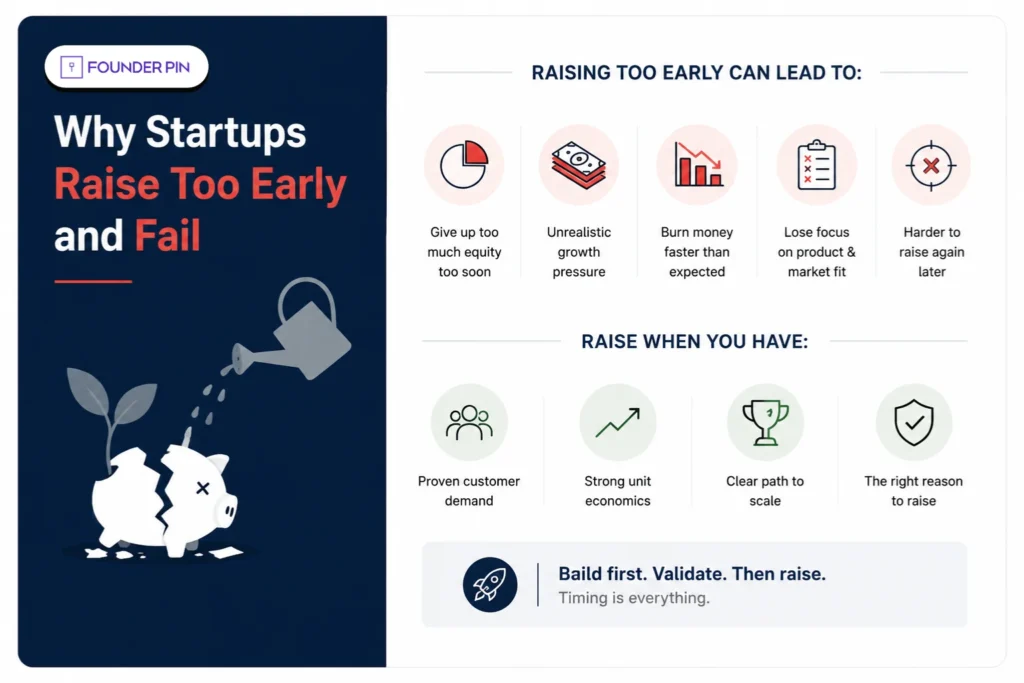
Key Takeaways
- Raising funding too early can be risky if a startup has not yet achieved product-market fit, customer validation, or consistent traction.
- Early fundraising often leads to unnecessary equity dilution, reducing founder ownership before the business reaches its true value.
- Access to capital can encourage overspending, increasing burn rate and creating pressure to scale before the business is ready.
- Investors expect rapid growth after funding, making it difficult for startups with unproven business models to meet performance expectations.
- The best time to raise capital is when the startup has validated demand, demonstrated traction, and can use investment to accelerate proven growth.
Introduction
For many founders, raising investment feels like the ultimate validation of a startup idea. Media headlines often celebrate funding rounds, making venture capital seem like the primary milestone every startup should pursue. However, one of the most overlooked realities in entrepreneurship is that many startups fail not because they raise too little money, but because they raise it too early.
Understanding why startups raise too early and fail is crucial for founders seeking sustainable growth. Funding can accelerate success, but when raised before achieving the right milestones, it can create pressure, inefficiencies, and strategic mistakes that ultimately hurt the business.
The goal of fundraising should not be to secure capital as quickly as possible. The goal should be to raise capital when the business is truly ready to use it effectively.
Why Raising Capital Too Early Can Hurt Your Startup
Raising investment before your startup is ready can create more problems than opportunities. While additional funding provides access to capital, it can also encourage founders to scale too quickly before achieving product-market fit. Expanding operations prematurely often leads to higher expenses, unnecessary hiring, and inefficient spending, making it difficult for startups to adapt if their business model needs to change.
Below are some of the biggest risks of raising capital too early.
Premature Scaling
Large funding rounds can create pressure to grow rapidly before validating your business model. Startups may invest heavily in marketing, hiring, or expansion without proving that their product can generate sustainable revenue, leading to increased losses.
Reduced Flexibility
As teams grow and operating costs rise, startups become less agile. A larger organization is more difficult to restructure, making it harder to pivot or respond to customer feedback when market conditions change.
Excessive Equity Dilution
Founders who raise capital before demonstrating traction often accept lower valuations. This means giving up a larger ownership stake for a relatively small investment, reducing long-term control and future financial rewards.
False Signs of Product-Market Fit
External funding can temporarily boost customer acquisition through paid marketing campaigns. However, rapid growth driven by advertising rather than genuine customer demand may create the illusion of product-market fit while masking underlying retention or engagement issues.
Pressure to Deliver Rapid Growth
Venture capital investors typically expect aggressive growth and significant returns. If a startup isn’t prepared to scale at that pace, founders may feel pressured to increase spending or pursue unsustainable growth strategies to meet investor expectations.
A Smarter Approach
Instead of raising capital immediately, many founders choose to bootstrap during the early stages. Building a product, generating initial revenue, and validating customer demand before seeking investment can strengthen your negotiating position, improve your valuation, and reduce unnecessary equity dilution. Entering fundraising with proven traction often leads to better investment terms and a stronger foundation for long-term growth.
The Importance of Product-Market Fit Before Fundraising
Product-market fit means customers genuinely value your product and consistently engage with it.
Signs include:
- Strong customer retention
- Growing demand
- Positive user feedback
- Repeat purchases
- Revenue growth
Raising capital after achieving product-market fit significantly improves the chances of successful scaling.
Investors are also more likely to offer favorable valuations when market demand has been validated.
Founders looking to improve fundraising readiness and understand startup growth fundamentals can explore resources available through the Startup India Initiative at https://www.startupindia.gov.in.
When Startups Should Consider Raising Capital
After Market Validation
Founders should demonstrate that their solution addresses a real problem and that customers are willing to pay for it.
After Achieving Early Traction
Traction can include:
- Revenue growth
- User growth
- Customer retention
- Strategic partnerships
These indicators reduce investor risk and improve fundraising outcomes.
When Capital Can Accelerate Growth
The best time to raise funds is when additional capital can amplify an already working business model rather than compensate for unresolved problems.
Successful Startups Focus on Fundamentals First
Many of the strongest startups spend significant time building before fundraising.
They focus on:
- Customer discovery
- Product improvement
- Revenue generation
- Operational efficiency
When they eventually seek investment, they do so from a position of strength rather than necessity.
This approach often leads to better valuations, stronger investor interest, and greater long-term success.
How Founders Can Avoid Raising Too Early
Build Before You Raise
Prioritize validation over valuation.
Focus on proving that customers want the product before seeking external capital.
Track Meaningful Metrics
Monitor:
- Revenue
- Customer acquisition
- Retention
- Burn rate
- Cash runway
Strong metrics improve investor confidence.
Also Read | How Much Runway Should a Startup Have? A Founder’s Guide
Funding should accelerate proven success, not fund experimentation indefinitely.
The strongest fundraising stories are built on evidence rather than assumptions.
Conclusion
Understanding why startups raise too early and fail can help founders avoid one of the most common mistakes in entrepreneurship. While fundraising can unlock growth opportunities, raising capital before validating demand, achieving traction, or developing financial discipline often creates more problems than it solves.
Successful founders focus on building strong businesses first. They prioritize customers, revenue, and product-market fit before pursuing investment. By raising capital at the right time, startups can maximize valuation, preserve ownership, and improve their chances of long-term success.
Contact FounderPin for Fundraising Strategy Support
Fundraising is not just about securing capital—it is about securing the right capital at the right time.
At FounderPin, we help founders assess fundraising readiness, improve investor positioning, and build sustainable growth strategies.
Contact us for a consultation today and discover whether your startup is truly ready to raise funds.
SHARE